

On this page
A bubble is shaped like a convex lens, yet it spreads light out. What a lens does depends on whether it is optically denser or rarer than the medium around it, not on shape alone.
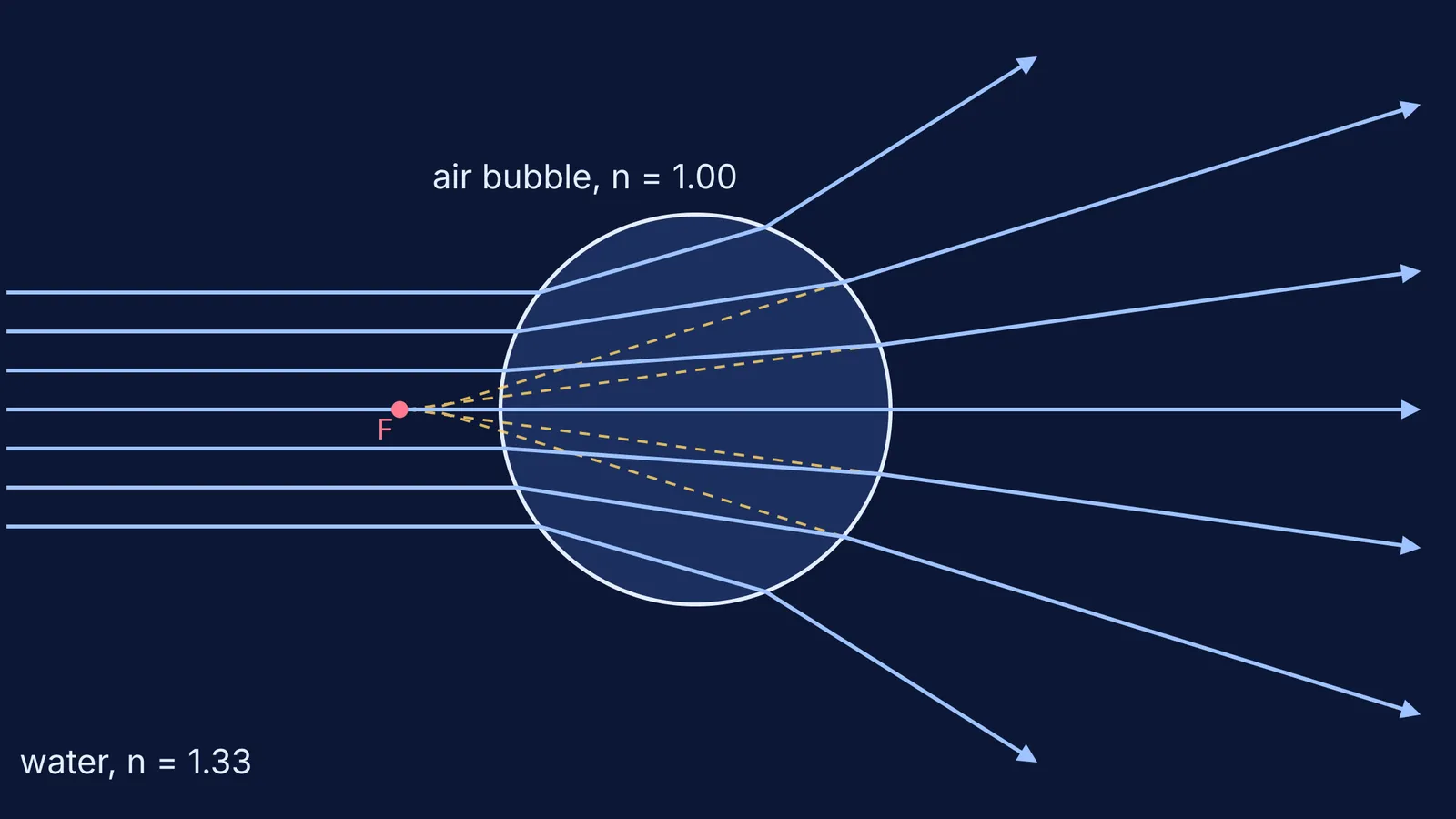
Why does an air bubble in water act as a concave lens?
A glass lens in air focuses light because light enters a denser medium and bends towards the normal. In NCERT's Class 12 chapter on ray optics, Table 9.1 gives the refractive index of water as 1.33 and crown glass as 1.52. Air is about 1.0003, according to the HyperPhysics refractive index table.
A bubble flips this. Light goes from water (denser) into air (rarer), so at the first surface it bends away from the normal, which points towards the bubble's centre. That pushes each ray away from the axis. At the back surface light re-enters water, and because that surface curves the other way, the bend again pushes the ray outward. Both surfaces diverge.
What does the lens maker's formula say about a bubble?
NCERT writes the lens maker's formula as 1/f = (n21 − 1)(1/R1 − 1/R2), where n21 = n2/n1 is the refractive index of the lens material relative to the surrounding medium (NCERT, equation 9.21).
For a convex shape, R1 is positive and R2 is negative, so the bracket (1/R1 − 1/R2) is positive. The sign of f then depends only on (n21 − 1):
Glass in air: n21 = 1.52/1.00 = 1.52, so (n21 − 1) is positive and f is positive. Converging.
Air in water: n21 = 1.00/1.33 ≈ 0.75, so (n21 − 1) ≈ −0.25 is negative and f is negative. Diverging.
You can check this surface by surface with NCERT's single-surface relation, n2/v − n1/u = (n2 − n1)/R (equation 9.16 in the same chapter). The term (n2 − n1)/R is the surface's power. Going from water into air at the front of a bubble, (1.00 − 1.33)/(+R) = −0.33/R. Going from air into water at the back, (1.33 − 1.00)/(−R) = −0.33/R. Both are negative, so both surfaces diverge.
Worked example: how strong is an air-bubble lens?
Imagine two thin watch glasses sealed rim to rim with air trapped between them, dipped in water. The air forms a double-convex "lens" with R1 = +10 cm and R2 = −10 cm. Ignore the thin glass walls.
Bracket: 1/R1 − 1/R2 = 1/10 + 1/10 = 0.2 per cm.
Relative index: n21 = 1.00/1.33 = 0.752.
Factor: n21 − 1 = −0.248.
Power: 1/f = −0.248 × 0.2 = −0.0496 per cm.
Focal length: f ≈ −20 cm. The minus sign means a diverging lens with a virtual focus on the side the light comes from.
Now keep the same shape but change the materials, using the indices in NCERT's Table 9.1:
Crown glass (1.52) in air: 1/f = 0.52 × 0.2, so f ≈ +9.6 cm, strongly converging.
Crown glass in water: n21 = 1.52/1.33 ≈ 1.14, so f ≈ +35 cm, still converging but much weaker.
Air in water: f ≈ −20 cm, diverging.
The shape is the same in all three. Only the ratio of refractive indices changes, and it decides both the strength and the sign. For the general case with a different medium on each side, see our guide to a lens with different media on each side.
Why do the edges of a bubble look silvery?
Rays that hit a bubble near its rim meet the water-air surface at a steep angle. NCERT's Table 9.1 lists the critical angle for water as 48.75° (NCERT ray optics chapter). Beyond that angle light cannot get into the air at all and is totally reflected. That helps explain why a bubble's outline can shine like a mirror while its middle looks clear. For the angles involved, read our explainer on the angle of refraction from water to air and the 48.8° limit.
How do you answer this in an exam?
A three-step answer that covers the physics:
State the media: light travels from water (n = 1.33, NCERT Table 9.1) into air (n = 1.00), from denser to rarer.
State the effect: at each curved surface the ray bends away from the normal, so it moves away from the axis.
Back it with the formula: n21 = 1/1.33 < 1, so (n21 − 1) is negative and f is negative. The bubble behaves as a diverging (concave) lens.
For why light bends towards or away from the normal, start with Snell's law and ray bending towards the normal.
Ray bending is easier to see than to read, which is what the interactive simulations in the Fermi Simulation Lab are for. To practise, the Fermi Problem Library has worked problems with a step-by-step solver that explains the reasoning, so you can see where a sign went wrong.


