

On this page
Picture a glass lens set into the wall of a fish tank: air on the left, water on the right. A JEE problem asks for its focal length, and you reach for the lens maker's formula. That is the first mistake. This lens has two focal lengths, not one, and they are not equal.
Why doesn't the lens maker's formula work here?
The lens maker's equation comes from refracting at the first surface, then using that image as the object for the second surface, in the thin-lens approximation, as OpenStax's University Physics, Volume 3 shows. Its general form, 1/f = (n₂/n₁ − 1)(1/R₁ − 1/R₂), has n₂ for the lens and a single surrounding index n₁ for both sides. For a lens in air it reduces to the familiar 1/f = (n − 1)(1/R₁ − 1/R₂).
When the two sides differ, the shortcut breaks but the method still works: refract twice.
How do you find the focal length using refraction at each surface?
Start from the single-surface equation. OpenStax writes it as n₁/dₒ + n₂/dᵢ = (n₂ − n₁)/R, with R positive when the surface is convex toward the object (OpenStax, section 2.3). In the Cartesian sign convention used in Indian textbooks (u negative for a real object), the same equation reads μ₂/v − μ₁/u = (μ₂ − μ₁)/R.
Let the object side have index μ₁, the lens μ, and the image side μ₂.
First surface (μ₁ into μ): μ/v₁ − μ₁/u = (μ − μ₁)/R₁
Second surface (μ into μ₂), with the first image as its object: μ₂/v − μ/v₁ = (μ₂ − μ)/R₂
Add them. For a thin lens the μ/v₁ terms cancel: μ₂/v − μ₁/u = (μ − μ₁)/R₁ + (μ₂ − μ)/R₂
Call the right-hand side P; it plays the role of power.
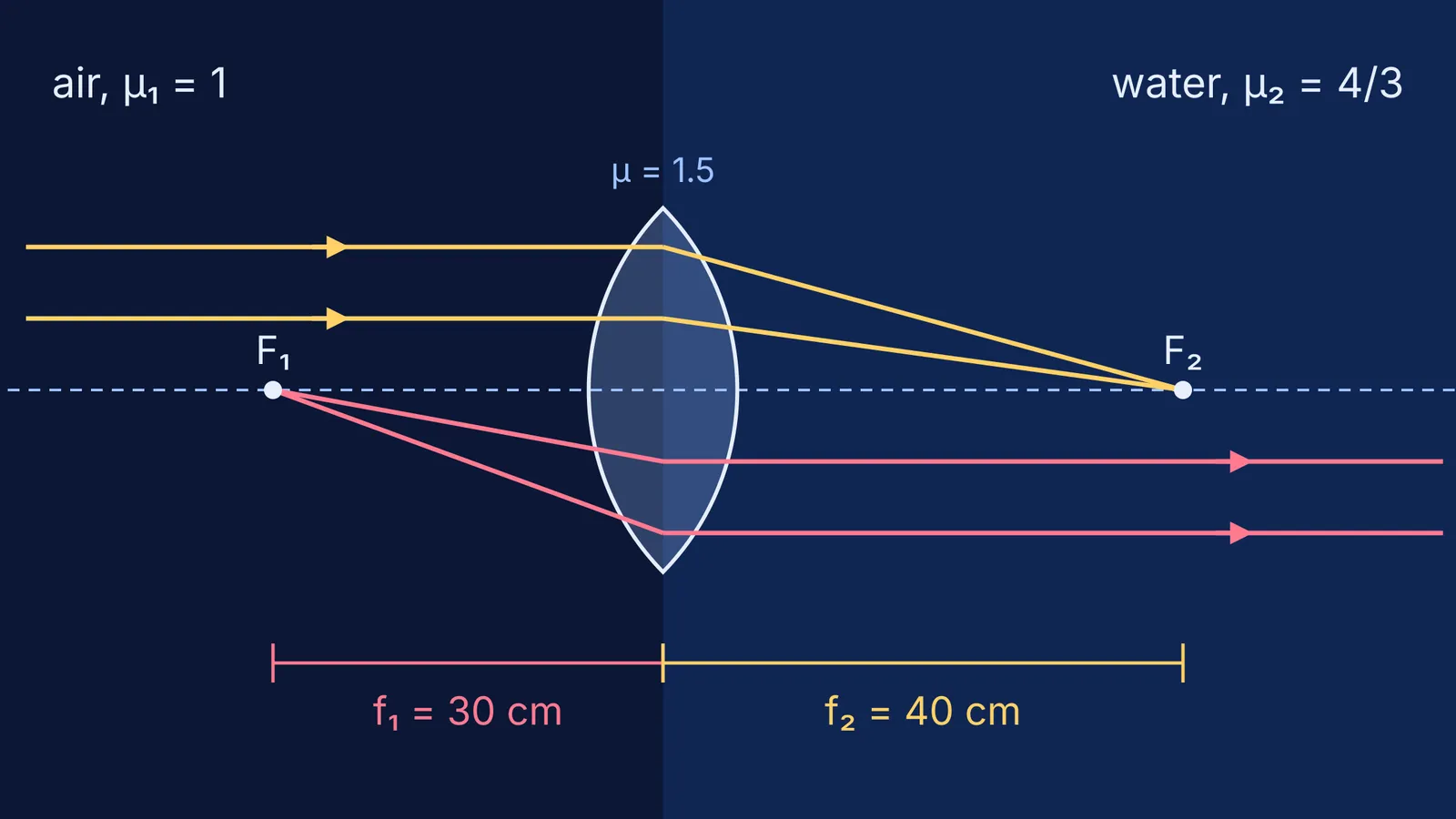
Now read off the two focal points. For an object at infinity (u → −∞), the image forms at the second focus: f₂ = μ₂/P. For an image at infinity (v → ∞), the object sits at the first focus, a distance f₁ = μ₁/P in front of the lens. Divide one by the other:
f₂/f₁ = μ₂/μ₁
The focal length is longer on the side with the higher refractive index. With air on both sides, μ₁ = μ₂ = 1, the two become equal and you are back to a single f.
Worked example: air on one side, water on the other
A thin biconvex glass lens (μ = 1.5) has R₁ = +20 cm and R₂ = −20 cm. Air (μ₁ = 1) is on the left, water (μ₂ = 4/3) on the right. Find both focal lengths, and the image of an object 60 cm to the left.
Step 1, the power: P = (1.5 − 1)/20 + (4/3 − 1.5)/(−20) = 1/40 + 1/120 = 1/30 cm⁻¹.
Step 2, the focal lengths:
f₂ = μ₂/P = (4/3) × 30 = 40 cm, measured into the water
f₁ = μ₁/P = 30 cm, measured in front of the lens in air
Check: 40/30 = 4/3, which is μ₂/μ₁
Step 3, the image. With u = −60 cm: μ₂/v = P + μ₁/u = 1/30 − 1/60 = 1/60, so v = (4/3) × 60 = 80 cm, a real image inside the water.
Now see what the shortcut gives. Putting f = 30 cm into 1/v − 1/u = 1/f gives v = 60 cm; using f = 40 cm gives v = 120 cm. Both are wrong. The correct 80 cm only appears when μ₁ and μ₂ stay in the equation.
What mistakes cost marks in these problems?
Using 1/f = (μ − 1)(1/R₁ − 1/R₂) because "it's a lens". That formula assumes the same medium on both sides.
Dropping μ₁ and μ₂ from the final equation and writing 1/v − 1/u = 1/f.
Getting the sign of R₂ wrong. For a biconvex lens with light travelling left to right, R₂ is negative; our guide to signs in the lens maker's formula walks through it.
Giving one focal length when the question asks for the focal length on the water side.
Mixing up which side is μ₁. Index 1 belongs to the side the light comes from.
How should you practise this?
Work the same lens three ways: air on both sides, water on both sides, then air–water. Watching f change builds the habit faster than memorising a special formula. If the single-surface equation is still shaky, revise refraction at a single spherical surface first, then read when a convex lens acts like a concave lens for the case where the surrounding liquid has a higher refractive index than the glass.
The Fermi Problem Library has worked problems with a step-by-step solver that explains the reasoning rather than printing an answer, so you can check each surface on its own instead of only the final v. If focal points themselves still feel slippery, the Fermi Concept Library gives each physics concept its own lesson.


