

On this page
The lens maker's formula connects the focal length of a lens to its refractive index and the radii of curvature of its two surfaces. But a common place to lose marks in exams like JEE Main and NEET-UG is plugging the values of R₁ and R₂ in with the wrong signs.
Before you substitute numbers into the formula 1/f = (n - 1)(1/R₁ - 1/R₂), you must assign a positive or negative sign to each radius based on the direction of the light.
Here is how to apply the sign convention for the standard lens shapes.
What is the sign convention in the lens maker's formula?
The rules follow the New Cartesian Sign Convention used by the CBSE and competitive exams. You measure every distance from the optical centre of the lens.
If you travel from the optical centre to the centre of curvature in the same direction as the incident light, the radius is positive. If you have to travel opposite to the incident light, the radius is negative.
By standard convention, we assume light travels from left to right. This means any centre of curvature lying on the right of the optical centre gives a positive radius, and any centre on the left gives a negative radius. If you are struggling with optics conventions, the Fermi Problem Library has a step-by-step solver that explains the reasoning for each sign before it calculates the answer.
How do you assign signs for a biconvex lens?
A biconvex lens bulges outwards on both sides. When light comes from the left, it hits the left surface first.
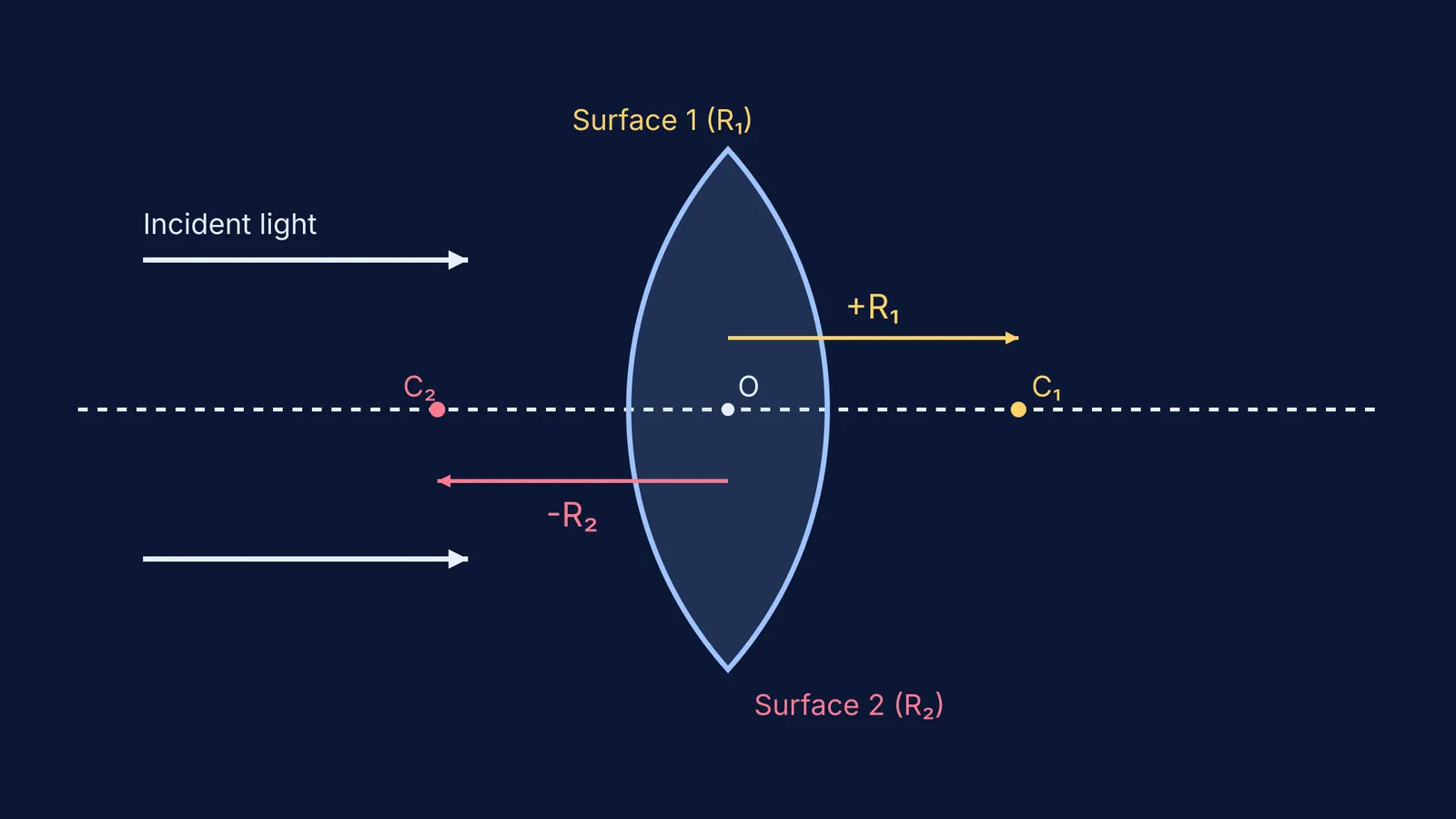
First surface (R₁): The left surface curves outwards toward the incoming light. If you complete the sphere for this surface, its centre (C₁) lies to the right of the lens. Because you move left-to-right (with the light) to reach C₁, R₁ is positive.
Second surface (R₂): The right surface bulges outwards away from the light. Its centre (C₂) lies to the left of the lens. Because you move right-to-left (against the light) to reach C₂, R₂ is negative.
When you substitute a positive R₁ and a negative R₂ into the lens maker's formula, the two negative signs for the second term cancel out. This always results in a positive focal length, which confirms that a biconvex lens is a converging lens. You can see how these converging rays behave in Convex lens image formation in a simulation: what to watch.
What about plano-convex and concave-convex lenses?
Lenses that are not symmetric follow the exact same rule, but their radii take different values.
Plano-convex lenses
A plano-convex lens has one flat surface and one convex surface. The sign depends on which way the lens faces.
Flat side first: If light hits the flat surface first, R₁ is infinity (∞). The second surface is convex, so its centre is on the left, making R₂ negative.
Curved side first: If light hits the convex surface first, its centre is on the right, making R₁ positive. The second surface is flat, so R₂ is infinity (∞).
In both cases, the formula yields the same positive focal length. To understand why thick lenses sometimes fail to focus all these rays to a single point, read about Spherical aberration and paraxial rays: why lenses blur the focus.
Concave-convex lenses (meniscus lenses)
A meniscus lens has one convex surface and one concave surface, meaning they both curve in the same direction.
If both surfaces bulge to the left, both their centres of curvature lie on the right. Therefore, both R₁ and R₂ are positive.
If both surfaces bulge to the right, both their centres lie on the left, making both R₁ and R₂ negative.
The focal length will be positive or negative depending on which radius is smaller.
The four-step sign checklist
Use this sequence to check your signs before calculating:
Identify the first surface the light hits; this is surface 1.
Complete the sphere for surface 1. If its centre is in the direction of the light, write down +R₁; if it is against the light, write -R₁.
Complete the sphere for surface 2. Apply the same rule to write +R₂ or -R₂.
Substitute the values with their signs into 1/f = (n - 1)(1/R₁ - 1/R₂).
If a question involves a Virtual object in lens problems: Why u is positive, the light still travels left to right, and the rules for R₁ and R₂ do not change.


