

On this page
Shine a torch up from the bottom of a bucket and the beam bends as it leaves the water. School tests and JEE Main questions often ask how much it bends. One equation gives the answer, and the same equation tells you when no light gets out at all.
What is Snell's law for light going from water to air?
Snell's law says n₁ sin θ₁ = n₂ sin θ₂, where θ₁ and θ₂ are measured from the normal, the line at right angles to the surface (OpenStax College Physics 2e, section 25.3). The refractive index is n = c/v, the speed of light in a vacuum divided by its speed in the material.
Fresh water at 20°C has a refractive index of 1.333 (OpenStax, Table 25.1). Most school problems round this to 1.33, and air is taken as 1.00.
For light going from water (medium 1) into air (medium 2), the law becomes:
1.33 × sin i = 1.00 × sin r
so sin r = 1.33 × sin i
Because sin r is bigger than sin i, the angle in air is always bigger than the angle in water. The ray bends away from the normal. From air into water, it is the other way round.
What is the angle of refraction for common angles of incidence?
Here are the angles worked out from Snell's law with n = 1.33. Check one or two with a calculator.
i = 0°: sin r = 0, so r = 0°. A ray along the normal goes straight through.
i = 10°: sin r = 1.33 × 0.1736 = 0.231, so r ≈ 13.4°.
i = 20°: sin r = 1.33 × 0.3420 = 0.455, so r ≈ 27.1°.
i = 30°: sin r = 1.33 × 0.5 = 0.665, so r ≈ 41.7°.
i = 40°: sin r = 1.33 × 0.6428 = 0.855, so r ≈ 58.8°.
i = 45°: sin r = 1.33 × 0.7071 = 0.940, so r ≈ 70.1°.
i = 48°: sin r = 1.33 × 0.7431 = 0.988, so r ≈ 81.3°.
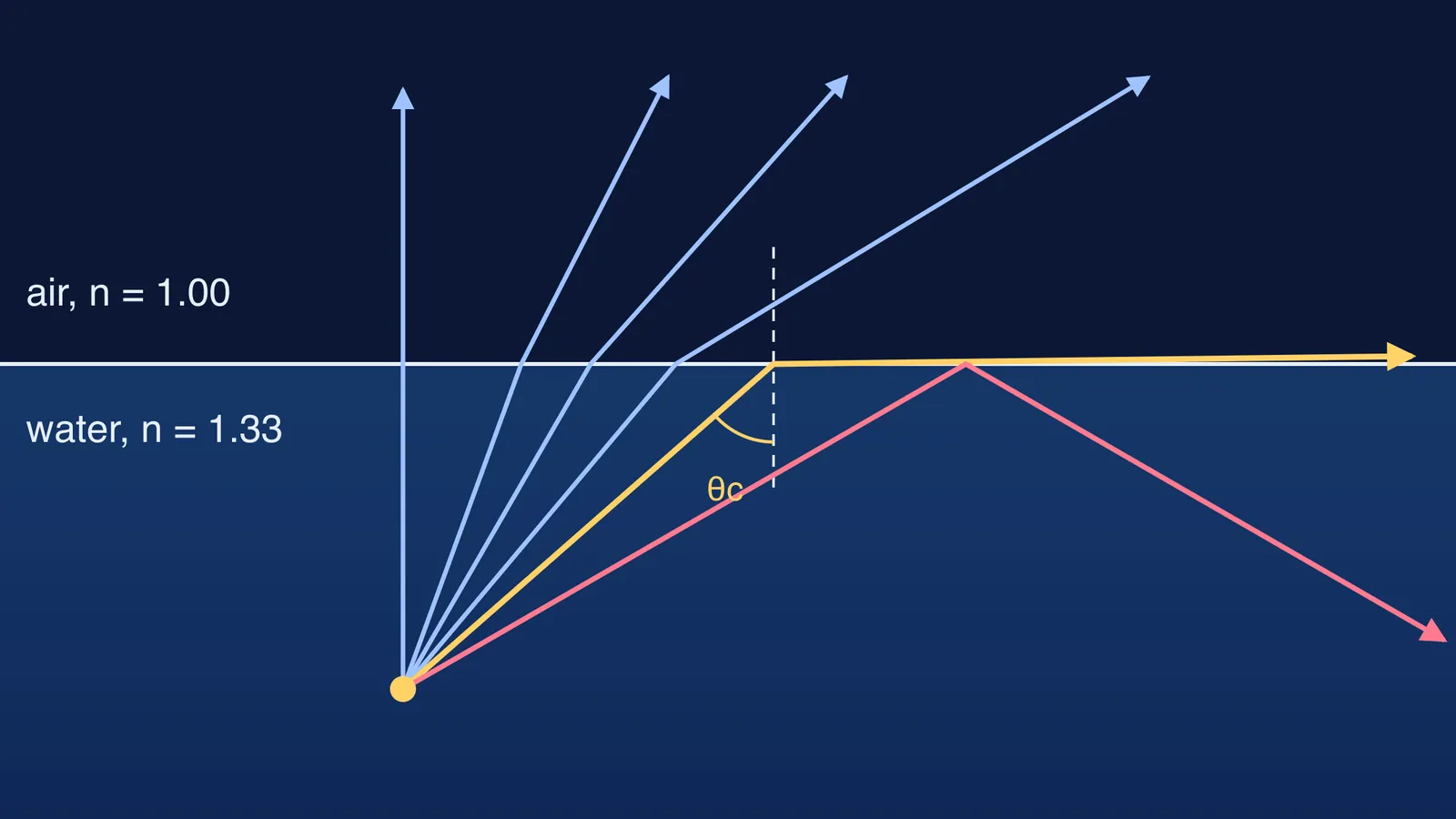
i = 50°: sin r = 1.33 × 0.7660 = 1.019. No angle has a sine above 1, so no ray goes into the air.
From 0° to 30° in the water gives about 42° in the air. Going from 40° to 48° adds about 22° more. Near the limit, a small tilt in the water swings the ray in the air a long way, until it lies flat along the surface.
What is the largest angle that still lets light out of water?
That limit is the critical angle. OpenStax defines it as the angle of incidence that gives an angle of refraction of 90°, with θc = sin⁻¹(n₂/n₁) for n₁ > n₂ (OpenStax College Physics 2e, section 25.4).
Put in r = 90°, so sin r = 1:
1.33 × sin θc = 1
sin θc = 1/1.33 = 0.752
θc ≈ 48.8°
With the more precise index of 1.333, the answer is 48.6°, the figure OpenStax gives for light going from water to air (OpenStax 25.4); HyperPhysics also gives 48.6°. Use whichever index your question gives you.
Above the critical angle, all the light reflects back into the water. This is total internal reflection. Our total internal reflection explainer covers the conditions.
What mistakes do students make with refraction from water to air?
Before you write the final answer, check:
Measure angles from the normal, not from the surface. If a ray makes 50° with the water surface, the angle of incidence is 40°.
Pair each index with the angle in its own medium: 1.33 goes with the angle in water.
Check the direction. From water to air, the angle in air must come out larger.
Compare i with the critical angle first: 48.8° for n = 1.33, by the OpenStax formula. If i is larger, there is no refracted ray.
Keep at least three decimal places in sines until the last step, so rounding doesn't shift your final angle.
The critical angle also explains why light from a lamp at the bottom of a pool escapes only through a circle on the surface. You can work out the size of that circle, as in our worked problem on a light source under water. The same bending away from the normal makes pools look shallower than they are, as our guide to apparent depth problems shows.
If you get the numbers but not why each step works, the Fermi Problem Library has worked problems with a step-by-step solver that explains the reasoning rather than printing an answer. If a ray lying flat along the surface is hard to picture, the Fermi Simulation Lab has interactive simulations for ideas that are easier to see than to read.
Try this one: a ray leaves water at 60° from the normal. What was its angle in the water? (Answer: sin i = 0.866/1.33 = 0.651, so i ≈ 40.6°.)


