On this page
Light bends towards the normal whenever it crosses into a medium where it travels more slowly, which means a medium with a higher refractive index. Air into water, air into glass, water into glass: each time, the refracted ray ends up closer to the normal than the incident ray was. Snell's law tells you how much closer.
When does light bend towards the normal?
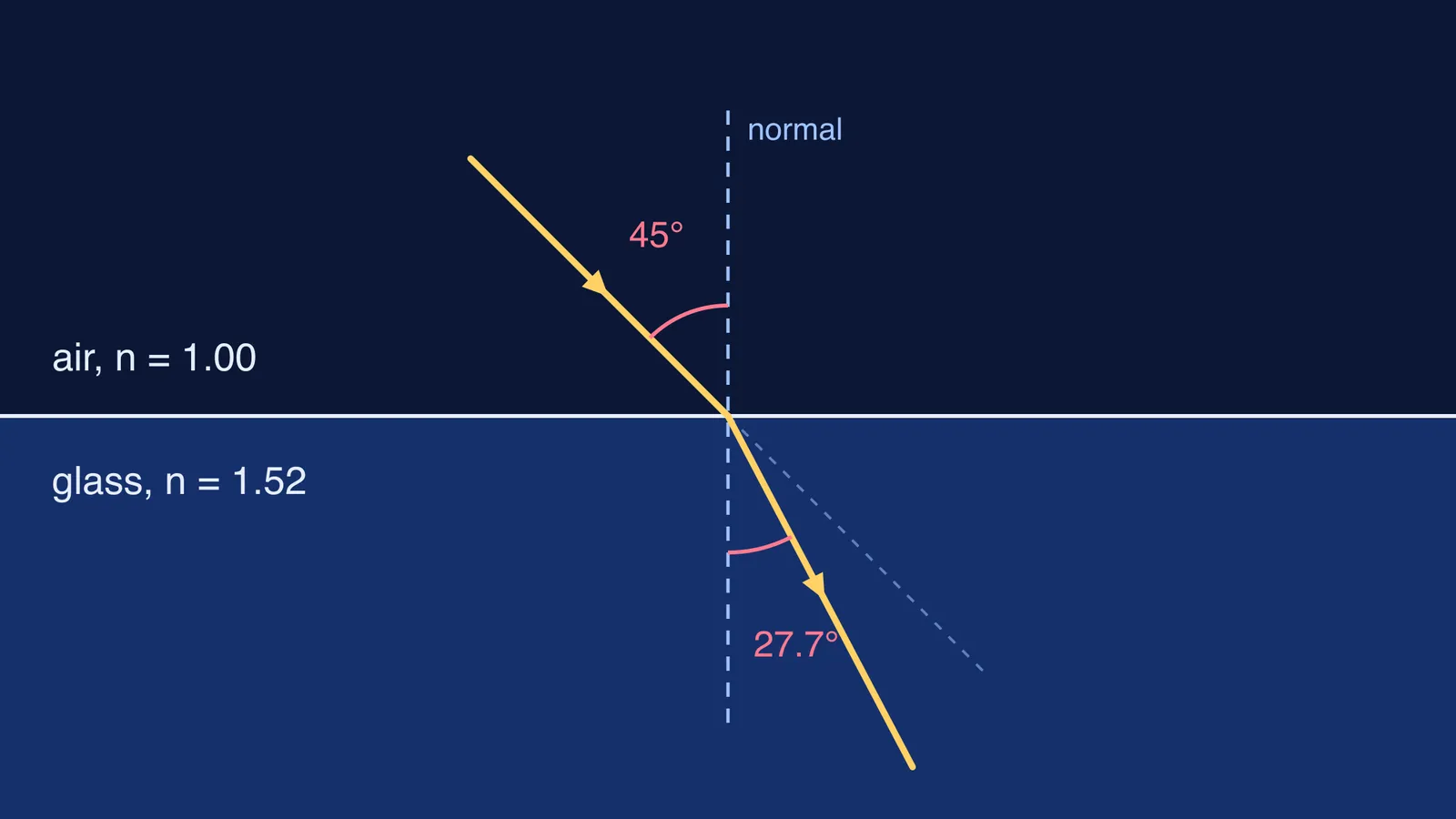
The normal is the imaginary line drawn at 90° to the surface at the point where the ray strikes it. Both angles in refraction, the angle of incidence and the angle of refraction, are measured from this line, not from the surface.
A medium's refractive index is the speed of light in vacuum divided by its speed in that medium, n = c/v (OpenStax University Physics, Volume 3). A bigger n means slower light. OpenStax states that when light enters a medium with a higher refractive index, the direction of the ray moves closer to the perpendicular.
Refraction of light passing from a fast medium to a slow medium bends the ray towards the normal, and the reverse trip bends it away (HyperPhysics, Georgia State University).
In this rule, "denser" means optically denser: a higher refractive index, not more mass per litre. Our post on optical density versus mass density explains the difference.
What does Snell's law say?
Snell's law states n1 sin θ1 = n2 sin θ2, where θ1 and θ2 are the angles the incident and refracted rays make with the normal (OpenStax University Physics, Volume 3).
Rearrange it to get sin θ2 = (n1/n2) sin θ1. If n2 is bigger than n1, the fraction n1/n2 is less than 1, so sin θ2 comes out smaller than sin θ1, and θ2 is smaller than θ1. That one line is the reason the ray bends towards the normal.
You need refractive index values to use it. OpenStax's table lists air as 1.000293, fresh water as 1.333, crown glass as 1.52 and diamond as 2.419 (OpenStax Physics, Table 16.2). For air, problems usually round to 1.00.
How do you find the angle of refraction?
Here is a worked example using the OpenStax values (OpenStax Physics). A ray of light in air strikes a still water surface at 45° to the normal. Find the angle of refraction.
Write down what you know: n1 = 1.00, θ1 = 45°, n2 = 1.333.
Predict the direction before calculating: 1.333 is bigger than 1.00, so θ2 must be less than 45°.
Substitute: sin θ2 = (1.00 × sin 45°) / 1.333 = 0.7071 / 1.333 = 0.5305.
Take the inverse sine: θ2 = sin⁻¹(0.5305) ≈ 32.0°.
Check against your prediction: 32.0° is less than 45°, so the ray bent towards the normal, as expected.
Now send the same 45° ray into crown glass (n = 1.52). This time sin θ2 = 0.7071 / 1.52 = 0.4652, so θ2 ≈ 27.7°. A higher index means more bending. OpenStax's own example sends a ray into diamond at 30.0° and gets a refraction angle of about 11.9° (OpenStax University Physics, Volume 3).
Last, water into glass at 45°. Here n1 is 1.333, not 1. So sin θ2 = (1.333 × 0.7071) / 1.52 = 0.6201, and θ2 ≈ 38.3°. The ray still bends towards the normal, but less, because the two indices are closer together.
If you keep putting the numbers in the wrong places, the Fermi Problem Library has worked problems with a step-by-step solver that explains the reasoning rather than printing an answer.
Which refraction mistakes cost marks?
Measuring from the surface. If a question says the ray makes 30° with the water surface, the angle of incidence is 90° − 30° = 60°.
Calculator in radians. sin 45 in radian mode gives 0.851, not 0.707. Check the mode before the exam starts.
Swapping n1 and n2. The prediction step catches this. If your answer bends the wrong way, the indices are swapped.
Assuming n1 is always 1. It is only 1 when the ray starts in air or vacuum.
Going the other way. From a denser medium into a rarer one, sin θ2 can come out bigger than 1. That is not an error in your arithmetic. It means no refracted ray exists, which is total internal reflection.
If refractive index itself feels shaky, the Fermi Concept Library gives each concept its own lesson and its place in the map.
Next, try the reverse trip and see how the same law handles light going from water into air.