On this page
We wrote these eight questions for NEET-UG Physics; none is copied from NCERT or a past paper. Each answer has a short solution and the trap behind the wrong option most students pick.
What does NEET ask from Properties of Solids and Liquids?
The National Medical Commission's updated syllabus for NEET (UG)-2026 lists Properties of Solids and Liquids as Physics Unit 7. In the NCERT Class 11 Physics Part II textbook (Reprint 2026-27), that is Chapter 8, Chapter 9 and Chapter 10.
For NEET-UG 2026, the NTA information bulletin gave four marks for a correct answer and took away one for a wrong one, so a blind guess is a risk.
How should you use this set?
Cover the solutions. Allow a minute per easy question, two per hard one.
Before any arithmetic, write how the answer scales: with r², √h or 1/g.
Circle every given quantity that is a diameter, a percentage, a depth or a thickness.
After marking, read every trap.
Take g = 10 m/s² throughout. New to the unit? Read our guide on how to prepare Properties of Solids and Liquids for NEET.
Easy: elasticity, Pascal's law and latent heat
Q1 (easy). A metal block is lowered into the sea until the pressure on it has risen by 2.0 × 10⁷ Pa. Its volume falls by 0.010%. What is the bulk modulus of the metal?
(A) 2.0 × 10⁹ Pa (B) 2.0 × 10¹¹ Pa (C) 2.0 × 10¹³ Pa (D) 5.0 × 10⁻¹² Pa
Answer: (B). B = Δp/(ΔV/V). A 0.010% change is ΔV/V = 1.0 × 10⁻⁴, so B = 2.0 × 10⁷ / 1.0 × 10⁻⁴ = 2.0 × 10¹¹ Pa.
Trap: (A) treats 0.010 as the fraction; (D) is 1/B, the compressibility.
Q2 (easy). In a hydraulic jack, the small piston has a diameter of 3 cm and the large one 30 cm. A force of 120 N on the small piston can just support what mass on the large one?
(A) 12 kg (B) 120 kg (C) 1200 kg (D) 12000 kg
Answer: (C). Pascal's law gives equal pressure, so F₂ = F₁(A₂/A₁) = 120 × (30/3)² = 12,000 N. The mass is 12,000/10 = 1200 kg.
Trap: (B) multiplies by the diameter ratio, 10, instead of the area ratio, 100.
Q3 (easy). How much heat turns 20 g of ice at −10 °C into water at 0 °C? Take the specific heat of ice as 2.1 J/g °C and its latent heat of fusion as 336 J/g.
(A) 6300 J (B) 6720 J (C) 7140 J (D) 7560 J
Answer: (C). Warm the ice to 0 °C: 20 × 2.1 × 10 = 420 J. Melt it: 20 × 336 = 6720 J. Total: 7140 J.
Trap: (B) melts the ice but forgets that it first has to reach 0 °C.
Medium: surface tension, viscosity and Bernoulli
Q4 (medium). A soap bubble in air has a radius of 1.5 cm. The surface tension of the soap solution is 0.030 N/m. By how much does the pressure inside exceed the pressure outside?
(A) 2.0 Pa (B) 4.0 Pa (C) 8.0 Pa (D) 16 Pa
Answer: (C). A bubble has two surfaces, so the excess pressure is 4T/r = 4 × 0.030/0.015 = 8.0 Pa.
Trap: (B) is 2T/r, the result for a drop, which has one surface.
Q5 (medium). A metal ball of diameter 3.0 mm and density 7200 kg/m³ falls through an oil of density 1200 kg/m³ and viscosity 1.5 Pa s. What is its terminal velocity?
(A) 2.0 cm/s (B) 2.4 cm/s (C) 8.0 cm/s (D) 9.6 cm/s
Answer: (A). From Stokes' law, v_t = 2r²(ρ − σ)g/(9η). With r = 1.5 × 10⁻³ m, v_t = 2 × 2.25 × 10⁻⁶ × 6000 × 10/(9 × 1.5) = 0.020 m/s = 2.0 cm/s.
Trap: (C) uses the diameter as the radius; (B) ignores the upthrust.
Q6 (medium). An open tank has a small hole of area 2.0 cm² in its side, 1.8 m below the water surface. At what rate does water flow out at that moment?
(A) 0.85 L/s (B) 1.2 L/s (C) 3.6 L/s (D) 7.2 L/s
Answer: (B). Torricelli's law, from Bernoulli: v = √(2gh) = √36 = 6.0 m/s. Flow rate = Av = 2.0 × 10⁻⁴ × 6.0 = 1.2 × 10⁻³ m³/s, or 1.2 L/s.
Trap: (A) uses √(gh) and drops the 2.
Hard: conduction in layers and capillary rise in a lift
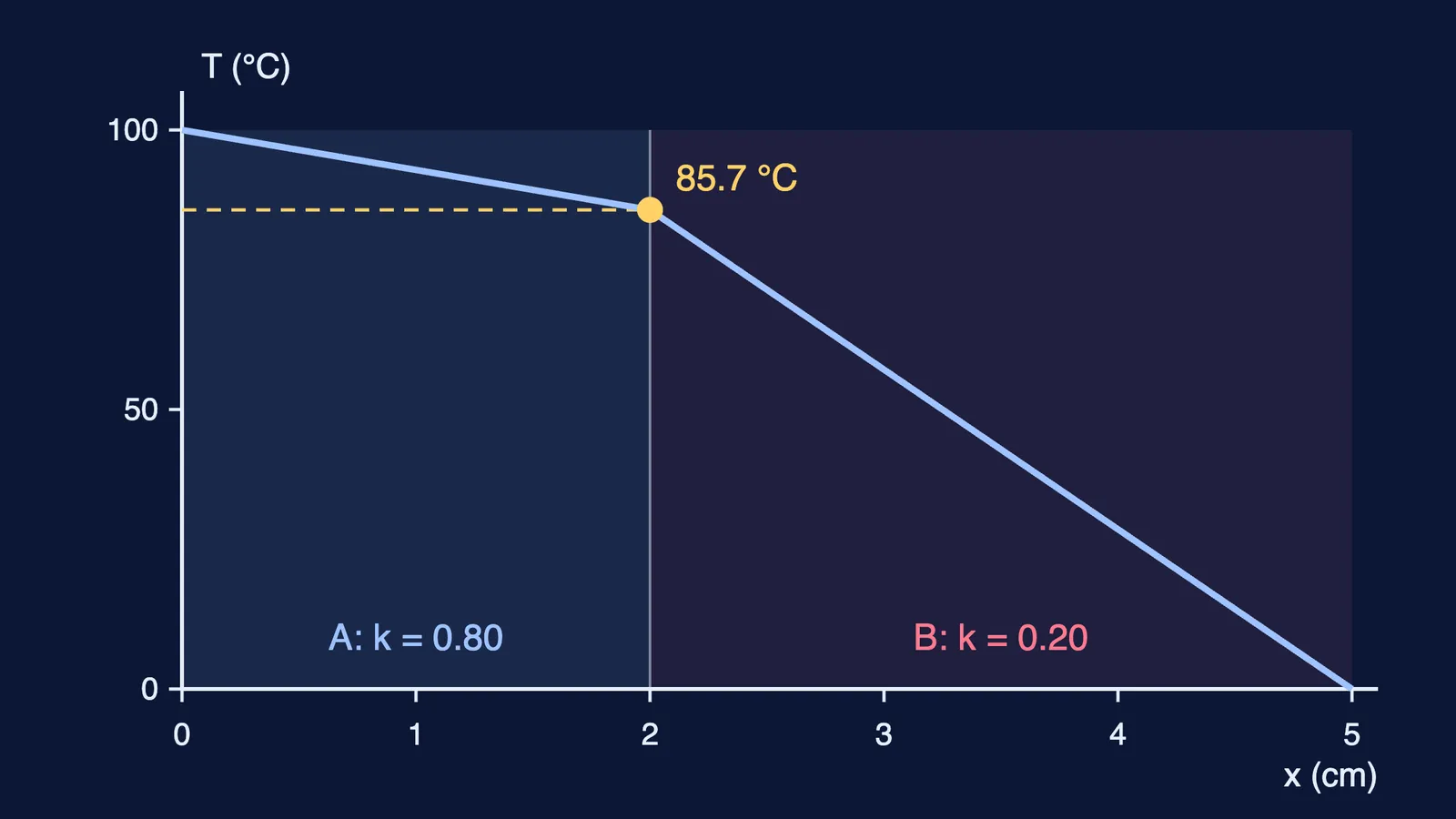
Q7 (hard). A wall has two layers. Layer A is 2.0 cm thick with thermal conductivity 0.80 W/m K; layer B is 3.0 cm thick with 0.20 W/m K. The outer face of A is at 100 °C and the outer face of B at 0 °C. In the steady state, what is the temperature where the layers meet?
(A) 14.3 °C (B) 50.0 °C (C) 60.0 °C (D) 85.7 °C
Answer: (D). The same heat current crosses both layers, so each layer's drop is proportional to its resistance L/k: 0.025 for A, 0.15 for B. A takes 1/7 of the 100 °C drop, about 14.3 °C, leaving the interface at about 85.7 °C.
Trap: (C) splits the drop by thickness alone and ignores k.
Q8 (hard). Water rises in a clean glass capillary of internal diameter 0.30 mm (surface tension 0.072 N/m, contact angle 0°). The tube is now inside a lift accelerating upward at 2.0 m/s². How high does the water stand?
(A) 4.0 cm (B) 8.0 cm (C) 9.6 cm (D) 12.0 cm
Answer: (B). In the lift, the effective gravity is g + a = 12 m/s². With r = 0.15 mm, h = 2T/(rρg_eff) = 0.144/(1.5 × 10⁻⁴ × 1000 × 12) = 0.080 m = 8.0 cm.
Trap: (D) uses g − a. An upward acceleration makes the water effectively heavier, so it rises less.
What should you revise after this set?
Missed Q5 or Q6? Reread our Class 11 guide to Mechanical Properties of Fluids. Missed Q7? See the rate of heat flow through a rod.
If a solution loses you, the Fermi Problem Library has worked problems with a step-by-step solver that explains the reasoning rather than printing an answer.