On this page
Eight original questions on Electromagnetic Waves, easy to hard. Q6 is a numerical-value question; the rest are single-correct.
How should you use this electromagnetic waves question set?
Unit 15 of the NTA's Syllabus for JEE (Main) - 2027 covers displacement current, the characteristics and transverse nature of electromagnetic waves, the spectrum from radio waves to gamma rays, and applications. The textbook match is NCERT Class 12 Physics Chapter 8. The JEE (Main) 2027 information bulletin gives +4 for a correct answer and −1 for a wrong one, and numerical answers are rounded to the nearest integer.
Set a 20-minute timer and work on paper, without a calculator.
Take c = 3.0 × 10⁸ m/s, ε₀ = 8.85 × 10⁻¹² F/m and μ₀ = 4π × 10⁻⁷ T m/A.
Mark each answer before reading its solution, then read every trap line.
New to the chapter? Start with our guide on how to prepare Electromagnetic Waves for JEE Main.
Easy: can you place a wave and point its fields?
Q1 (easy). Match each source with the radiation it produces, as listed in NCERT's Table 8.1: (P) magnetron valve, (Q) vibration of atoms and molecules, (R) radioactive decay of the nucleus, (S) rapid acceleration of electrons in aerials.
(A) P microwaves, Q infrared, R gamma rays, S radio waves
(B) P microwaves, Q infrared, R X-rays, S radio waves
(C) P radio waves, Q infrared, R gamma rays, S microwaves
(D) P microwaves, Q ultraviolet, R gamma rays, S radio waves
Answer: (A). Each pairing is in Table 8.1. Trap: (B). X-rays come from X-ray tubes or inner-shell electrons, not from the nucleus.
Q2 (easy). An FM station broadcasts at 93.5 MHz. The wavelength of its waves in air is closest to:
(A) 0.312 m
(B) 0.511 m
(C) 3.21 m
(D) 32.1 m
Answer: (C). λ = c/ν = 3.0 × 10⁸/(93.5 × 10⁶) = 3.21 m. Trap: (B), which divides by an extra 2π, as if λ = c/(2πν).
Q3 (easy). A plane wave in vacuum travels along +y. At one point and instant its magnetic field is 25 nT along +z. The electric field there is:
(A) 7.5 V/m along +x
(B) 7.5 V/m along −x
(C) 7.5 V/m along +y
(D) 8.3 × 10⁻¹⁷ V/m along −x
Answer: (B). E = cB = 3.0 × 10⁸ × 25 × 10⁻⁹ = 7.5 V/m. E × B must point along +y, and (−x̂) × ẑ = +ŷ. Trap: (A), from taking B × E instead of E × B.
Medium: where do displacement current and energy catch you?
Q4 (medium). A lamp emits photons of energy 5.0 eV. Taking hc = 1240 eV nm, the radiation is:
(A) 248 nm, ultraviolet
(B) 248 nm, X-ray
(C) 2.48 μm, infrared
(D) 620 nm, visible
Answer: (A). λ = hc/E = 1240/5.0 = 248 nm, inside NCERT's ultraviolet range of 400 nm down to about 0.6 nm. Trap: (B), from assuming anything more energetic than visible light must be an X-ray. NCERT's X-ray band starts near 10 nm.
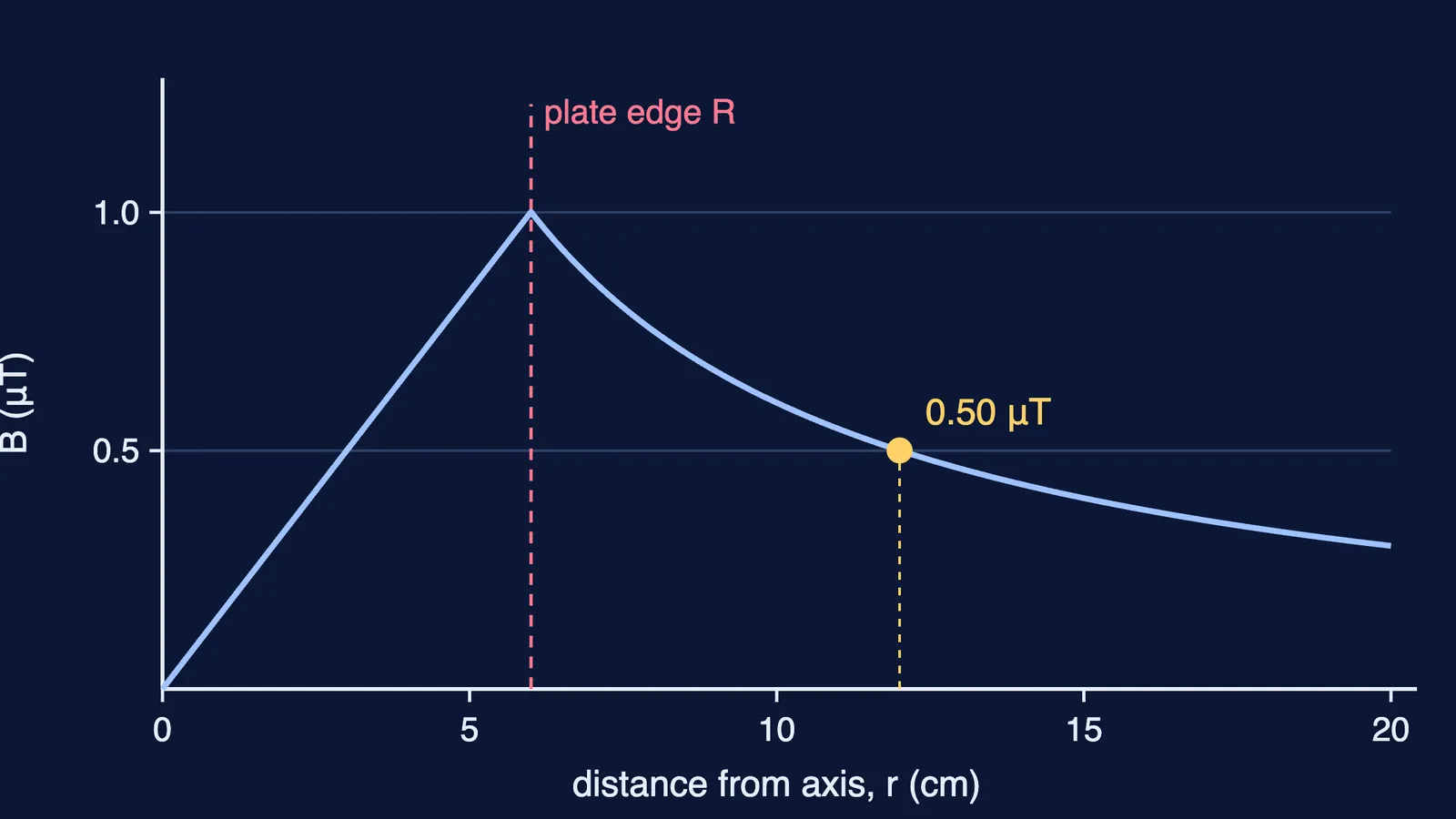
Q5 (medium). A capacitor has circular plates of radius 6.0 cm. While it charges, the uniform field between the plates rises at 3.0 × 10¹² V m⁻¹ s⁻¹. The magnetic field at 12 cm from the axis, in the plane midway between the plates, is closest to:
(A) 0
(B) 0.50 μT
(C) 1.0 μT
(D) 2.0 μT
Answer: (B). The displacement current is i_d = ε₀ πR² dE/dt = 8.85 × 10⁻¹² × π × (0.060)² × 3.0 × 10¹² ≈ 0.30 A. A loop of radius 12 cm encloses all of it, so B = μ₀i_d/(2πr) ≈ 5.0 × 10⁻⁷ T. Trap: (D), which uses the inside-the-plates formula μ₀i_d r/(2πR²) at a point outside them.
Q6 (medium, numerical). A plane wave in vacuum has an electric field amplitude of 60 V/m. Find its average total energy density, in units of 10⁻⁹ J/m³.
Answer: 16. The average electric and magnetic energy densities are equal, which is NCERT exercise 8.10, so the total is ½ε₀E₀², as in OpenStax University Physics, section 16.3. That is ½ × 8.85 × 10⁻¹² × 3600 ≈ 15.9 × 10⁻⁹ J/m³, which rounds to 16. Trap: 8, which counts only the electric half.
Hard: can you go from power to field, and from an equation to a medium?
Q7 (hard). A 6.0 mW laser beam has a uniform circular cross-section of diameter 2.0 mm. The amplitude of its magnetic field is closest to:
(A) 2.0 μT
(B) 2.8 μT
(C) 4.0 μT
(D) 5.7 μT
Answer: (C). Intensity I = P/(πr²) = 6.0 × 10⁻³/(π × 10⁻⁶) ≈ 1.9 × 10³ W/m². With I = ½cε₀E₀² from the same OpenStax section, E₀ = √(2I/(cε₀)) ≈ 1.2 × 10³ V/m, and B₀ = E₀/c ≈ 4.0 × 10⁻⁶ T. Trap: (B), the rms value, which comes from dropping the ½. (A) uses the diameter as the radius.
Q8 (hard). In a non-magnetic medium, E_x = 40 sin(20z − 3.0 × 10⁹ t) V/m, in SI units. The relative permittivity of the medium and the wavelength in it are:
(A) 2 and 0.314 m
(B) 4 and 0.314 m
(C) 4 and 0.628 m
(D) 0.25 and 0.314 m
Answer: (B). The wave speed is ω/k = 3.0 × 10⁹/20 = 1.5 × 10⁸ m/s. NCERT's v = 1/√(με) with μ = μ₀ gives εᵣ = (c/v)² = 4, and λ = 2π/k = 0.314 m. Trap: (A), which stops at c/v = 2. That is the refractive index, and εᵣ is its square.
What should you revise after this set?
Sort your misses. Spectrum slips (Q1, Q2, Q4) mean rewriting NCERT's band table from memory. Direction and medium slips (Q3, Q8) need the E × B rule and v = 1/√(με). Field and energy slips (Q5 to Q7) need one formula each, written in full.
Then try our JEE Main practice set on electromagnetic induction and AC, or move on to Wave Optics for JEE Main. If a whole method keeps failing, the Fermi Problem Library has worked problems with a step-by-step solver that explains the reasoning rather than printing an answer.