On this page
Eight original JEE Main-style questions, easy to hard. Q6 and Q8 ask for a number; the rest are single-correct. Each answer names its trap.
Which part of the JEE Main syllabus does this set cover?
The NTA "Syllabus for JEE (Main) - 2027" lists Purification and Characterisation of Organic Compounds as Chemistry Unit 13: purification methods, detection of N, S, P and halogens, estimation of C, H, N, halogens, S and P, and formula numericals. Every fact and formula below follows sections 8.8 to 8.10 of NCERT Class 11 Chemistry, Unit 8 (reprint 2026-27).
How to use this set:
Allow 12 minutes, paper only.
Before any estimation sum, write the weighed product and its molar mass.
Mark every guess, even the lucky ones.
Not revised yet? Start with our guide on how to prepare purification and characterisation of organic compounds for JEE Main.
Easy: do you know why each method works?
Q1 (easy). A compound dissolved in water is only sparingly soluble in diethyl ether, which does not mix with water. Which technique recovers it without a very large volume of ether?
(A) Continuous extraction, reusing the same ether
(B) Steam distillation
(C) Sublimation
(D) One shake with ether in a separating funnel
Answer: (A). NCERT uses continuous extraction when the compound is less soluble in the organic solvent, to avoid a very large quantity of solvent. Trap: (D). A single shake is the ordinary extraction that wastes solvent here.
Q2 (easy). Before testing a sodium fusion extract for halogens, why is it boiled with concentrated nitric acid when N or S is also present?
(A) To decompose sodium cyanide and sulphide, which would interfere with the silver nitrate test
(B) To oxidise halide ions to free halogens
(C) To dissolve the silver halide so its colour shows
(D) To oxidise phosphorus to phosphate
Answer: (A). Cyanide and sulphide would also react with silver ions. Trap: (D). Nitric acid also appears in the phosphorus test, but there sodium peroxide has already oxidised phosphorus to phosphate.
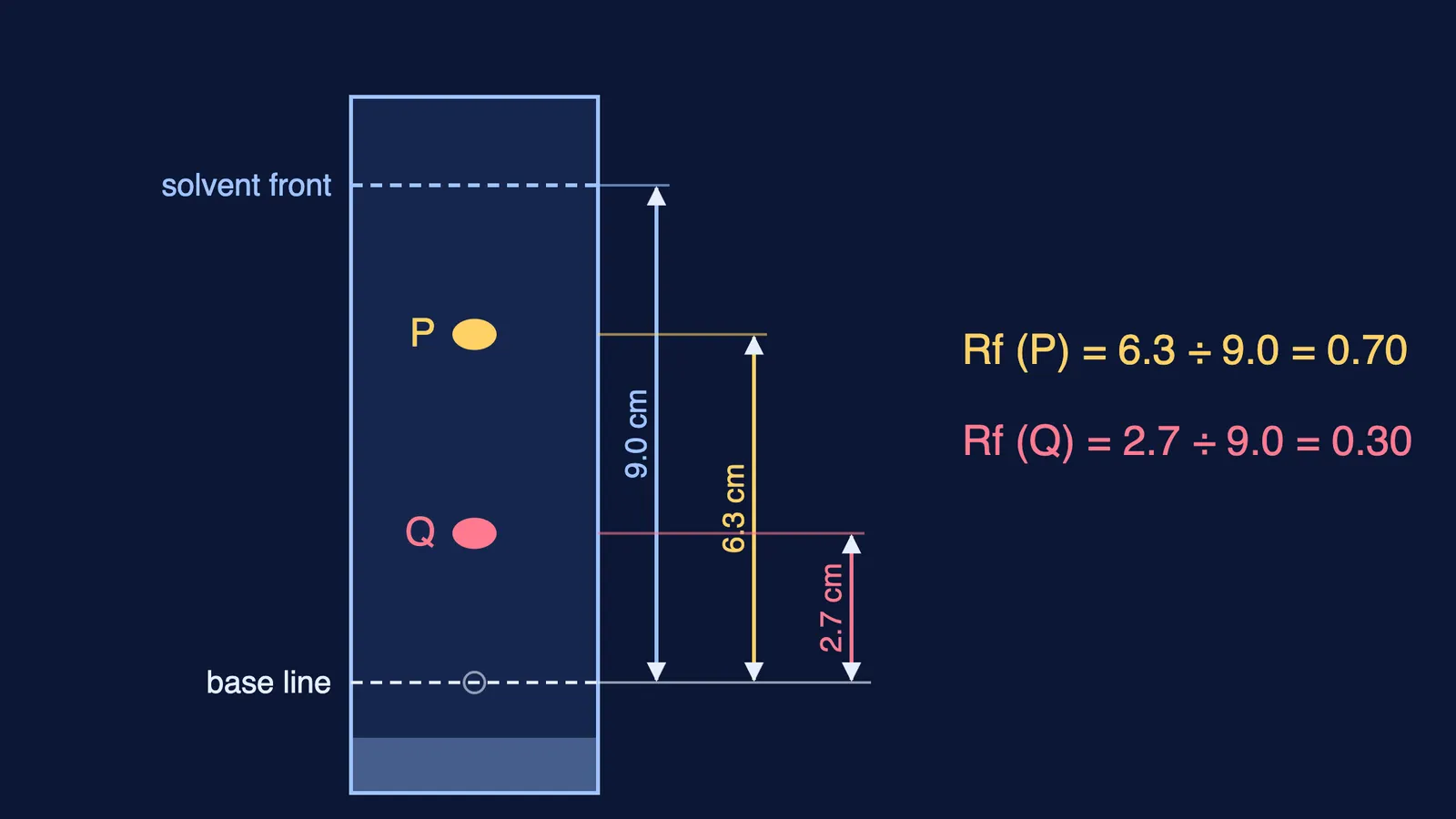
Q3 (easy). On a silica gel TLC plate the solvent front is 9.0 cm above the base line. Spot P is 6.3 cm and spot Q 2.7 cm above it. Which statement is correct?
(A) Rf of P = 0.70; P is adsorbed more strongly
(B) Rf of Q = 0.30; Q is adsorbed more strongly
(C) Rf of P = 1.43; Q is adsorbed more strongly
(D) Rf of Q = 0.30; P is adsorbed more strongly
Answer: (B). Rf = distance moved by the substance ÷ distance moved by the solvent, both from the base line: P = 6.3 ÷ 9.0 = 0.70, Q = 2.7 ÷ 9.0 = 0.30. The more strongly adsorbed component moves less. Trap: (A). Larger Rf means weaker adsorption.
Medium: can you pick the right ratio?
Q4 (medium). In a Carius estimation, 0.180 g of a compound gives 0.349 g of BaSO₄ (Ba = 137, S = 32, O = 16). The percentage of sulphur is:
(A) 26.6%
(B) 45.3%
(C) 63.3%
(D) 64.6%
Answer: (A). BaSO₄ = 233 g mol⁻¹ with one S. Percentage of S = (32 × 0.349 × 100) ÷ (233 × 0.180) = 26.6%. Trap: (C). The weighed solid is BaSO₄, not sulphuric acid, so dividing by 98 is wrong.
Q5 (medium). All the phosphorus in 0.250 g of a compound ends up as 0.333 g of Mg₂P₂O₇ (222 g mol⁻¹). The percentage of phosphorus (P = 31) is:
(A) 18.6%
(B) 37.2%
(C) 58.2%
(D) 2.2%
Answer: (B). One Mg₂P₂O₇ holds two P atoms, 62 g. Percentage of P = (62 × 0.333 × 100) ÷ (222 × 0.250) = 37.2%. Trap: (A). Using 31 counts one phosphorus atom and halves the answer.
Q6 (medium, numerical value). In a Kjeldahl estimation, ammonia from 0.350 g of a compound is absorbed in 30.0 mL of 0.25 M H₂SO₄. The leftover acid needs 20.0 mL of 0.25 M NaOH. Find the percentage of nitrogen.
Answer: 40. NaOH = 0.0050 mol, which neutralises 0.0025 mol of acid. Of 0.0075 mol acid taken, 0.0050 mol reacted with 0.0100 mol NH₃, so N = 0.140 g, or 40.0% of 0.350 g. NCERT's formula, 1.4 × M × 2(V − V₁/2) ÷ m, agrees. Trap: 20. Subtracting 20.0 mL straight from 30.0 mL treats NaOH and H₂SO₄ as one-to-one.
Hard: can you follow a full method?
Q7 (hard). A compound contains only carbon, hydrogen and chlorine. On complete combustion, 0.297 g of it gives 0.264 g of CO₂ and 0.108 g of H₂O (Cl = 35.5). Its empirical formula is:
(A) CHCl
(B) CH₂Cl
(C) CH₃Cl
(D) C₂H₃Cl
Answer: (B). C = 12 × 0.264 ÷ 44 = 0.072 g and H = 2 × 0.108 ÷ 18 = 0.012 g, so chlorine = 0.297 − 0.084 = 0.213 g. Moles C : H : Cl = 0.0060 : 0.012 : 0.0060 = 1 : 2 : 1, giving CH₂Cl. Trap: (A). Taking one hydrogen atom per H₂O halves the hydrogen and gives CHCl.
Q8 (hard, numerical value). A compound of molar mass 253 g mol⁻¹ gives 0.424 g of AgBr from 0.190 g in a Carius estimation (Ag = 108, Br = 80). How many bromine atoms are in one molecule?
Answer: 3. AgBr = 188 g mol⁻¹, so AgBr = 0.424 ÷ 188 = 2.26 × 10⁻³ mol. Compound = 0.190 ÷ 253 = 7.51 × 10⁻⁴ mol. The ratio is 3.00. Trap: 1. Dividing the percentage of Br (95.0) by 80 gives 1.19; it skips multiplying by the molar mass.
What should you do after checking your answers?
7-8 right: try timed sets mixing this chapter with mole concept.
4-6 right: rework each miss and write its trap in your own words.
0-3 right: reread NCERT 8.8 to 8.10, then retry in a week.
For more estimation practice, the Fermi Problem Library has worked problems with a step-by-step solver that explains the reasoning rather than printing an answer.
Q2 is explained further in why nitric acid is boiled before silver nitrate in Lassaigne's test. For another way to find molar mass, see the silver salt method for an organic acid.