On this page
The silver salt method is an old weighing technique that still turns up in Class 11 mole-concept chapters and JEE-style numericals. It works because carboxylic acids form insoluble silver salts, and when you heat these salts they decompose to leave a residue of metallic silver. Weigh the salt, weigh the silver, and two numbers give you the molar mass, as long as you know the acid's basicity.
How does the silver salt method work?
The lab procedure, as set out in this step-by-step description of the method, runs like this:
Dissolve the acid in water and treat it with ammonia solution (ammonium hydroxide), then boil off the excess ammonia.
Add silver nitrate solution. The silver salt comes down as a white precipitate.
Filter it, wash it, and dry it.
Weigh a small sample of the dry salt into a crucible.
Heat it strongly, cool and weigh, and repeat until the mass stops changing.
What's left is pure silver.
Research backs up the idea that heat leaves the metal behind. In a 2016 study in The Journal of Physical Chemistry C, Masayoshi Nakano, Takayuki Fujiwara and Nobuyoshi Koga studied the thermal decomposition of silver acetate, a reaction that forms silver nanoparticles, to find out what controls how those particles form.
Where does the formula come from?
Call the acid HₙA, where n is its basicity. Each acidic hydrogen is swapped for one silver atom, so the salt is AgₙA. One mole of salt leaves n moles of silver, or 108n grams.
If w₁ grams of salt leave w₂ grams of silver, the molar mass of the salt is 108n × w₁/w₂. To get back to the acid, take out n silver atoms (108 each) and put back n hydrogen atoms (1 each):
Molar mass of acid = n × (108 × w₁/w₂ − 107)
The bracket on its own, 108 × w₁/w₂ − 107, is the acid's equivalent mass. Multiply by basicity and you have the molar mass.
The standard atomic weight of silver is 107.8682, according to IUPAC's Commission on Isotopic Abundances and Atomic Weights. Textbook problems round it to 108, which is why the net correction is 107.
Worked example: a monobasic acid
0.458 g of the silver salt of a monobasic acid leaves 0.216 g of silver on ignition. Find the molar mass.
Ratio of salt to silver: 0.458 ÷ 0.216 = 2.120.
Molar mass of the salt: 108 × 2.120 = 229 g/mol.
Basicity is 1, so the acid is 229 − 107 = 122 g/mol.
Check: benzoic acid, C₆H₅COOH, is 7 × 12 + 6 × 1 + 2 × 16 = 122. Its silver salt, C₆H₅COOAg, is 229. The numbers agree.
How does basicity change the answer for a dibasic acid?
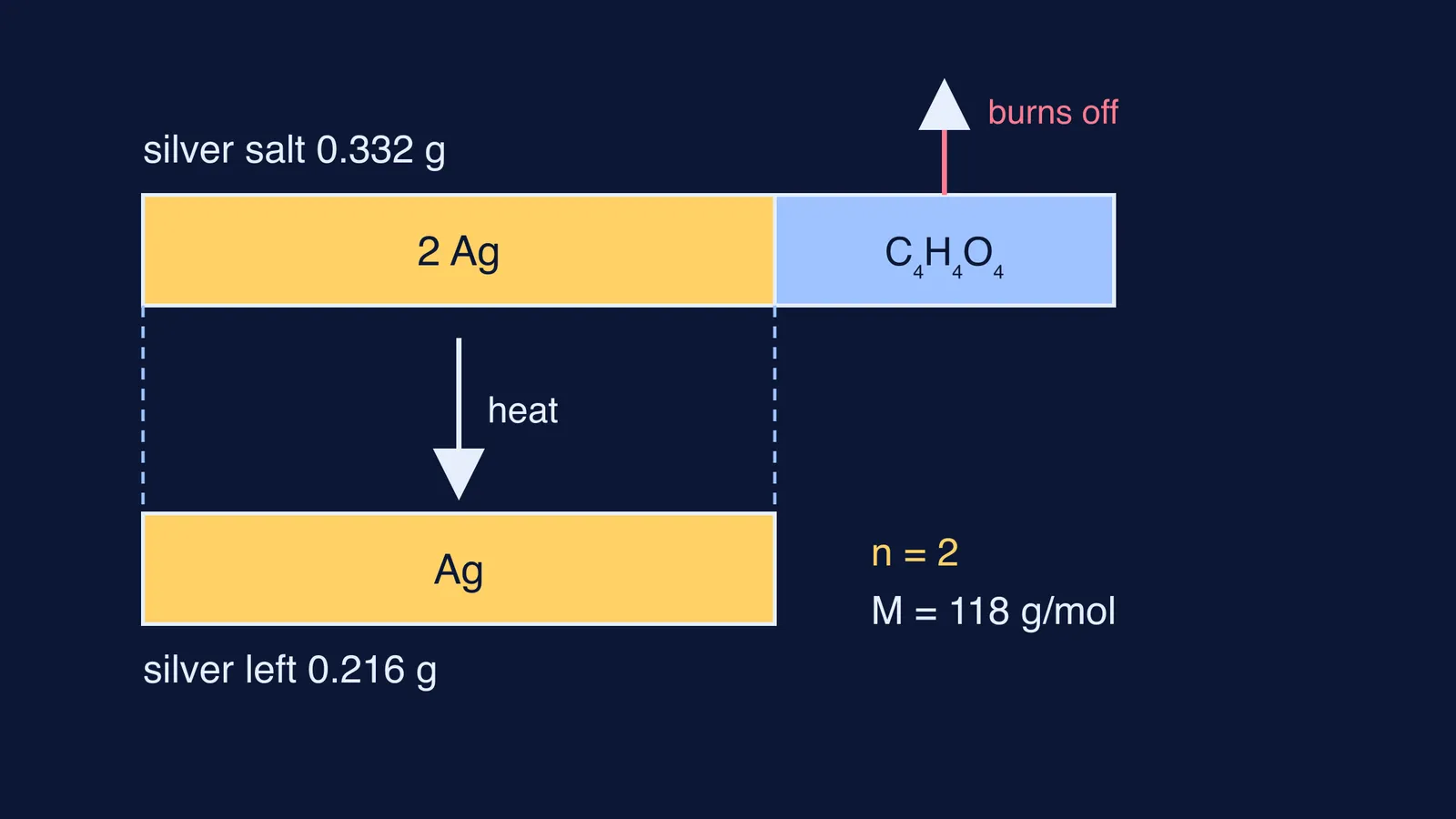
0.332 g of the silver salt of a dibasic acid leaves 0.216 g of silver.
Ratio: 0.332 ÷ 0.216 = 1.537.
Salt mass per silver atom: 108 × 1.537 = 166.
Equivalent mass of the acid: 166 − 107 = 59.
Multiply by basicity: 2 × 59 = 118 g/mol.
Succinic acid, HOOC–CH₂–CH₂–COOH, is 4 × 12 + 6 × 1 + 4 × 16 = 118, so the answer checks out. Forget step 4 and you write 59.
The method also runs backwards. In one practice question on the silver salt method, 0.5 mol of a silver salt leaves 216 g of silver. That is 2 mol of silver from 0.5 mol of salt, so each formula unit holds 4 silver atoms and the acid's basicity is 4.
What mistakes cost marks in silver salt questions?
Check these before you write the answer:
Basicity counts only replaceable hydrogens. Acetic acid, CH₃COOH, has four hydrogens but a basicity of 1, because only the –COOH hydrogen is replaced by silver.
n multiplies the whole bracket. Write n × (108 × w₁/w₂ − 107), not 108n × w₁/w₂ − 107.
The ratio must be above 1. The salt is always heavier than the silver it leaves. If your ratio is below 1, you have the masses upside down.
Round late. Keep four significant figures in the ratio. Rounding 1.537 to 1.5 turns 118 into 110.
Sense-check the answer. Work out the formula mass of a likely acid and see if it matches, as we did above.
The same weigh-the-heavy-atom pattern finds the molar mass of a base by the chloroplatinate method, which weighs the platinum left behind, and it is close to finding the equivalent mass of a metal from its oxide. Silver carboxylates also show up in organic reactions: see how the Hunsdiecker reaction turns a silver salt into an alkyl bromide.
If equivalent mass and basicity still feel shaky, the Fermi Concept Library has a lesson for every concept in chemistry, each placed in the wider map. To practise, try problems in the Fermi Problem Library, where a step-by-step solver explains the reasoning rather than just printing an answer.