On this page
When converting a long-chain carboxylic acid into an alkyl halide, chemists often face a hurdle: how to "step down" the carbon chain by exactly one atom. The Hunsdiecker reaction does exactly this, cleanly removing the carboxyl carbon as carbon dioxide.
This reaction is a classic example of a radical decarboxylation. It is especially useful in organic synthesis and competitive exam preparations like JEE and NEET, where identifying the missing link in a descent of series problem is a frequent challenge.
What is the Hunsdiecker reaction?
The Hunsdiecker reaction is a chemical process where a silver salt of a carboxylic acid is heated with a halogen (usually bromine) in an inert solvent like carbon tetrachloride (CCl₄) to form an alkyl halide. The resulting alkyl chain has one carbon atom fewer than the starting carboxylic acid.
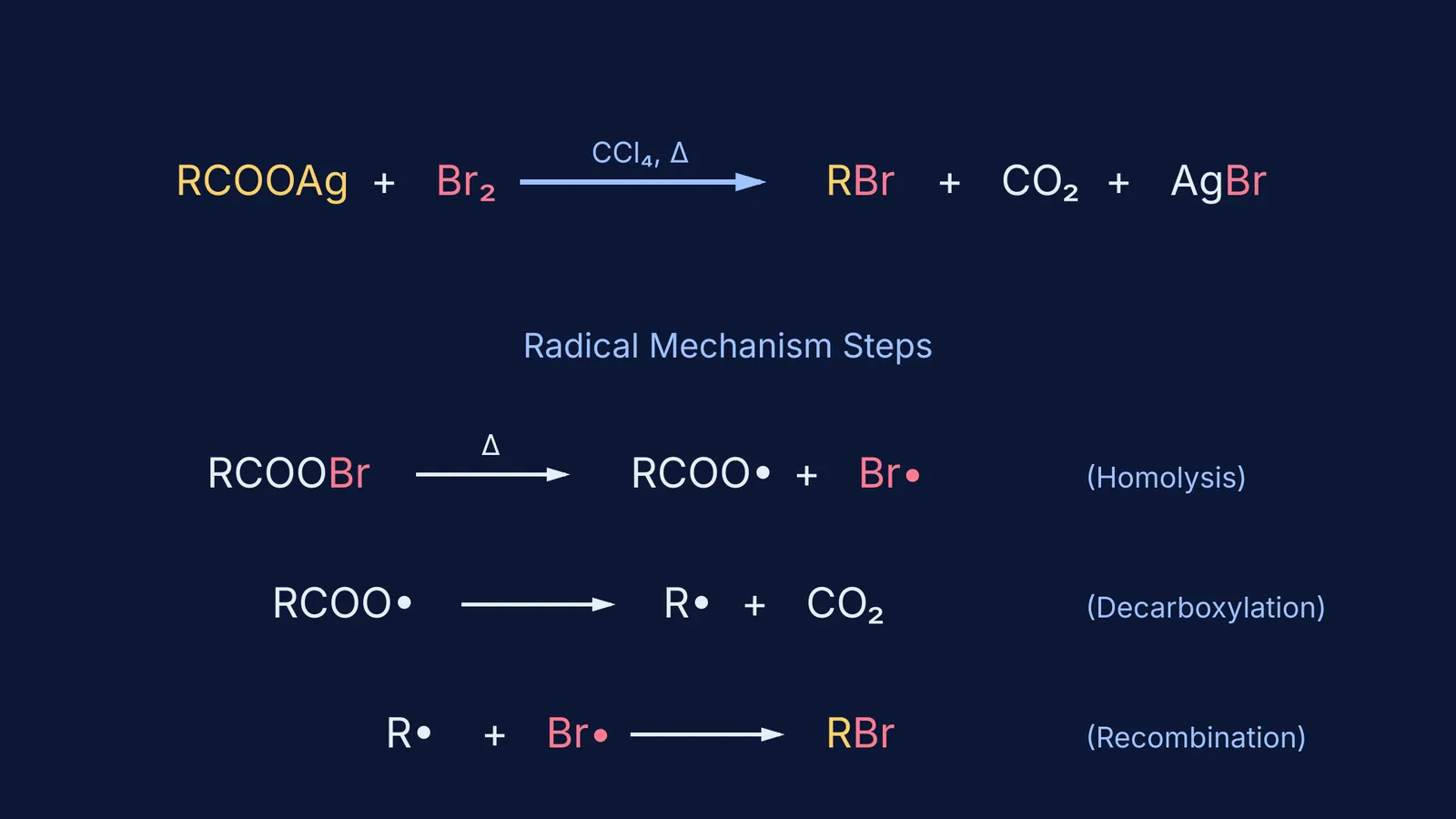
The general equation is: R–COOAg + Br₂ → R–Br + CO₂ + AgBr
Alexander Borodin first demonstrated the reaction in 1861 by preparing methyl bromide from silver acetate. Heinz and Cläre Hunsdiecker later developed it into a general synthetic method in the 1930s.
How does the radical mechanism work?
The Hunsdiecker reaction does not follow a typical ionic substitution pathway. Instead, it proceeds via free radicals in four main steps:
Formation of acyl hypobromite: The silver carboxylate reacts with bromine to form an unstable intermediate, acyl hypobromite (RCOOBr), along with a precipitate of silver bromide (AgBr).
Initiation (Homolysis): The weak oxygen-bromine bond in the acyl hypobromite breaks evenly (homolytic cleavage) when heated, creating an acyloxy radical (RCOO•) and a bromine radical (Br•).
Decarboxylation: The acyloxy radical is highly unstable. It loses a molecule of carbon dioxide gas to leave behind an alkyl radical (R•). This is the exact moment the carbon chain steps down.
Recombination: The alkyl radical quickly reacts with a bromine radical (or another molecule of acyl hypobromite) to form the final alkyl bromide (R–Br).
How is it used in descent of series problems?
In exam questions, the Hunsdiecker reaction is a reliable tool to reduce the carbon count.
Worked Example: How do you convert propanoic acid to bromoethane?
Treat propanoic acid (CH₃CH₂COOH) with ammonium hydroxide, then silver nitrate to form silver propanoate (CH₃CH₂COOAg).
Reflux the silver propanoate with bromine (Br₂) in carbon tetrachloride (CCl₄).
The carboxylate group (–COOAg) is removed as CO₂ and AgBr.
The remaining ethyl group (CH₃CH₂–) binds with bromine to form bromoethane (CH₃CH₂Br).
We started with three carbons and finished with two. If you are comparing this with stepping up a chain, you can review how to step up ethanol to propanoic acid.
If you get stuck trying to map out a descent of series pathway, Fermi's AI tutor can work out what you already know, build a plan for the session, and teach through it — writing on a board and checking understanding as it goes.
How can you predict the product quickly?
When you see a Hunsdiecker reaction in a multiple-choice question, you can bypass the mechanism and predict the product quickly:
Identify the starting salt: Find the silver carboxylate (R–COOAg).
Cut the carboxylate: Cross out the entire –COOAg group to isolate your alkyl group (R).
Attach the halogen: Place a bromine atom exactly where the carboxylate was attached.
This shortcut ensures you do not accidentally include the carbonyl carbon in your final product.
If you find yourself relying too heavily on shortcuts, remember that understanding why a bond breaks is better than memorising the outcome. The Fermi Concept Library contains every concept in physics, chemistry, biology, mathematics and computing, each with its own lesson and its place in the map, helping you explore radical decarboxylation from first principles. For a broader look at organic mechanisms, read about asking AI the 'why' behind named organic reactions.