On this page
The chloroplatinate method looks hard because of the reagent names, not the maths. You get two masses, the salt you heated and the platinum left behind, and must find the molar mass of an organic base. Once you see why one platinum atom ties the whole calculation together, it becomes a three-line problem.
What is the chloroplatinate method?
It is a classical way to find the molar mass of an organic base, usually an amine. According to this summary of the chloroplatinate method, most bases combine with chloroplatinic acid (H₂PtCl₆) to form insoluble salts called platinichlorides, written B₂H₂PtCl₆, and these salts leave a residue of platinum when ignited.
Chloroplatinic acid also precipitates potassium and ammonium ions as hexachloroplatinates, as the chloroplatinic acid article describes. The method relies on organic bases forming the same kind of salt.
Precipitate the salt from the base and chloroplatinic acid.
Dry and weigh the salt. Call this mass x.
Ignite it until only platinum remains, and weigh that. Call this mass a.
Why does the platinum mass give the molar mass?
Every formula unit of the salt holds exactly one platinum atom, so moles of salt heated = moles of platinum left.
The standard atomic weight of platinum is 195.084, according to the IUPAC Commission on Isotopic Abundances and Atomic Weights. Exam questions round it to 195.
Moles of salt = a ÷ 195, and mass ÷ moles gives:
Molar mass of salt = (x ÷ a) × 195
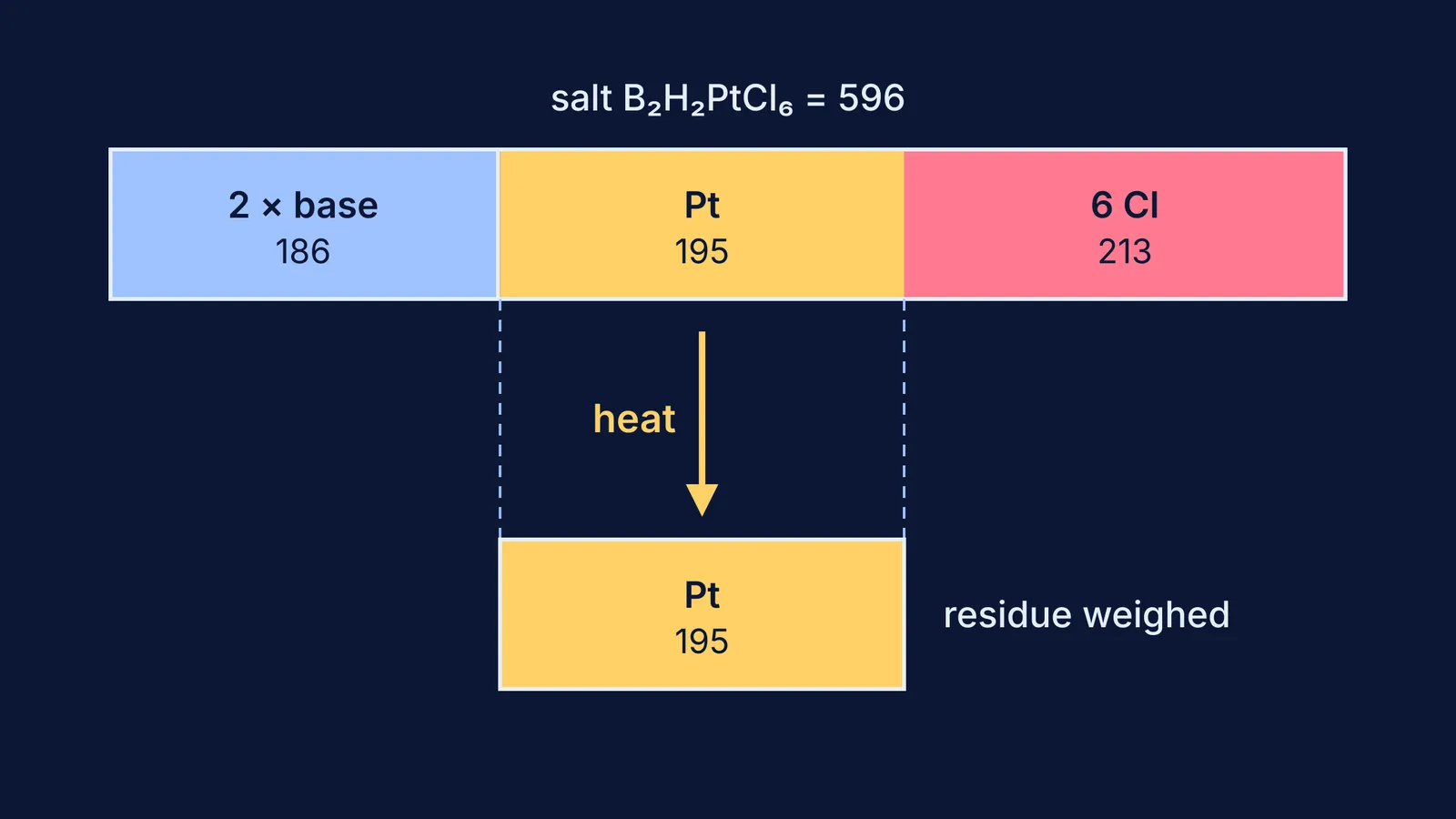
Next, split the salt into its parts. The salt is two equivalents of base plus one H₂PtCl₆. PubChem lists chloroplatinic acid as Cl₆H₂Pt with a molecular weight of 409.8, which questions round to 410. So:
Molar mass of salt = 2E + 410, where E is the equivalent mass of the base
E = [(x ÷ a) × 195 − 410] ÷ 2
Molar mass of base = E × acidity
The acidity is the number of H⁺ ions one molecule of base can accept: 1 for aniline, 2 for ethylenediamine, which has two amino groups.
How do you calculate it step by step?
These use the rounded atomic weights from the CIAAW table: Pt = 195, Cl = 35.5, H = 1, C = 12, N = 14.
Example 1: a monoacidic base
1.192 g of the chloroplatinate of a monoacidic base leaves 0.390 g of platinum on ignition. Find the molar mass of the base.
Salt molar mass = (1.192 ÷ 0.390) × 195 = 3.056 × 195 = 596 g/mol.
2E = 596 − 410 = 186, so E = 93.
Acidity = 1, so the molar mass of the base = 93 g/mol.
Check: aniline, C₆H₅NH₂, is 6 × 12 + 7 × 1 + 14 = 93.
Example 2: a diacidic base
0.470 g of the chloroplatinate of a diacidic base leaves 0.195 g of platinum. Find the molar mass of the base.
Salt molar mass = (0.470 ÷ 0.195) × 195 = 470 g/mol.
2E = 470 − 410 = 60, so E = 30.
Acidity = 2, so the molar mass = 30 × 2 = 60 g/mol.
Check: ethylenediamine, H₂NCH₂CH₂NH₂, is 2 × 12 + 8 × 1 + 2 × 14 = 60.
What mistakes cost marks in this question?
Swapping x and a. The salt mass goes on top: (salt ÷ Pt) × 195. Upside down, you get a molar mass smaller than platinum itself.
Forgetting to halve. Subtracting 410 gives 2E, not E.
Ignoring acidity. For a diacidic or triacidic base, multiply E by 2 or 3. Read the question for words like "diacidic" or "diacid base".
Using 195.08 when the question says 195. Use the atomic weights given, or you may miss the listed options.
Skipping the salt's formula. Write B₂H₂PtCl₆ (or B·H₂PtCl₆ for a diacidic base) before you subtract anything, so you know what the 410 stands for.
If you keep landing on the wrong option, the Fermi Problem Library has worked problems with a step-by-step solver that explains the reasoning rather than printing an answer, so you can see exactly where your setup went off. If equivalent mass or the mole idea behind it still feels shaky, the Fermi Concept Library gives each chemistry concept its own lesson.
How should you practise this before an exam?
Write the principle from memory: one Pt per salt unit, so moles of salt = moles of Pt.
Rederive 2E + 410 from H₂PtCl₆ instead of memorising it.
Solve one monoacidic and one diacidic question, and check each answer against a real amine's formula.
Swap the two masses on purpose and see how wrong the answer looks, so you catch it in the exam hall.
Run this once now and once a week before your test.