

On this page
The concept of equivalent weight dates back to early chemistry in the 19th century, before modern atomic theory was fully established. Early chemists needed a reliable way to standardise chemical reactions. They relied on direct experimental measurements to find the "combining weight" of different elements. If you have ever burned a strip of magnesium in the laboratory to produce a bright blinding white light and a crumbly white powder, you have made a metal oxide. This classic experiment leaves a question: how do you know exactly how much metal reacted with the invisible oxygen in the air? The equivalent mass provides the answer.
What is equivalent mass?
The equivalent mass of an element is the mass that combines with or displaces exactly 1.008 grams of hydrogen, 8.0 grams of oxygen, or 35.5 grams of chlorine (Wikipedia). It is a way to ensure that one equivalent of any substance reacts with exactly one equivalent of another, simplifying calculations across different types of chemical reactions.
For more on how equivalents are used in advanced problem-solving, n-factor and the equivalent concept in redox titrations explains how the idea extends to complex titration equations.
Why does oxygen have an equivalent mass of 8 g?
The standard of 8 grams comes directly from oxygen's atomic mass and its valency, as detailed on Wikipedia. Oxygen has an atomic mass of approximately 16.0 and typically exhibits a valency of 2, because it shares or gains two electrons to complete its outer shell.
Since equivalent mass is simply the atomic mass divided by the valency, oxygen's equivalent mass is 16.0 / 2 = 8.0 g.
How to find equivalent mass of metal from oxide data?
When a metal reacts with oxygen to form an oxide, the mass of the oxygen gained can be found by subtraction (see Wikipedia for standard experimental methods). If you know the initial mass of the pure metal and the final mass of the metal oxide, the mass of the oxygen is the difference between the two.
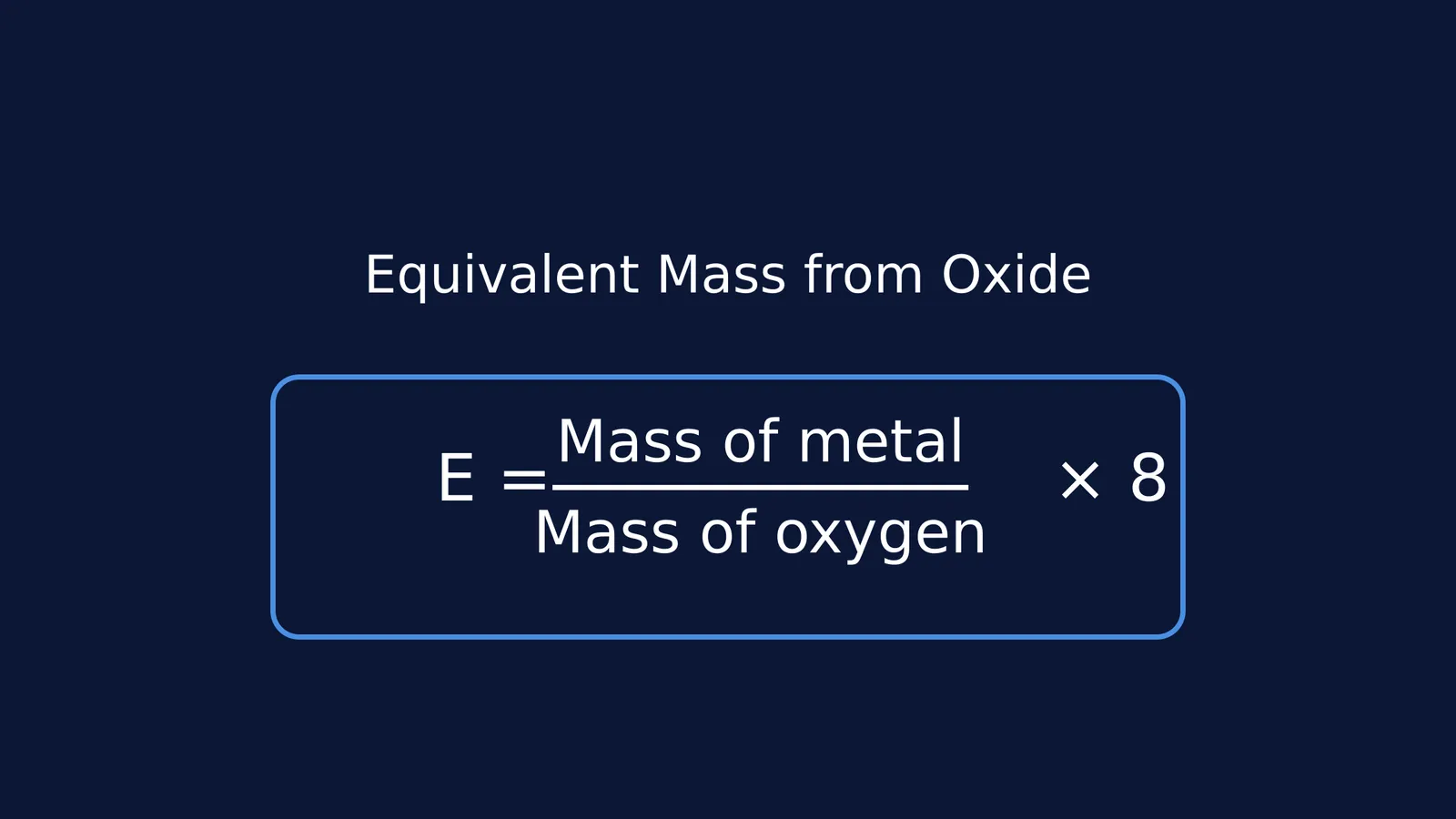
The equivalent mass of the metal (E) is the mass of the metal that would combine with exactly 8 g of oxygen. You can calculate it using the Oxide Formation Method:
E = (Mass of metal / Mass of oxygen) × 8
If you are stuck on setting up these ratios, Fermi's AI tutor can work out what you already know and build a plan for the session, so you sit down to a clear next step instead of a blank page.
Worked example: equivalent mass from oxide
Imagine a standard problem (similar to those outlined on Wikipedia) where 1.50 g of a metal, when heated in oxygen, yields 2.15 g of its oxide. Here is how to find the equivalent mass of the metal:
Find the mass of oxygen: 2.15 g (oxide) − 1.50 g (metal) = 0.65 g of oxygen.
Set up the ratio: If 0.65 g of oxygen combines with 1.50 g of metal, how much metal combines with 8.0 g of oxygen?
Calculate E: E = (1.50 / 0.65) × 8 ≈ 18.46 g.
The equivalent mass of this metal is approximately 18.46 g.
What is the relationship between equivalent mass, valency and atomic mass?
The equivalent mass of a metal is directly tied to its atomic mass by a simple rule:
Equivalent mass = Atomic mass / Valency
If you know the equivalent mass from an experiment and you know the valency of the metal in that specific compound, you can multiply the two to find the atomic mass of the unknown metal. Understanding how metals behave in different oxidation states is crucial when studying the extracting metals for Class 10 curriculum.
How to find equivalent mass from chloride data?
The process is exactly the same for metal chlorides (as noted on Wikipedia), but instead of 8 g of oxygen, you use the standard of 35.5 g of chlorine. Chlorine has an atomic mass of approximately 35.5 and a valency of 1, so its equivalent mass is 35.5 / 1 = 35.5 g.
If a problem gives you the mass of a metal and the mass of the resulting metal chloride, you follow the same logic as the oxide method:
Find the mass of chlorine: Subtract the mass of the pure metal from the mass of the metal chloride.
Calculate E: Set up the ratio to find how much metal combines with exactly 35.5 g of chlorine. The formula is E = (Mass of metal / Mass of chlorine) × 35.5.
For instance, if 2.0 g of a metal reacts with chlorine to form 5.55 g of a metal chloride, the mass of chlorine is 3.55 g. The equivalent mass of the metal would be (2.0 / 3.55) × 35.5 = 20 g.
For a deeper dive into valency, atomic structures, and chemical bonding, explore the Concept Library. It covers every concept in physics, chemistry, biology, mathematics and computing, each with its own lesson and its place in the map.


