

On this page
You have fused the compound with sodium, made the extract, and run the nitrogen and sulphur tests. Now you want to know if there is a halogen. This step is a common viva question: why does nitric acid go in, and get boiled, before the silver nitrate? Here is what the acid does, what goes wrong without it, and a short answer you can give an examiner. If you need the whole procedure first, start with our guide to Lassaigne's test for nitrogen, sulphur and halogens.
What does the sodium extract contain before the halogen test?
Sodium fusion turns each element you are looking for into a water-soluble sodium salt. The Virtual Labs Lassaigne's test experiment sets out what forms:
Halogens give sodium halides (NaCl, NaBr, NaI).
Carbon and nitrogen together give sodium cyanide (NaCN).
Sulphur gives sodium sulphide (Na₂S).
Nitrogen and sulphur together give sodium thiocyanate (NaSCN).
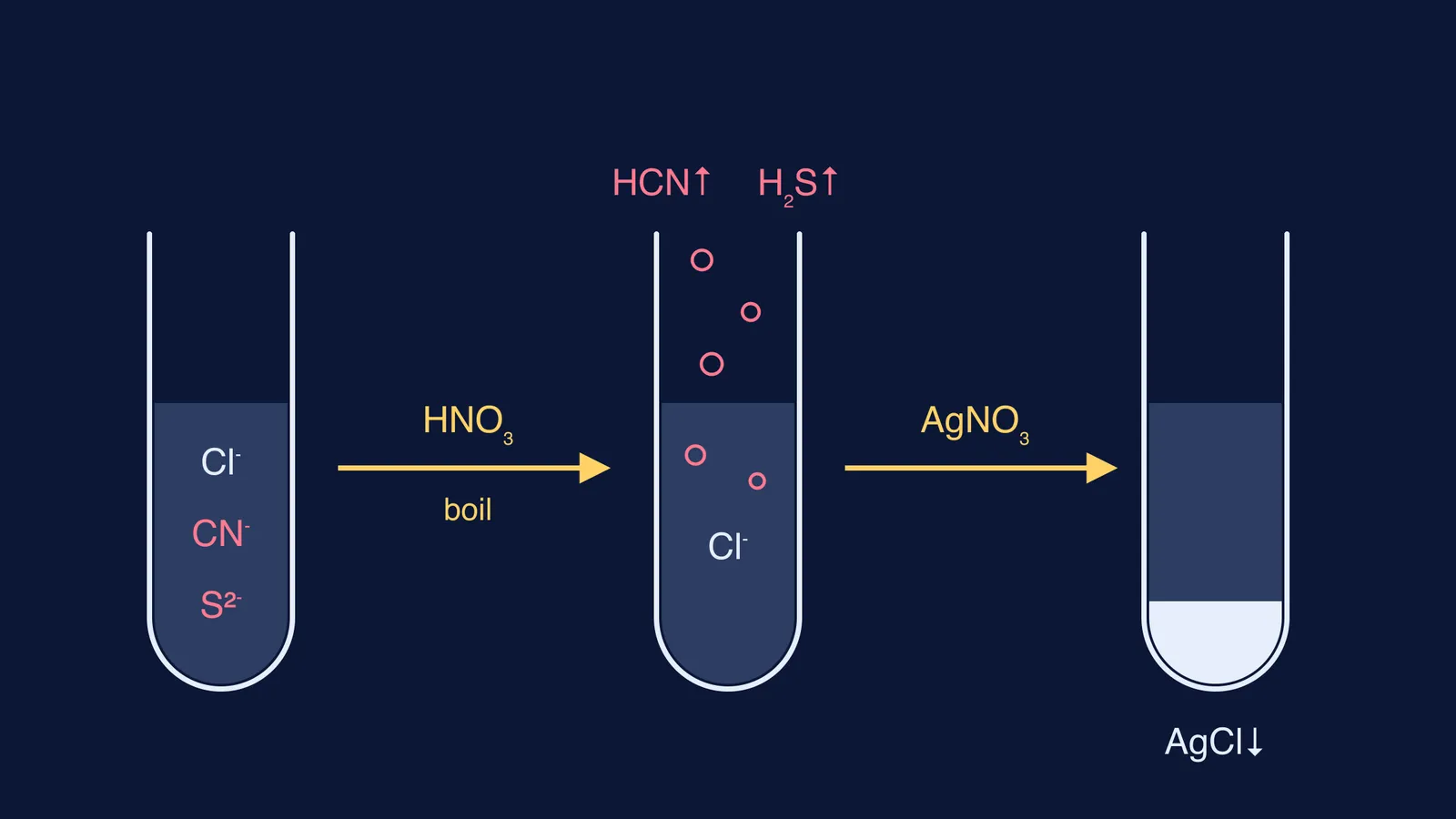
So a single test tube can hold Cl⁻, CN⁻ and S²⁻ at the same time. Silver ions don't pick only the ion you are testing for.
Why is nitric acid boiled before adding silver nitrate?
Cyanide and sulphide both precipitate with silver ions: sulphide gives black Ag₂S and cyanide gives white AgCN, as the explanation to a JEE Main 2016 question on this exact step puts it. White AgCN is easy to mistake for white AgCl. Black Ag₂S can hide whatever else is in the tube.
Nitric acid turns these ions into weak-acid gases, and boiling drives the gases out of the solution. The reactions, as given by eSaral, are:
NaCN + HNO₃ → NaNO₃ + HCN
Na₂S + 2HNO₃ → 2NaNO₃ + H₂S
The halide ions stay in solution. When you then add silver nitrate, the Virtual Labs page lists what you should see: a white curdy precipitate soluble in ammonium hydroxide for chlorine, a yellowish-white one only sparingly soluble for bromine, and a yellow one insoluble for iodine.
What goes wrong if you skip the nitric acid?
Two worked cases show the two kinds of error.
Case 1: urea, which contains nitrogen and no halogen. The extract holds CN⁻.
Without nitric acid: add AgNO₃ and you get a white precipitate of AgCN. You write "chlorine present". Wrong.
With nitric acid boiled first: the cyanide leaves as HCN, nothing precipitates, and you correctly write "no halogen".
Urea fools the copper-wire halogen test too, for a related reason; see why urea gives a false positive in the Beilstein test.
Case 2: a compound with sulphur and chlorine but no nitrogen. The extract holds S²⁻ and Cl⁻.
Without nitric acid: black Ag₂S forms along with white AgCl. You can't read the colour, so you can't name the halogen.
With nitric acid boiled first: the sulphide leaves as H₂S. A white curdy precipitate that dissolves in ammonia tells you chlorine.
The first case is a false positive; the second is a masked result. Nitric acid fixes both.
Dilute or concentrated nitric acid: which is right?
Sources word this differently. Wikipedia's sodium fusion test article and the JEE Main question say concentrated HNO₃, while eSaral's answer and the Virtual Labs page say dilute. Follow your own lab manual for the practical. For a theory answer, the reason is what earns the marks: the acid removes CN⁻ and S²⁻ before silver ions are added.
Why nitric acid and not hydrochloric acid? HCl would add chloride ions of its own, so you would see a white precipitate that you put there yourself.
How do you explain this in a viva or a 2-mark answer?
Say it in three sentences:
"Sodium fusion converts nitrogen to NaCN and sulphur to Na₂S. With silver nitrate, CN⁻ and S²⁻ would form AgCN and Ag₂S and give a false or masked result. Boiling with nitric acid decomposes them to HCN and H₂S, which escape, so only halide ions are left to react with AgNO₃."
Before you submit a written answer, check that you have:
written both equations, with HCN and H₂S as the products
named both interfering precipitates and their colours
said "boiled", not just "added", because the gases have to leave the solution
named the halogen from the precipitate's colour and how it dissolves in ammonia
That last step has its own logic; our post on telling chloride, bromide and iodide apart with silver nitrate walks through it.
If ions and precipitates keep blurring together, the Fermi Concept Library gives each chemistry concept its own lesson and shows its place in the map. To practise questions like the JEE one above, the Fermi Problem Library has worked problems with a step-by-step solver that explains the reasoning rather than printing an answer.


