

On this page
The Beilstein test is a classic, visually striking way to check for halogens in an organic compound. You heat a copper wire, dip it into your sample, and return it to the flame. If the flame turns a brilliant green, you have a positive result.
But exam boards like to test the exceptions. Certain compounds, most famously urea and thiourea, give a bright green flame even though they contain no chlorine, bromine, or iodine. The Fermi Problem Library has worked problems with a step-by-step solver that explains the reasoning rather than printing an answer, helping you spot these qualitative analysis traps before they cost you marks.
Here is exactly what the Beilstein test shows, how the false positive works, and what you must do to confirm your results.
What is the Beilstein test for halogens?
The Beilstein test is a simple qualitative chemical test that uses a heated copper wire to detect organic halides. Developed by Friedrich Konrad Beilstein, the test relies on the volatility of copper salts.
You begin by cleaning a copper wire and heating it in a Bunsen burner flame until it forms a dark coating of copper(II) oxide. You then dip the hot wire into the organic compound and put it back into the flame.
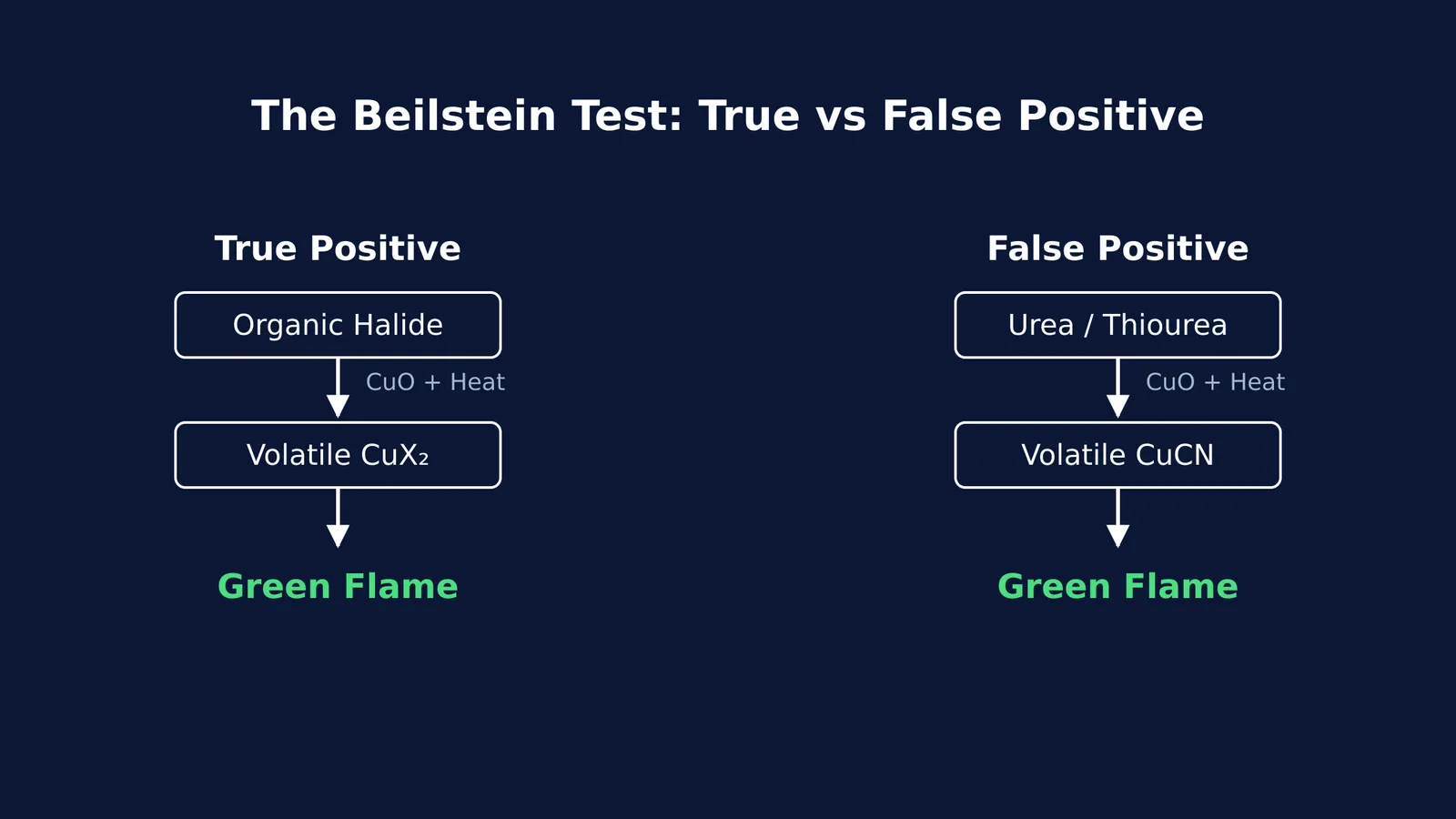
If the compound contains a halogen (chlorine, bromine, or iodine), the halogen reacts with the copper oxide to form a copper halide, such as copper(II) chloride. These copper halides are volatile. As they vaporise in the heat of the flame, the excited copper atoms emit light, creating a characteristic green or blue-green flame.
Why are organic halides important to detect?
Organic compounds containing halogens are widely used as solvents, medicines, and agricultural chemicals. Because they can have significant environmental and health impacts, identifying their presence is a critical first step in chemical analysis.
The Beilstein test was historically popular because it is fast and requires minimal equipment. A chemist only needed a copper wire and a Bunsen burner. Today, it is less common in professional laboratories because heating certain chlorinated compounds can generate toxic by-products. While modern labs rely on spectroscopic methods, the Beilstein test remains a classic teaching tool in exams.
Why do urea and thiourea give a green flame?
Urea (NH₂CONH₂) and thiourea (NH₂CSNH₂) do not contain halogens, yet they produce the same green flame.
The confusion happens because of the elements they do contain: carbon and nitrogen. When urea or thiourea is heated intensely on the oxidised copper wire, it decomposes. Urea gives a false positive in the Beilstein test because it reacts with copper to form volatile copper cyanide, which also colours the flame green.
Like the copper halides, this cuprous cyanide is volatile at high temperatures. It vaporises into the flame and emits the same green light, perfectly mimicking a positive result for a halogen. Other nitrogen-rich compounds, such as pyridine and quinoline derivatives, can also form volatile copper-cyanide complexes and give false positives.
Does a green flame always mean a halogen is present?
No. Because it is prone to false positives from nitrogenous compounds and is extremely sensitive to trace impurities (like chloride from tap water or fingerprints), a positive Beilstein test is only a preliminary clue. It is not definitive proof.
If you are running these tests in the lab, you can use this decision checklist to interpret a Beilstein result:
Negative (no green flame): Chlorine, bromine, and iodine are absent. (Fluorine may still be present).
Faint green flame: Likely a false positive from a trace impurity. Use distilled water and clean equipment.
Strong green flame: A halogen is likely present, but it could be a nitrogenous compound like urea or pyridine. You must run a confirmatory test.
If you are navigating these edge cases in your revision, the Fermi Concept Library has every concept in physics, chemistry, biology, mathematics and computing, each with its own lesson and its place in the map.
How do you confirm the presence of a halogen?
To be certain, chemists follow up with Lassaigne's test. The sodium fusion test is used to definitively convert organic halogens into inorganic salts for detection.
In this test, the organic sample is heated strongly with sodium metal. This harsh treatment destroys the organic molecule and converts any covalently bonded halogens into inorganic sodium halides (NaCl, NaBr, NaI).
You then dissolve the fused mixture in water and add silver nitrate (AgNO₃). If a halogen was present, a silver halide precipitates out (white for chloride, pale yellow for bromide, yellow for iodide). This wet test is specific and does not give a false positive for urea.
Understanding how one test can fool you and how another confirms the truth is a staple of organic chemistry, just like mastering the Carbylamine test: detecting primary amines by the isocyanide smell, the Iodoform test: spotting which compounds give the yellow solid, and Tollens' and Fehling's tests: which carbonyl compounds pass them.


