On this page
Eight new JEE Advanced-style modern physics questions, easy to hard, each with a worked solution and the trap a hurried student falls into.
The official JEE (Advanced) 2026 syllabus covers radioactive decay, α, β and γ radiations, binding energy, the photoelectric effect, Bohr's theory of hydrogen-like atoms, X-rays with Moseley's law, and de Broglie waves. Every question stays inside it. Start with our guide on how to prepare modern physics for JEE Advanced.
How should you use this practice set?
Allow 30 minutes.
Cover each solution and answer first.
Each question is labelled: single-correct, one or more options correct, or numerical-value.
Judge every option of a "one or more" question on its own; our guide to JEE Advanced question types explains how these formats work.
Constants: hc = 1240 eV nm from the NIST Planck constant in eV s, 13.6 eV for hydrogen's ground state from the NIST Rydberg energy, and an alpha particle's rest energy of 3727 MeV from NIST.
Easy: decay, radiations and Moseley's law
Q1 (easy, single-correct). Nuclides X (half-life 2 h) and Y (half-life 3 h) have equal activities at t = 0. What is the ratio of the number of X nuclei to Y nuclei at t = 6 h?
(A) 1/2 (B) 1/3 (C) 2/3 (D) 3/4
Answer: (B). A = λN, so equal activities mean N ∝ T½: initially N_X/N_Y = 2/3. In 6 h, X falls by 1/8 and Y by 1/4. N_X/N_Y = (2/3)(1/8)/(1/4) = 1/3. Trap: (A) is the activity ratio; the samples started with different numbers of nuclei.
Q2 (easy, one or more options correct). Which statements are correct?
(A) In β⁻ decay, A is unchanged and Z rises by 1. (B) α emission from a heavy nucleus with N > Z lowers its N/Z ratio. (C) γ emission changes neither A nor Z. (D) The electrons emitted in β⁻ decay have a continuous range of kinetic energies up to a maximum.
Answer: (A), (C), (D). (B) fails: removing 2 protons and 2 neutrons raises N/Z when N > Z: uranium-238 goes from 146/92 = 1.587 to 144/90 = 1.600. Trap: ticking (B) because "losing neutrons" sounds like a lower ratio.
Q3 (easy, numerical-value). The Kα wavelength of element X is one quarter of copper's (Z = 29). Find the atomic number of X.
Answer: 57. Moseley's law: 1/λ ∝ (Z − 1)². A quarter of the wavelength means four times (Z − 1)², so Z − 1 = 2 × 28 = 56 and Z = 57. Trap: using Z instead of Z − 1 gives 58.
Medium: hydrogen-like ions, stopping potential, two decay routes
Q4 (medium, one or more options correct). In a hydrogen-like ion, the n = 6 → 3 transition emits the same wavelength as hydrogen's n = 2 → 1 transition. Then
(A) Z = 3. (B) the ion's ground-state ionisation energy is about 122 eV. (C) the ion's n = 6 orbit has the same radius as hydrogen's n = 2 orbit. (D) the electron's speed in the ion's n = 3 orbit equals its speed in hydrogen's ground state.
Answer: (A), (B), (D). Z²(1/9 − 1/36) = 1 − 1/4 gives Z² = 9, so Z = 3 and the ionisation energy is 9 × 13.6 = 122.4 eV. Radius ∝ n²/Z: 12 Bohr radii against 4, so (C) fails. Speed ∝ Z/n: 3/3 = 1/1, so (D) holds. Trap: rejecting (D) by comparing n alone.
Q5 (medium, single-correct). Light on a metal is changed from 400 nm to 300 nm. By how much does the stopping potential rise?
(A) 12.4 V (B) 4.13 V (C) 1.03 V (D) It cannot be found without the work function
Answer: (C). eV₀ = hc/λ − φ, so φ cancels in the difference: ΔV = 1240(1/300 − 1/400) = 1.03 V. Trap: (D) misses that φ cancels; (A) uses 1240/(400 − 300).
Q6 (medium, numerical-value). A nuclide decays by α emission with a partial half-life of 30 min and by β⁻ emission with a partial half-life of 60 min. After how many minutes has 87.5% of a sample decayed?
Answer: 60. Decay constants add: λ = ln 2 (1/30 + 1/60) = ln 2/20 per minute, an effective half-life of 20 min. Leaving 1/8 takes three half-lives: 60 min. Trap: averaging the half-lives to 45 min gives 135.
Hard: alpha recoil and a decay chain
Q7 (hard, one or more options correct). A nucleus with A = 220 at rest emits an α particle, releasing Q = 6.40 MeV. Take masses as A u, the α rest energy as 3727 MeV and hc = 1240 MeV fm. Then
(A) the α particle's kinetic energy is about 6.28 MeV. (B) the α particle and the daughter have de Broglie wavelengths in the ratio 54 : 1. (C) the α particle's de Broglie wavelength is about 5.7 fm. (D) the α particle carries away all 6.40 MeV.
Answer: (A), (C). Equal momenta split Q inversely with mass: K_α = 6.40 × 216/220 = 6.28 MeV; the daughter takes 116 keV. Equal momenta give equal wavelengths, so (B) fails. pc = √(2 × 3727 × 6.28) = 216 MeV, so λ = 1240/216 = 5.7 fm. Trap: (D) ignores recoil.
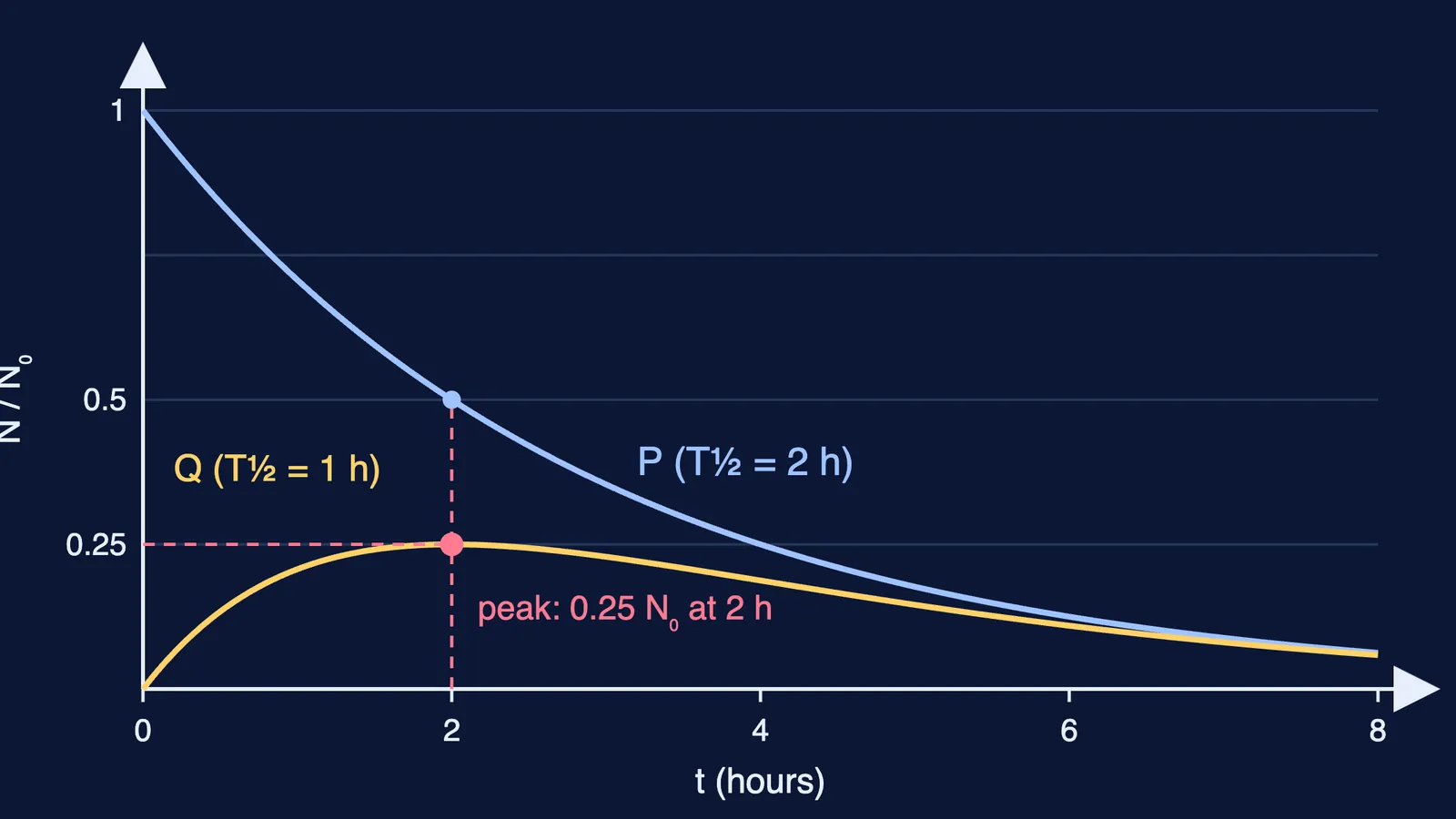
Q8 (hard, numerical-value). Nuclide P (half-life 2 h) decays to Q (half-life 1 h), which decays to a stable product. At t = 0 there are N₀ nuclei of P and none of Q. What is the largest number of Q nuclei present at any time, as a percentage of N₀?
Answer: 25. Solving dN_Q/dt = λ_P N_P − λ_Q N_Q gives N_Q = N₀ λ_P/(λ_Q − λ_P) × (e^(−λ_P t) − e^(−λ_Q t)). N_Q peaks when λ_P N_P = λ_Q N_Q, at t = ln(λ_Q/λ_P)/(λ_Q − λ_P) = 2 h. Then N_P = N₀/2, so N_Q = N_P/2 = N₀/4, which is 25%. Trap: setting N_Q = N_P at the peak gives 50.
What should you do after this set?
Decay-law slips (Q1, Q6, Q8): write N(t) and A(t) before any ratio. Bohr and photoelectric slips (Q4, Q5): write each scaling law with its powers of Z and n. Recoil (Q7): momentum before energy.
For more practice, the Fermi Problem Library has worked problems with a step-by-step solver that explains the reasoning rather than printing an answer.