On this page
Modern physics in JEE (Advanced) is a short topic list with long problems. Here is the official list, what JEE Main leaves out, three original worked examples and a plan.
What is in the JEE Advanced modern physics syllabus?
The official JEE (Advanced) 2026 syllabus lists: "Atomic nucleus; α, β and γ radiations; Law of radioactive decay; Decay constant; Half-life and mean life; Binding energy and its calculation; Fission and fusion processes; Energy calculation in these processes. Photoelectric effect; Bohr's theory of hydrogen-like atoms; Characteristic and continuous X-rays, Moseley's law; de Broglie wavelength of matter waves."
It is unchanged from 2025. The 2027 syllabus is not published yet (as of 19 November 2026), so plan with the 2026 list. The JEE (Advanced) website says the 2027 exam is on 23 May 2027 (Sunday), organised by IIT Delhi, and the eligibility page requires, among other criteria, a place in the top 2,50,000 of the JEE (Main) 2027 B.E./B.Tech. paper.
What does JEE Advanced add beyond JEE Main?
The JEE (Main) 2027 syllabus covers Bohr's model, the photoelectric effect, de Broglie, binding energy, fission and fusion. It does not list α, β and γ radiations, radioactive decay, half-life and mean life, characteristic and continuous X-rays, or Moseley's law. Add those. If you used our guides to Atoms and Nuclei for JEE Main and Dual Nature of Matter for JEE Main, build on them.
The 2026 Information Brochure describes two compulsory papers, but question types and marking change each year and are announced in the paper itself; see our guide to JEE Advanced question types. Prepare for multiple-correct options, numerical answers and problems joining two or three ideas, in whatever format the paper uses.
How do you solve multi-concept modern physics problems?
We use hc = 1239.84 eV nm from the NIST Planck constant, the Rydberg energy, 13.6057 eV, and the electron rest energy, 0.511 MeV.
Example 1: Bohr, photoelectric effect, de Broglie. In Li²⁺ (Z = 3) an electron drops from n = 3 to n = 2, and the photon hits a metal of work function 4.50 eV. Find the stopping potential and the fastest photoelectron's de Broglie wavelength.
Photon: E = 13.6057 × 3² × (1/4 − 1/9) = 17.01 eV.
Kmax = 17.01 − 4.50 = 12.51 eV, so the stopping potential is 12.5 V.
de Broglie: λ = hc / √(2mₑc²K) = 1239.84 / √(2 × 511 000 × 12.51) = 0.347 nm.
Trap: using Z instead of Z² gives 5.67 eV. Check: Z = 1 must give hydrogen's 1.89 eV line.
Example 2: made and decaying at once. A cyclotron makes a nuclide at a steady 2.0 × 10⁹ nuclei per second; its half-life is 20 min. Find the activity after 60 min, the nuclei present then, and the time after production stops for activity to reach 1.0 × 10⁸ Bq.
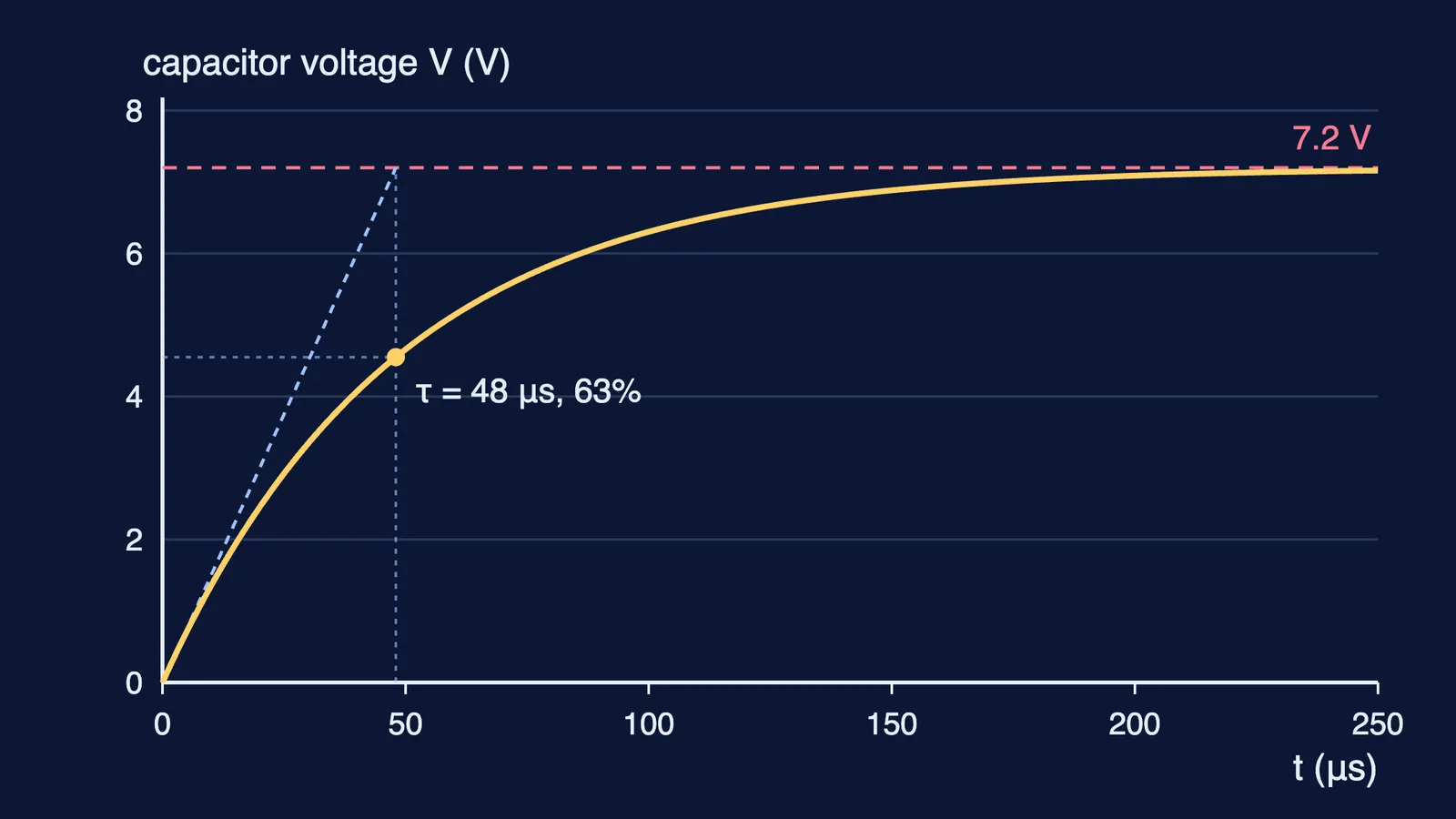
dN/dt = R − λN gives A = R(1 − e^(−λt)). After three half-lives, A = 2.0 × 10⁹ × 7/8 = 1.75 × 10⁹ Bq.
λ = ln 2 / 1200 s = 5.78 × 10⁻⁴ s⁻¹, so N = A/λ = 3.03 × 10¹².
Then A halves every 20 min: t = 20 × log₂(17.5) = 82.6 min.
Limiting case: as t → ∞, A → R, never above it.
Example 3: X-rays and Moseley's law. A tube runs at 25 kV and the target's Kα line is at 0.194 nm. Identify the target, the cut-off wavelength, and what doubling the voltage changes.
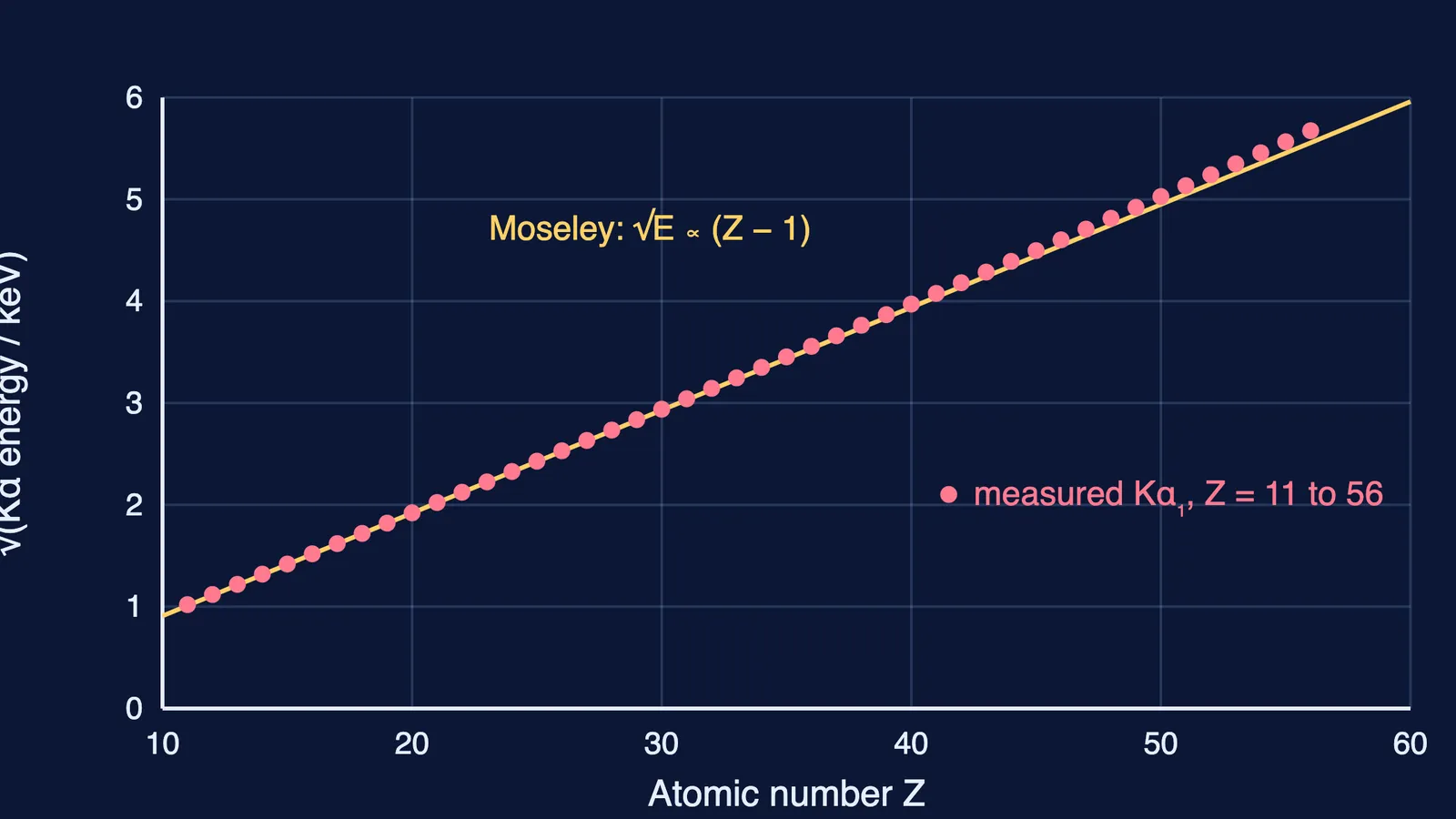
Kα energy = 1239.84 / 0.194 = 6391 eV. With E = (3/4)(13.6057 eV)(Z − 1)², (Z − 1)² = 626, so Z = 26: iron.
λmin = hc/eV = 1239.84 / 25 000 = 0.0496 nm.
At 50 kV, λmin halves to 0.0248 nm; Kα stays at 0.194 nm. Voltage sets the cut-off; the target sets the lines.
Which traps cost marks in modern physics?
Bohr energies use Z²; Moseley's law for Kα uses (Z − 1)².
Mean life = half-life / ln 2, not the half-life.
In fission and fusion, include emitted neutrons before taking the mass difference.
How should you plan JEE Advanced modern physics practice?
Week 1: radioactive decay and X-rays. Derive A = R(1 − e^(−λt)) yourself.
Week 2: Bohr and photoelectric problems for hydrogen-like ions.
Week 3: binding energy, fission and fusion energy from given masses.
Week 4: timed mixed sets; name the failed step in every wrong answer.
Not sure which step broke? The Fermi Problem Library has worked problems with a step-by-step solver that explains the reasoning rather than printing an answer.
Practise with these originals:
An electron in Be³⁺ (Z = 4) is in n = 2. Find its de Broglie wavelength. Answer: r = a₀n²/Z equals the Bohr radius, 0.0529 nm, so λ = 2πr/n = 0.166 nm.
A nuclide's mean life is 10 days. What fraction survives 10 days, and what is the half-life? Answer: 1/e (about 0.368); 6.93 days.