On this page
These eight new questions cover practical chemistry for JEE Main, easy to hard, each with a worked solution and the trap a rushed student falls into. They stay inside Unit 20, Principles Related to Practical Chemistry, of the official JEE (Main) 2027 syllabus from NTA. Answers follow the NCERT lab manuals. New here? Start with our guide on how to prepare practical chemistry for JEE Main.
How should you use this practice set?
The JEE (Main) 2027 information bulletin gives Chemistry 20 multiple-choice questions (Section A) and 5 numerical-value questions (Section B), with +4 for a correct answer and −1 for a wrong one in both.
Allow 16 minutes, about two a question.
Commit to an option and a reason before reading the solution.
Q5 and Q6 are numerical: give the nearest integer.
For every miss, note the trap in your own words.
If a method keeps slipping, the Fermi Problem Library has worked problems with a step-by-step solver that explains the reasoning rather than printing an answer.
Easy: can you read a salt analysis observation?
Q1 (easy). A salt solution gives no precipitate with dilute HCl or H₂S in dilute HCl. With solid NH₄Cl and excess NH₄OH it gives a white gelatinous precipitate. Dissolved in dilute HCl, it gives a floating blue mass with blue litmus and NH₄OH. The cation is
(A) Zn²⁺ (B) Mg²⁺ (C) Al³⁺ (D) Pb²⁺
Answer: (C). NH₄OH with NH₄Cl is the Group III reagent; white Al(OH)₃ adsorbing litmus as a blue "lake" confirms Al³⁺ (NCERT Class 12 lab manual, Unit 7). Trap: (A) Zn²⁺ precipitates white too, but later, as ZnS in Group IV.
Q2 (easy). Which statement about titrations with KMnO₄ is correct?
(A) Dilute HCl is preferred as it is not an oxidant.
(B) Mohr's salt solution is warmed to 50–60 °C first.
(C) No indicator is added; the first permanent light pink is the end point.
(D) Dilute HNO₃ can replace dilute H₂SO₄.
Answer: (C). A slight excess of KMnO₄ is pink, so it is a self-indicator (NCERT Class 12 lab manual, Unit 6). KMnO₄ oxidises HCl to chlorine, and HNO₃ is itself an oxidant. Trap: (B) is the oxalic acid step; Mohr's salt reacts fast cold, and heat lets air oxidise Fe²⁺. See why the oxalic acid titration starts slowly.
Q3 (easy). Heated with conc. H₂SO₄, a salt gives reddish-brown fumes that thicken with MnO₂. Its water extract with chloroform and excess chlorine water gives a brown organic layer. The anion is
(A) NO₃⁻ (B) I⁻ (C) Br⁻ (D) Cl⁻
Answer: (C). Chlorine frees bromine, which turns chloroform brown (NCERT Class 12 lab manual, Table 7.4); iodide would turn it violet. Trap: (A) nitrate's brown fumes thicken with copper turnings, not MnO₂, and give no coloured layer.
Medium: can you turn a test into a structure or a number?
Q4 (medium). Compound X gives a yellow-orange precipitate with 2,4-DNP, no silver mirror with Tollens' reagent, and yellow iodoform with iodine and NaOH. X is
(A) 3-methylbutanal (B) pentan-3-one (C) 3-methylbutan-2-ol (D) 3-methylbutan-2-one
Answer: (D). 2,4-DNP marks a carbonyl; negative Tollens' rules out an aldehyde (NCERT Class 12 lab manual, Unit 8); iodoform needs CH₃CO– (or CH₃CH(OH)–, oxidised to it). Only CH₃COCH(CH₃)₂ passes all three. Trap: (C) gives iodoform but has no C=O. The haloform mechanism shows why (B) fails.
Q5 (medium, numerical). 20.0 mL of 0.0450 M oxalic acid, warmed with dilute H₂SO₄, is titrated with 0.0200 M KMnO₄. Find the end-point volume of KMnO₄ in mL (nearest integer).
Answer: 18. From the NCERT Class 12 lab manual: 2MnO₄⁻ + 5C₂O₄²⁻ + 16H⁺ → 2Mn²⁺ + 10CO₂ + 8H₂O. Oxalic acid = 20.0 × 0.0450 = 0.900 mmol, so MnO₄⁻ = 0.900 × 2/5 = 0.360 mmol and V = 0.360 ÷ 0.0200 = 18.0 mL. Trap: a 1:1 ratio gives 45.
Q6 (medium, numerical). 50.0 mL of water at 45.0 °C is poured into 50.0 mL of water at 25.0 °C in a beaker; the mixture settles at 34.5 °C. Taking density × heat capacity of water as 4.184 J mL⁻¹ K⁻¹, find the beaker's calorimeter constant W in J K⁻¹ (nearest integer).
Answer: 22. By the method of mixtures (NCERT Class 12 lab manual, Unit 3), heat lost by hot water = heat gained by cold water and beaker. Lost: 4.184 × 50.0 × 10.5 = 2196.6 J. Cold water gained 4.184 × 50.0 × 9.5 = 1987.4 J. The beaker took 209.2 J = W × 9.5, so W = 22.0 J K⁻¹. Trap: dividing by the 10.5 K drop gives 20; the beaker warms with the cold water.
Hard: can you chain several observations or runs?
Q7 (hard). A salt gives these results:
Dilute H₂SO₄: no gas. BaCl₂: no precipitate.
Conc. H₂SO₄ and fresh FeSO₄: a dark brown ring.
Groups I to III: no precipitate. H₂S in ammoniacal solution: black precipitate, which dissolved in aqua regia gives bright red with dimethylglyoxime.
The salt is
(A) Zn(NO₃)₂ (B) Ni(NO₂)₂ (C) NiSO₄ (D) Ni(NO₃)₂
Answer: (D). Black Group IV sulphide plus red dimethylglyoxime is Ni²⁺ (Zn²⁺ gives white ZnS); the brown ring is nitrate, and no BaCl₂ precipitate rules out sulphate (NCERT Class 12 lab manual, Unit 7). Trap: (B) ignores line one: nitrite gives brown fumes with dilute H₂SO₄.
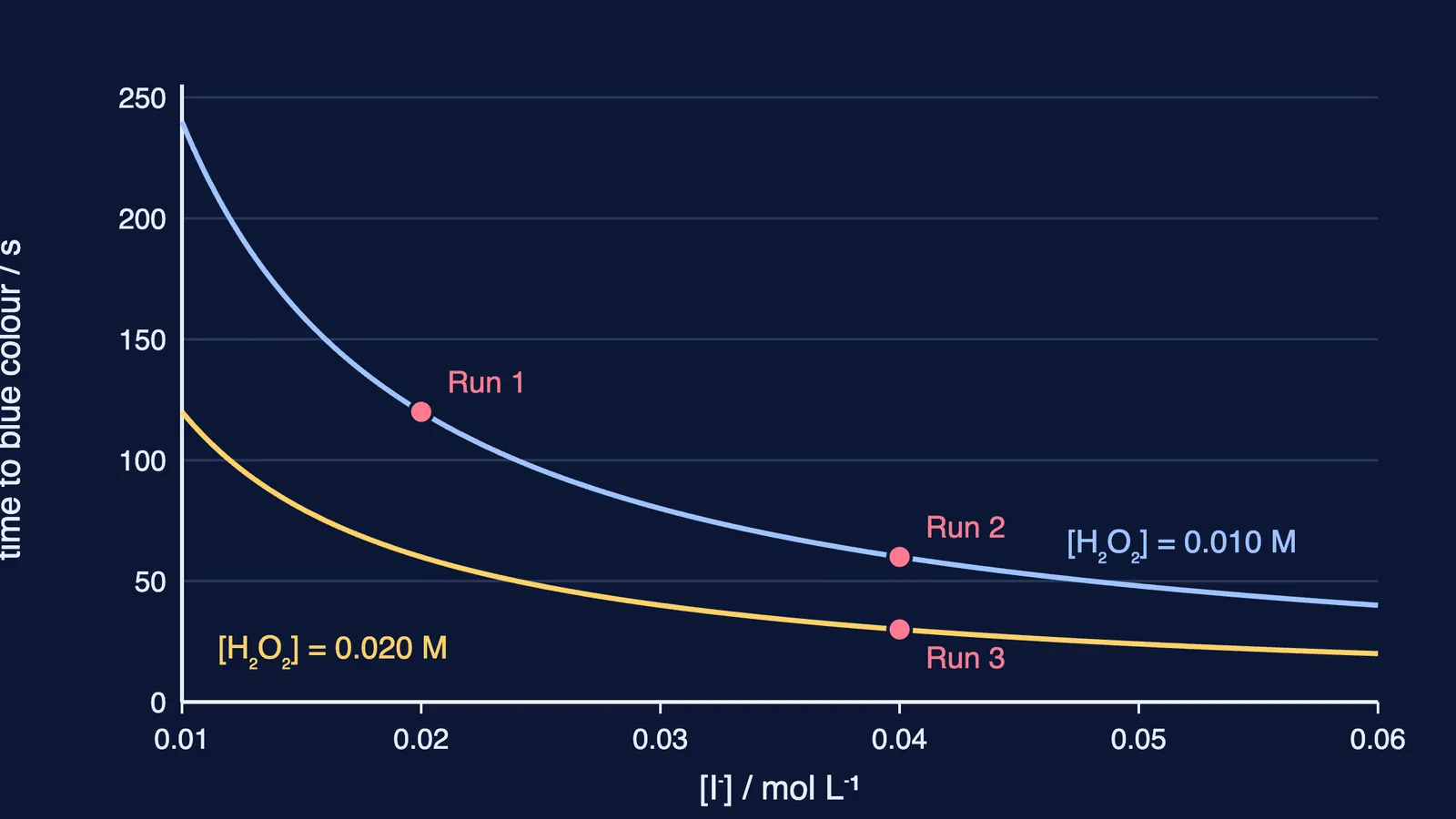
Q8 (hard). In the iodide–hydrogen peroxide clock experiment (with thiosulphate and starch), t is the time for the blue colour. Same thiosulphate and temperature each time:
Run 1: [I⁻] = 0.020 M, [H₂O₂] = 0.010 M, t = 120 s
Run 2: [I⁻] = 0.040 M, [H₂O₂] = 0.010 M, t = 60 s
Run 3: [I⁻] = 0.040 M, [H₂O₂] = 0.020 M, t = 30 s
In Run 4, [I⁻] = 0.030 M, [H₂O₂] = 0.015 M, with thiosulphate doubled. Taking the rate as constant until the colour appears, t is about
(A) 53 s (B) 80 s (C) 107 s (D) 270 s
Answer: (C). Blue appears once a fixed amount of thiosulphate is used up (NCERT Class 12 lab manual, Unit 2), so rate ∝ 1/t. Doubling either [I⁻] or [H₂O₂] halves t: first order in each. Run 4 is 1.5 × 1.5 = 2.25 times faster than Run 1: 53.3 s for equal thiosulphate, 107 s for double. Trap: (A) forgets the doubled thiosulphate; (D) treats t as the rate.
Missed Q1, Q3 or Q7? Rewrite the group table from memory.