On this page
These eight original questions follow the four topics the official JEE (Advanced) 2026 syllabus lists for differential equations: formation, homogeneous equations of first order and first degree, separation of variables, and linear first-order equations. Each is labelled by type, and every answer and option was checked with Python (sympy).
How to use this set
Attempt all eight on paper with a 30-minute timer, without opening a solution.
For multiple-correct questions, test every option on its own. Mark only what you have proved.
Check each answer by putting it back into the equation and the initial condition.
Read the trap line even when you were right. It names a common mistake.
If any method feels new, start with our guide on how to prepare differential equations for JEE Advanced, then come back. For how multiple-correct and numerical questions work, see JEE Advanced question types.
Easy: can you separate and integrate cleanly?
Q1 (easy, single correct). A curve satisfies (1 + x²) dy/dx = xy with y(0) = 2. Then y(√3) equals:
(A) 8 (B) 4 (C) 2e^(π/3) (D) 3
Answer: (B). Separate: dy/y = x dx/(1 + x²), so ln y = ½ ln(1 + x²) + C. With y(0) = 2, y = 2√(1 + x²), and y(√3) = 2 × 2 = 4. Trap: (A) drops the ½ in front of the logarithm; (C) integrates x/(1 + x²) as an inverse tangent.
Q2 (easy, numerical value). For x > 0, x dy/dx − 2y = x⁴ and y(1) = 0. Find y(2).
Answer: 6. Divide by x: dy/dx − (2/x)y = x³. The integrating factor is 1/x², so (y/x²)′ = x and y/x² = x²/2 + C. Then C = −1/2 and y = x²(x² − 1)/2, so y(2) = 6. Trap: dividing only the left side by x leaves x⁴ on the right and gives 28/3.
Medium: which substitution or condition does the question hide?
Q3 (medium, single correct). For x ≥ 1, x dy/dx = y + x e^(−y/x) with y(1) = 0. Then y(e) is:
(A) e ln 2 (B) ln 2 (C) e (D) e ln(1 + e)
Answer: (A). Put y = vx: v + xv′ = v + e^(−v), so e^v dv = dx/x and e^v = ln x + 1. Hence y = x ln(1 + ln x) and y(e) = e ln 2. Trap: (B) is v(e); you must multiply back by x. The formula is valid only for x > 1/e, where 1 + ln x > 0.
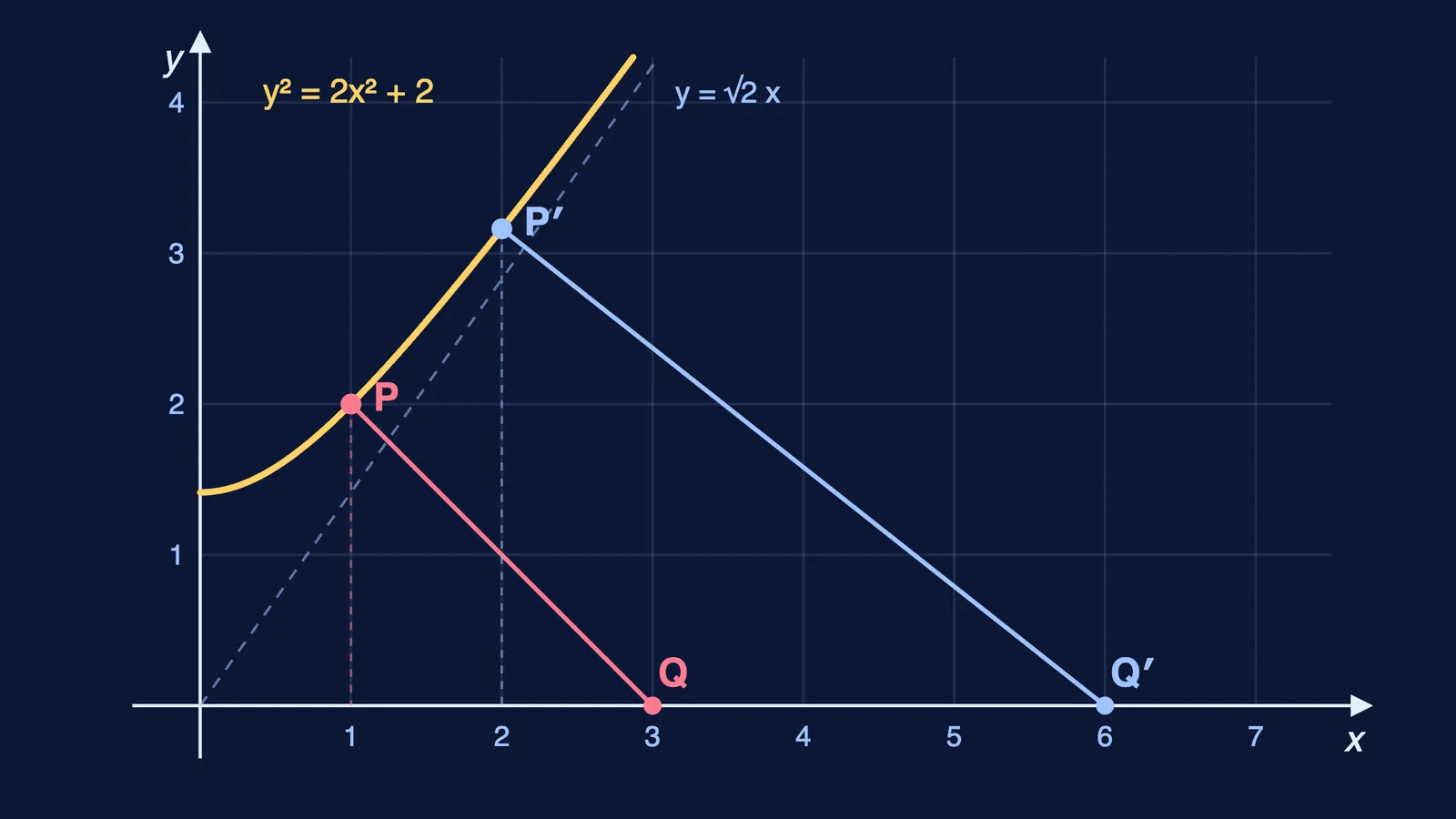
Q4 (medium, one or more options correct). A curve y = f(x), x > 0, y > 0, passes through P(1, 2). The normal at every point (x, y) meets the x-axis at (3x, 0). Which are correct?
(A) The curve lies on a hyperbola of eccentricity √3. (B) The slope of the curve at P is 1. (C) f(√7) = 4. (D) The line y = √2 x is an asymptote of the curve.
Answer: (B), (C), (D). The normal meets the x-axis at x + y dy/dx, so x + yy′ = 3x, giving yy′ = 2x and y² = 2x² + 2. At P, y′ = 2x/y = 1. f(√7) = √16 = 4. Also f(x) − √2 x tends to 0 as x grows. The hyperbola y²/2 − x² = 1 has e = √(1 + 1/2) = √6/2. Trap: (A) takes b²/a² as 2 instead of 1/2.
Q5 (medium, numerical value). A continuous function f satisfies f(x) = sin x + ∫₀ˣ f(t) dt for all real x. Find 2f(π) − e^π.
Answer: 1. Differentiate: f′ = cos x + f. Putting x = 0 in the given equation gives f(0) = 0. With integrating factor e^(−x), f(x) = (eˣ + sin x − cos x)/2, so 2f(π) = e^π + 1. Trap: skipping the f(0) = 0 step leaves an unknown constant.
Hard: can you carry the solution into another chapter?
Q6 (hard, one or more options correct). Let (1 + x²) dy/dx + 2xy = 4x², with y(0) = 0. Which are correct?
(A) y is an odd function. (B) y = 4x/3 is an asymptote of the curve. (C) y has a local maximum at some x > 0. (D) ∫₀¹ y dx = (2/3)(1 − ln 2).
Answer: (A), (B), (D). The left side is the derivative of (1 + x²)y, so y = 4x³/(3(1 + x²)). This is odd. Since y − 4x/3 = −4x/(3(1 + x²)), which tends to 0, (B) holds. y′ = 4x²(x² + 3)/(3(1 + x²)²) ≥ 0, so y never turns down and (C) fails. Writing y = (4/3)(x − x/(1 + x²)) and integrating gives (D). Trap: y′ = 0 at x = 0 is a point of inflection, not an extremum.
Q7 (hard, numerical value). A positive continuous f on [0, 2) has f(0) = 1 and f(1) = 4, and for every x, ∫₀ˣ f(t) dt = x√f(x). Find f(3/2).
Answer: 16. Let u = √f. Differentiating, u² = u + xu′, so du/(u(u − 1)) = dx/x and (u − 1)/u = kx. f(1) = 4 gives u = 2 and k = 1/2, so f(x) = 4/(2 − x)². Then f(3/2) = 16. Check: ∫₀^(3/2) f dt = 6 = (3/2)(4). Trap: f(0) = 1 holds for every k, so only f(1) = 4 fixes k.
Q8 (hard, single correct). A differentiable f satisfies f(x + y) = f(x)e^(2y) + f(y)e^(2x) for all real x, y, and f′(0) = 3. The minimum value of f is:
(A) −3/(2e) (B) −3/e (C) −1/(2e) (D) f has no minimum
Answer: (A). Putting x = y = 0 gives f(0) = 0. From the definition of the derivative, f′(x) = 2f(x) + 3e^(2x). With integrating factor e^(−2x), f(x) = 3x e^(2x). f′ = 3e^(2x)(1 + 2x) = 0 at x = −1/2, giving −3/(2e); f tends to 0 as x → −∞, so this is the minimum. Trap: (B) uses e^x for e^(2x), and (C) forgets f′(0) = 3.
Where should you go after this set?
Sort each mistake: wrong type (go back to spotting the type before you solve), algebra slip, or a missed condition.
For more problems at this level, the Fermi Problem Library has worked problems with a step-by-step solver that explains the reasoning rather than printing an answer.