On this page
Below: the official list, the JEE (Main) comparison, two solved problems and a plan.
What does the JEE Advanced syllabus say about differential equations?
The official JEE (Advanced) 2026 syllabus lists, under Integral Calculus: "Formation of ordinary differential equations, solution of homogeneous differential equations of first order and first degree, separation of variables method, linear first order differential equations."
It says it is unchanged from 2025. The 2027 syllabus is not yet published (as of 19 November 2026).
JEE (Advanced) 2027 will be held on 23 May 2027 (Sunday), organised by IIT Delhi, says the official JEE (Advanced) website. One eligibility criterion is being among the top 2,50,000 candidates in the B.E./B.Tech. paper of JEE (Main) 2027. JEE (Advanced) 2026 had two compulsory papers of three hours each (2026 Information Brochure). Question types and marking change from year to year; see JEE Advanced question types.
How is JEE Advanced different from JEE Main here?
The lists are close. Unit 9 of NTA's JEE (Main) 2027 syllabus covers order and degree, separation of variables, and homogeneous and linear equations of the type dy/dx + p(x)y = q(x). Only the Advanced list names formation of differential equations.
The real gap is depth. Advanced problems tend to:
start from a tangent, normal or area condition you must turn into an equation
end in another unit: a maximum, an area or a limit
hide a trap in where the solution exists
test several statements at once
If the basic types feel shaky, start with our guide to spotting the type before you solve and forming an equation by eliminating constants.
What do Advanced-level differential equation problems look like?
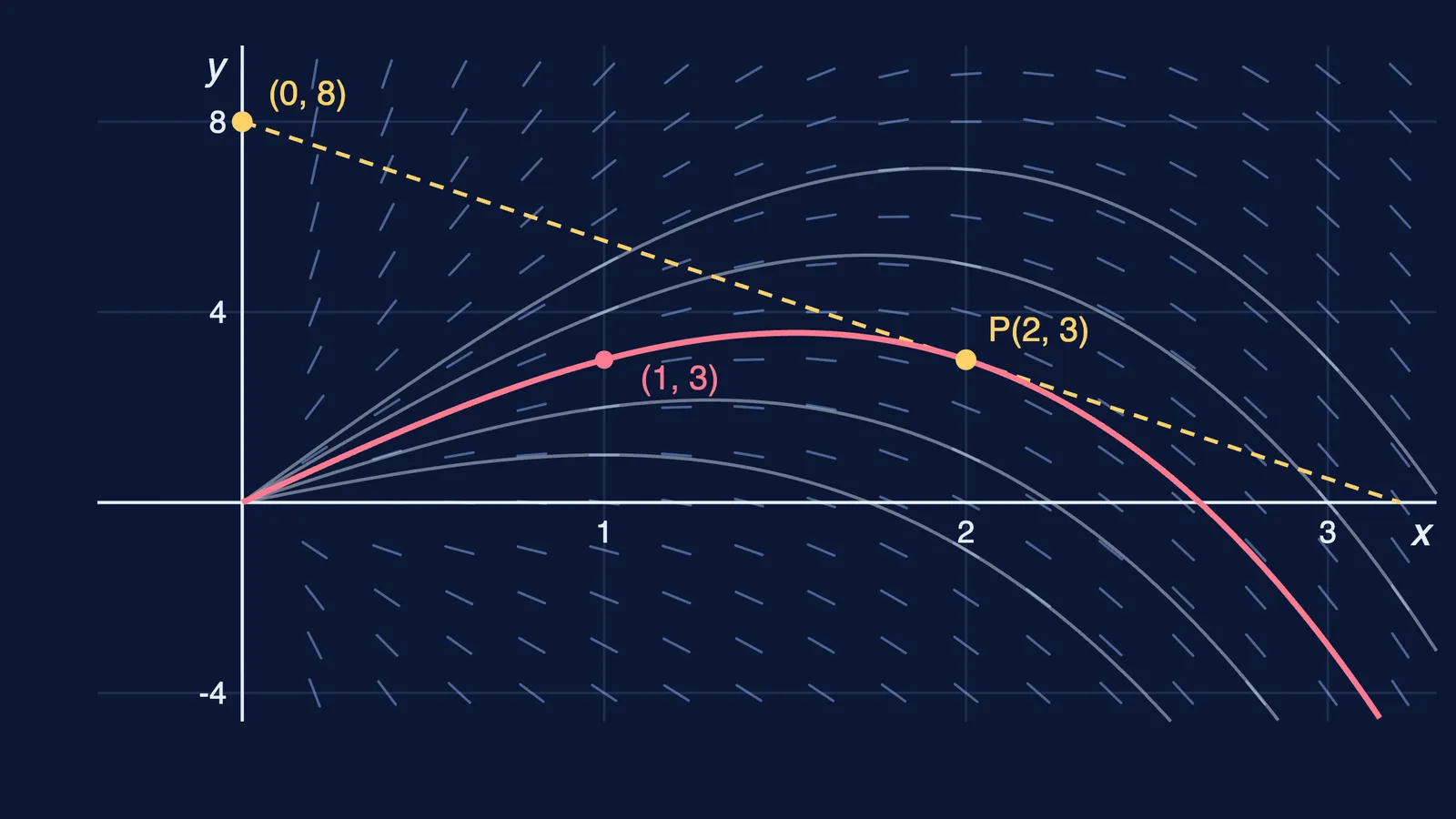
Example 1: formation plus linear, multiple correct. A curve y = f(x), x > 0, passes through (1, 3). The tangent at every point P(x, y) meets the y-axis at height x³. Which are true? (A) f(2) = 3. (B) The maximum value of f is 7√21/9. (C) The curve meets the x-axis at x = √7. (D) The area between the curve and the x-axis for 0 ≤ x ≤ √7 is 49/4.
Form the equation. The tangent is Y − y = y′(X − x); at X = 0 its height is y − xy′. So y − xy′ = x³.
This is linear: y′ − y/x = −x². With integrating factor 1/x, (y/x)′ = −x.
Integrate: y/x = −x²/2 + C. At (1, 3), C = 7/2, so f(x) = (7x − x³)/2.
f(2) = (14 − 8)/2 = 3. (A) is true.
f′(x) = (7 − 3x²)/2 = 0 at x = √(7/3), giving f = 7√21/9, about 3.56. (B) is true.
f(x) = 0 at x = √7. (C) is true.
The area is ∫(7x − x³)/2 dx from 0 to √7 = 49/8, not 49/4. (D) is false.
Answer: A, B and C. Check: at P(2, 3) the slope is −5/2, so the tangent meets the y-axis at 3 + 5 = 8 = 2³.
Example 2: homogeneous, numerical answer. Solve dy/dx = (y² + 3xy)/x² with y(1) = 1, and find y(3/2).
Put y = vx. Then v + xv′ = v² + 3v, so xv′ = v(v + 2).
Separate: (1/2)(1/v − 1/(v + 2)) dv = dx/x, so v/(v + 2) = Cx².
At x = 1, v = 1, so C = 1/3. Then v = 2x²/(3 − x²) and y = 2x³/(3 − x²).
y(3/2) = (27/4)/(3/4) = 9.
Answer: 9. The trap: this solution exists only for 0 < x < √3, since y blows up as x approaches √3. A statement such as "y(2) = −16" uses the formula outside its interval, so it is false. In multiple-correct questions, mark only options you have checked.
How should you practise differential equations for JEE Advanced?
Week 1: separable and homogeneous. Write the substitution and the interval of validity every time.
Week 2: linear. Find the integrating factor, then differentiate your product to check it.
Week 3: formation. Turn tangent, normal and area conditions into equations.
Week 4: mixed sets with maxima, areas and limits. Label every error by its cause.
Not sure which method a problem needs? The Fermi Problem Library has worked problems with a step-by-step solver that explains the reasoning rather than printing an answer.
Can you solve these practice questions?
Solve dy/dx = 6x²√y, y > 0, with y(0) = 1, and find y(1). Answer: y = (x³ + 1)², so y(1) = 4.
Solve x dy/dx + 2y = 3x, x > 0, with y(1) = 2, and find y(2). Answer: y = x + 1/x², so y(2) = 9/4.
Form the differential equation of the family y = Ae⁴ˣ + Be⁻ˣ. Answer: y″ − 3y′ − 4y = 0.