On this page
You are given a family of curves, say y = Aeˣ + Be⁻ˣ, and asked for the differential equation it satisfies. The job is to get rid of A and B. One rule makes this mechanical: differentiate as many times as there are arbitrary constants, then eliminate them.
Why do n arbitrary constants need n differentiations?
Think of the constants as unknowns you want to remove. The equation of the family is one equation, and each differentiation gives you one more. With n constants you need n + 1 equations: n of them to pin the constants down, and one left over. That leftover relation between x, y and the derivatives is your differential equation, and because you differentiated n times, its order is n.
The NCERT Class 12 textbook makes the same link from the other side. It calls the solution that contains arbitrary constants the general solution, and its Exercise 9.2 asks how many arbitrary constants the general solution of a fourth-order equation has (NCERT Mathematics Part II, Chapter 9). By the counting above, the answer is four.
One catch: count only essential constants. In y = Ae^(x+B) there seem to be two, but Ae^(x+B) = (Ae^B)eˣ, so there is really one. A single differentiation gives y′ = y. Differentiating twice gives a true equation, but of higher order than the question wants.
How do you eliminate A and B from y = Aeˣ + Be⁻ˣ?
Two constants, so differentiate twice.
Start: y = Aeˣ + Be⁻ˣ.
First derivative: y′ = Aeˣ − Be⁻ˣ.
Second derivative: y″ = Aeˣ + Be⁻ˣ.
Compare step 3 with step 1: the right-hand sides are identical, so y″ = y.
The answer is y″ − y = 0, order 2.
Stop after step 2 and the two equations only pin down A = (y + y′)e⁻ˣ/2 and B = (y − y′)eˣ/2, with no equation free of A and B left over. That is why the second differentiation is needed.
If it feels odd that eˣ survives differentiation unchanged, our visual explainer on why eˣ is its own derivative shows it on a graph.
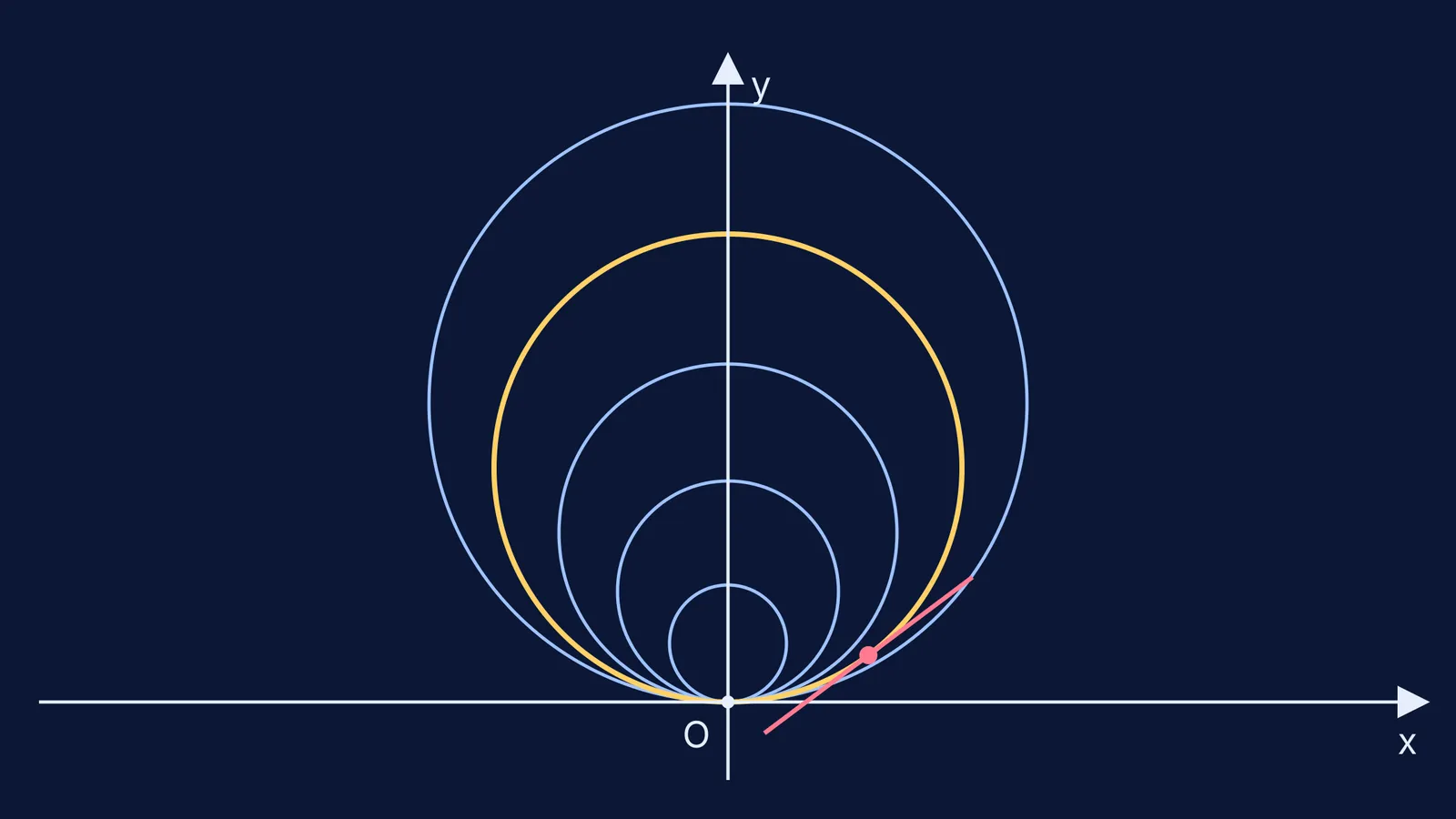
What is the differential equation of circles touching the x-axis at the origin?
A circle that touches the x-axis at O has its centre on the y-axis, at (0, a), and radius |a|. Its equation is x² + (y − a)² = a², which simplifies to x² + y² = 2ay. One constant, so differentiate once.
Differentiate: 2x + 2yy′ = 2ay′, so x + yy′ = ay′.
From the original equation, a = (x² + y²)/(2y).
Substitute: x + yy′ = y′(x² + y²)/(2y).
Multiply by 2y and collect the y′ terms: (x² − y²)y′ = 2xy.
Check it on the circle with a = 1 at the point (0.6, 0.2), which lies on x² + y² = 2y. The circle's own slope there is x/(1 − y) = 0.75, and the formula gives 2(0.6)(0.2)/(0.36 − 0.04) = 0.75. They match.
What if the circle can touch the x-axis anywhere?
Now the centre is (h, k) and the radius is |k|, so (x − h)² + (y − k)² = k². Two constants, so differentiate twice.
First derivative: (x − h) + (y − k)y′ = 0.
Second derivative: 1 + y′² + (y − k)y″ = 0, so y − k = −(1 + y′²)/y″.
From step 1: x − h = −(y − k)y′ = y′(1 + y′²)/y″.
From step 2: k = (yy″ + 1 + y′²)/y″.
Substitute all three into the circle equation and clear y″²: (1 + y′²)³ = (yy″ + 1 + y′²)².
It comes out second order, as the count predicted. Same test point: on the circle with centre (0, 1), at (0.6, 0.2), y′ = 0.75 and y″ = 1.5625/0.8 = 1.953125, and both sides come to about 3.81. For more on centres and radii, our post on the condition for two circles to touch works through it.
How should you practise this before a test?
Use the same four steps every time:
Count the essential constants first, merging any that combine, such as Ae^B or A + B.
Differentiate exactly that many times, writing each line in full.
Eliminate, by comparing equations (example 1) or by solving for a constant and substituting (example 2).
Test your answer on one specific member of the family.
A syllabus note: the 2026-27 NCERT reprint has no separate section on formation, and the JEE Main 2026 syllabus from NTA lists order and degree, separation of variables, and homogeneous and linear equations without naming it. Check your board's current syllabus.
For the reverse, solving an equation and fixing the constant from data, see our population growth differential equation problem.
If you get stuck at the elimination step, the Fermi Problem Library has worked problems with a step-by-step solver that explains the reasoning rather than printing an answer. For the background ideas, such as order, degree and general solutions, the Fermi Concept Library gives each concept its own lesson.