On this page
A question on whether two circles touch starts with one step: find both centres and radii, then compare one distance with two numbers. Here is the rule, the five cases it gives, and two worked examples.
What is the condition for two circles to touch?
Tangent circles are circles that meet at exactly one point, as Wolfram MathWorld's entry on tangent circles defines them.
Let the circles have centres C₁ and C₂, radii r₁ and r₂, and let d be the distance C₁C₂.
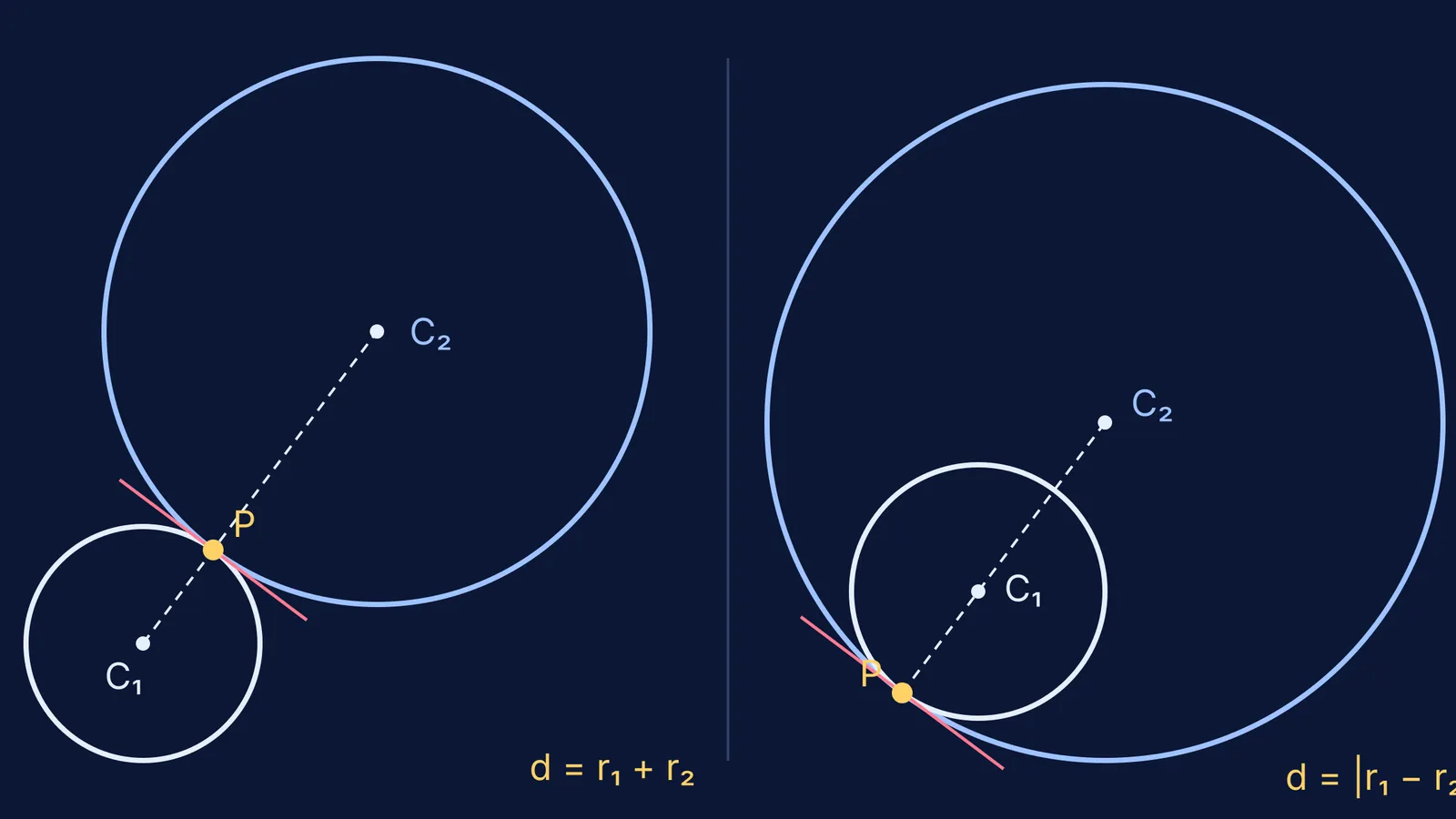
Touch externally: d = r₁ + r₂. The circles sit side by side.
Touch internally: d = |r₁ − r₂|. The smaller circle sits inside the larger one.
Both conditions are in the same MathWorld entry. NCERT's Class 11 chapter on conic sections finds a centre and radius by completing the square: its example x² + y² + 8x + 10y − 8 = 0 becomes (x + 4)² + (y + 5)² = 7², so the centre is (−4, −5) and the radius is 7. For x² + y² + 2gx + 2fy + c = 0, the same method gives centre (−g, −f) and radius √(g² + f² − c).
How do you compare d with r₁ + r₂ and |r₁ − r₂|?
d > r₁ + r₂: the circles are separate.
d = r₁ + r₂: they touch externally.
|r₁ − r₂| < d < r₁ + r₂: they cut at two points. MathWorld's circle-circle intersection page gives this condition.
d = |r₁ − r₂|: they touch internally.
d < |r₁ − r₂|: one circle lies wholly inside the other without meeting it.
Each case also fixes the number of common tangents; see common tangents of two circles: how many, and how long.
How do you find the point of contact of two touching circles?
The point of contact P always lies on the line through both centres, because the common tangent at P is perpendicular to each radius there (see why a tangent is perpendicular to the radius). Since C₁P = r₁ and C₂P = r₂, P splits C₁C₂ in the ratio r₁ : r₂.
External touch: P lies between the centres, so it divides C₁C₂ internally in the ratio r₁ : r₂.
Internal touch: P lies beyond the smaller centre, so it divides C₁C₂ externally in the ratio r₁ : r₂.
The section formula in NCERT Class 10, Chapter 7 gives the internal point as ((m₁x₂ + m₂x₁)/(m₁ + m₂), (m₁y₂ + m₂y₁)/(m₁ + m₂)). For external division, replace each plus sign with a minus.
Worked example 1: touching externally
Take S₁: x² + y² − 2x − 4y − 4 = 0 and S₂: x² + y² − 14x − 20y + 100 = 0.
S₁ has centre (1, 2) and radius √(1 + 4 + 4) = 3.
S₂ has centre (7, 10) and radius √(49 + 100 − 100) = 7.
d = √(6² + 8²) = 10, and r₁ + r₂ = 3 + 7 = 10. They touch externally.
P divides (1, 2) to (7, 10) internally in the ratio 3 : 7: x = (3·7 + 7·1)/10 = 2.8 and y = (3·10 + 7·2)/10 = 4.4.
Worked example 2: touching internally
Keep S₁ and take S₂: x² + y² − 8x − 12y − 12 = 0.
S₂ has centre (4, 6) and radius √(16 + 36 + 12) = 8.
d = √(3² + 4²) = 5, and |r₁ − r₂| = |3 − 8| = 5. They touch internally.
P divides (1, 2) to (4, 6) externally in the ratio 3 : 8: x = (3·4 − 8·1)/(3 − 8) = −0.8 and y = (3·6 − 8·2)/(3 − 8) = −0.4.
That S₁ − S₂ line is the radical axis of the two circles; our post on the radical axis explains why subtracting the equations works.
What mistakes cost marks on these questions?
Reading off g, f and c before making the x² and y² coefficients 1.
Dropping the modulus in |r₁ − r₂|.
Using internal division for an internal touch, where P lies outside the segment C₁C₂.
Stopping at "they touch" when the question wants the point of contact.
If you get the comparison right but lose the thread in the algebra, the Fermi Problem Library has worked problems with a step-by-step solver that explains the reasoning rather than printing an answer. If the trouble starts earlier, with completing the square or the section formula, revise it in the Fermi Concept Library, where each concept has its own lesson.
Try one yourself: change S₂'s constant in example 1 and predict, before calculating, which case you land in.