On this page
Lay a ruler against a circle so it touches at one point, then join that point to the centre. The angle is always 90°. In the NCERT Class 10 textbook used for CBSE, this is Theorem 10.1, and many of the chapter's tangent questions depend on it.
Why is a tangent perpendicular to the radius?
A tangent to a circle is a line that meets the circle at exactly one point, as defined in the NCERT Class 10 chapter on circles. The same chapter states Theorem 10.1: the tangent at any point of a circle is perpendicular to the radius through the point of contact.
NCERT's proof is a shortest-distance argument:
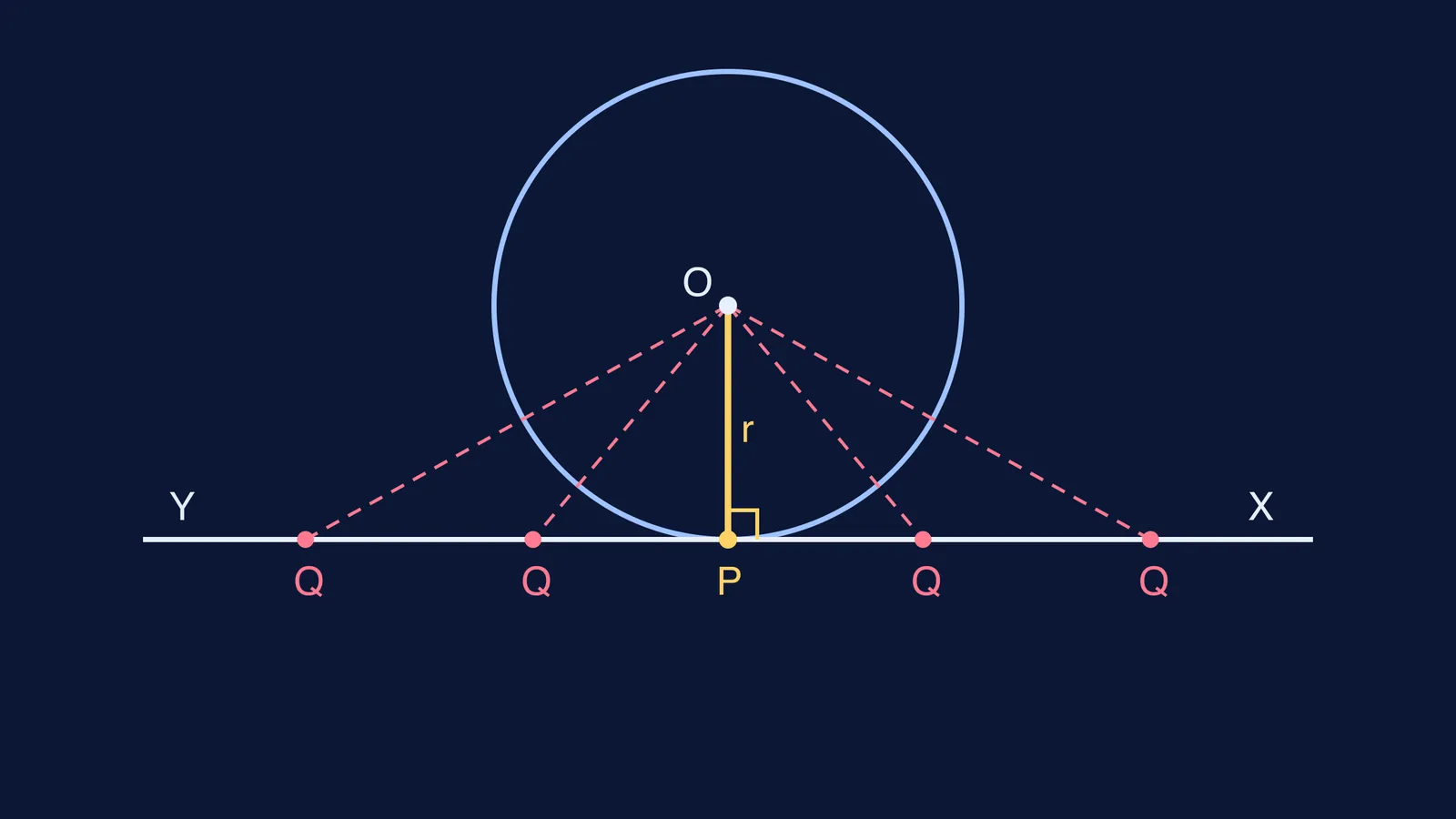
Take a circle with centre O and radius r, and a tangent XY touching it at P. So OP = r.
Pick any other point Q on XY.
Q cannot be inside the circle. If it were, the line XY would become a secant, not a tangent.
Q cannot be on the circle either, because P is the only common point. So Q is outside, and OQ > r = OP.
This holds for every point on XY except P, so OP is the shortest distance from O to the line.
The shortest segment from a point to a line is the perpendicular one. So OP ⊥ XY.
Why step 6? NCERT cites its appendix; in short, if the perpendicular from O met XY at another point M, triangle OMP would have a right angle at M, making OP the hypotenuse and OP > OM. That contradicts step 5, so the foot must be P.
Did Euclid prove it the same way?
Almost. Euclid's Elements, Book III, Proposition 18 states that the line joining the centre to the point of contact is perpendicular to the tangent. Euclid argues by contradiction: if it were not, the perpendicular from the centre to the tangent would be shorter than the radius, yet its foot lies on the tangent outside the circle, so it must be longer. Same idea, far older.
How do you find the length of a tangent?
With the 90° angle in place, tangent-length problems follow one recipe:
Draw the radius to the point of contact and mark the right angle.
Join the centre to the outside point. This line is the hypotenuse.
Use Pythagoras: (tangent length)² = d² − r², where d is the distance from the centre to the outside point.
Example 1: find the tangent
From NCERT Exercise 10.1: radius 5 cm, OQ = 12 cm, find the tangent PQ. PQ² = 12² − 5² = 119, so PQ = √119 cm, about 10.9 cm. The trap option, 13 cm, comes from treating 12 as a leg.
Example 2: find the radius
In Exercise 10.2 of the same chapter, the tangent from Q is 24 cm and Q is 25 cm from the centre. So r² = 25² − 24² = 49, and r = 7 cm.
Example 3: a chord touching an inner circle
In Exercise 10.2, concentric circles have radii 5 cm and 3 cm, and a chord of the big one touches the small one. The small radius meets the chord at 90° and bisects it, so half the chord is √(25 − 9) = 4 cm and the chord is 8 cm. More of this type: chords of a larger circle touching a smaller concentric circle.
Example 4: how far away is the horizon?
Your line of sight to the horizon is a tangent to the Earth. Earth's mean radius is 6,371 km, according to the NASA Earth fact sheet. If your eyes are h metres above the sea, the distance to the horizon is √((R + h)² − R²) = √(2Rh + h²).
At 1.7 m (standing on a beach): about 4.7 km.
At 30 m (a tall lighthouse): about 19.6 km.
Air bends light slightly, so real distances differ a little, but the triangle is the one from Example 1.
What mistakes do students make in tangent questions?
Using the radius as the hypotenuse. The hypotenuse runs from the centre to the outside point.
Putting the right angle at the outside point.
Forgetting the right angles when angle-chasing. With two tangents from T touching at P and Q, the quadrilateral OPTQ has 90° at P and Q, so ∠PTQ + ∠POQ = 180°.
Writing "by symmetry" in a proof. Say "by Theorem 10.1, OP ⊥ XY" instead.
The chapter's next result, that two tangents from an outside point are equal, also follows from this right angle; test it in tangents from an external point: why they are equal. For a full set of board-style questions, work through Class 10 tangent theorems with worked examples.
If you keep picking the wrong side as the hypotenuse, the Fermi Problem Library has worked problems with a step-by-step solver that explains the reasoning rather than printing an answer. If the shortest-distance idea is the gap, the Fermi Concept Library gives each concept its own lesson and shows where it fits in the map.