

On this page
From a point P outside a circle you can draw exactly two tangents, and they always come out the same length. Here you move P on paper, predict first, then see the two triangles that force the result.
Why are tangents from an external point equal?
Start with two facts from chapter 10 of the NCERT Class 10 maths textbook (NCERT, Circles):
Theorem 10.1: the tangent at any point of a circle is perpendicular to the radius through the point of contact.
Section 10.3, Case 3: there are exactly two tangents to a circle through a point lying outside the circle.
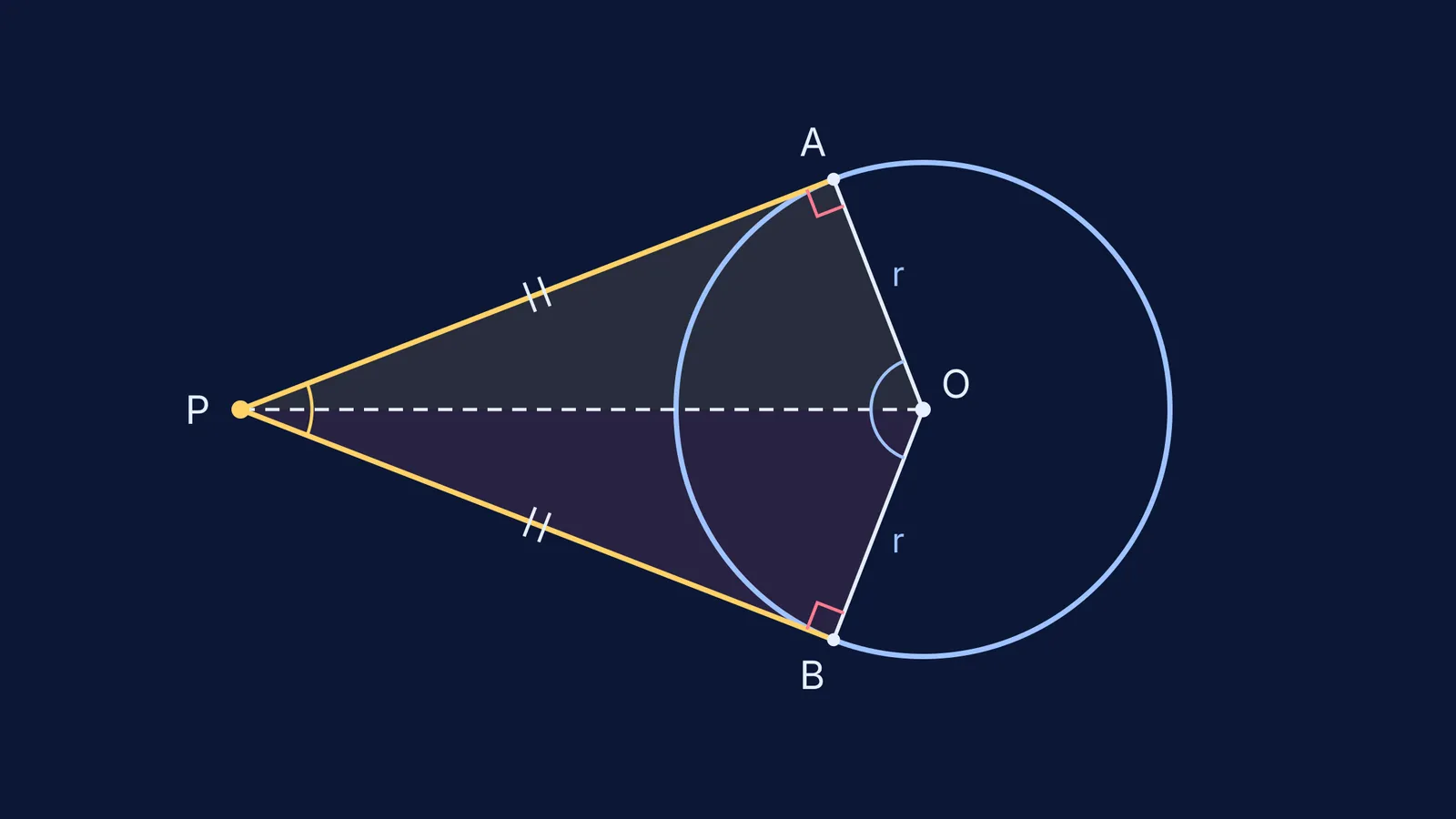
Call the centre O and the points of contact A and B. Join OA, OB and OP. Triangles OAP and OBP now share three things:
The angles at A and at B are both 90°, by Theorem 10.1.
OA = OB, because both are radii.
OP is common to both triangles, and it is the hypotenuse of each.
Right angle, hypotenuse, side: that is the RHS congruence rule, so triangle OAP is congruent to triangle OBP, and the matching sides PA and PB are equal. This is the proof NCERT gives for Theorem 10.2, "The lengths of tangents drawn from an external point to a circle are equal" (NCERT, Circles).
The same chapter offers a second route through Pythagoras: PA² = OP² − OA² = OP² − OB² = PB², so PA = PB. Either way, the tangent length depends only on the radius and on OP, which are the same for both tangents.
See why SSA and AAA do not prove triangles congruent if that feels shaky.
What should you predict when you move the point?
The congruent triangles also give equal angles: angle OPA = angle OPB, so OP bisects the angle between the tangents, as NCERT remarks after the proof. Since OAPB has right angles at A and B, angle APB and angle AOB add up to 180° (Exercise 10.2, question 10) (NCERT, Circles).
Write your answers down before you sketch anything. In a physics-education study, students who predicted a demonstration's outcome before seeing it showed significantly greater understanding, while those who only watched did no better than students who saw no demonstration (Crouch, Fagen, Callan and Mazur, American Journal of Physics, 2004).
Move P far from the circle. What happens to angle APB, and how does PA compare with OP?
Move P towards the circle. What happens to PA and to angle APB?
Place P so that OP is twice the radius. What is angle APB, and what kind of triangle is APB?
Place P so that OP = r√2. What shape is OAPB?
Swing P around the circle while keeping OP fixed. Do PA and PB change?
Answers: (1) the angle shrinks towards 0° and PA approaches OP; (2) PA shrinks to zero and the angle opens towards 180° as the tangents merge into one; (3) sin(angle OPA) = 1/2, so angle APB is 60° and APB is equilateral, every side r√3; (4) angle APB is 90° and PA = r, so OAPB is a square; (5) no, only OP and r matter.
For more to test this way, try the angle in a semicircle and other circle theorems.
How do you find the tangent length and the angles?
Use the right triangle from the proof, the same Pythagoras step that Exercise 10.2, questions 1 and 6, asks for (NCERT, Circles). Take radius 5 cm and OP = 13 cm.
PA = √(13² − 5²) = √144 = 12 cm, and PB is also 12 cm.
In right triangle OAP, sin(angle OPA) = OA/OP = 5/13, so angle OPA ≈ 22.6°.
Angle APB = 2 × 22.6° ≈ 45.2°, because OP bisects it.
Angle AOB = 180° − 45.2° ≈ 134.8°.
Where does the equal-tangents theorem show up in exams?
Mostly in disguise. Exercise 10.2 asks you to prove AB + CD = AD + BC for a quadrilateral drawn around a circle, and to find the sides of a triangle drawn around a circle (NCERT, Circles). Both work the same way: give each vertex's two equal tangent segments one letter, then add. See finding triangle side lengths from incircle tangent segments for that labelling step by step.
Board-exam proof checklist:
Draw O, P, A, B and join OA, OB and OP.
Give the reason for each right angle (Theorem 10.1).
List the three RHS parts, each with its reason.
Name the rule (RHS) and finish with PA = PB by CPCT.
For ideas that are easier to see than to read, the Fermi Simulation Lab has interactive simulations. When an exercise stalls you, the Fermi Problem Library has a step-by-step solver that explains the reasoning rather than printing an answer.
Try prediction 3 with a compass first, and see if the equilateral triangle appears.


