On this page
Most students memorise the circle theorems as three sentences. They are easier to keep once you have watched them refuse to break. Below are three short experiments: place points on a circle, write down the angle you expect, then drag a point and measure. Any geometry app that measures angles works, or a compass and protractor.
What are the three circle theorems you can test by dragging?
All three come from Book III of Euclid's Elements, which you can read in David Joyce's online edition at Clark University.
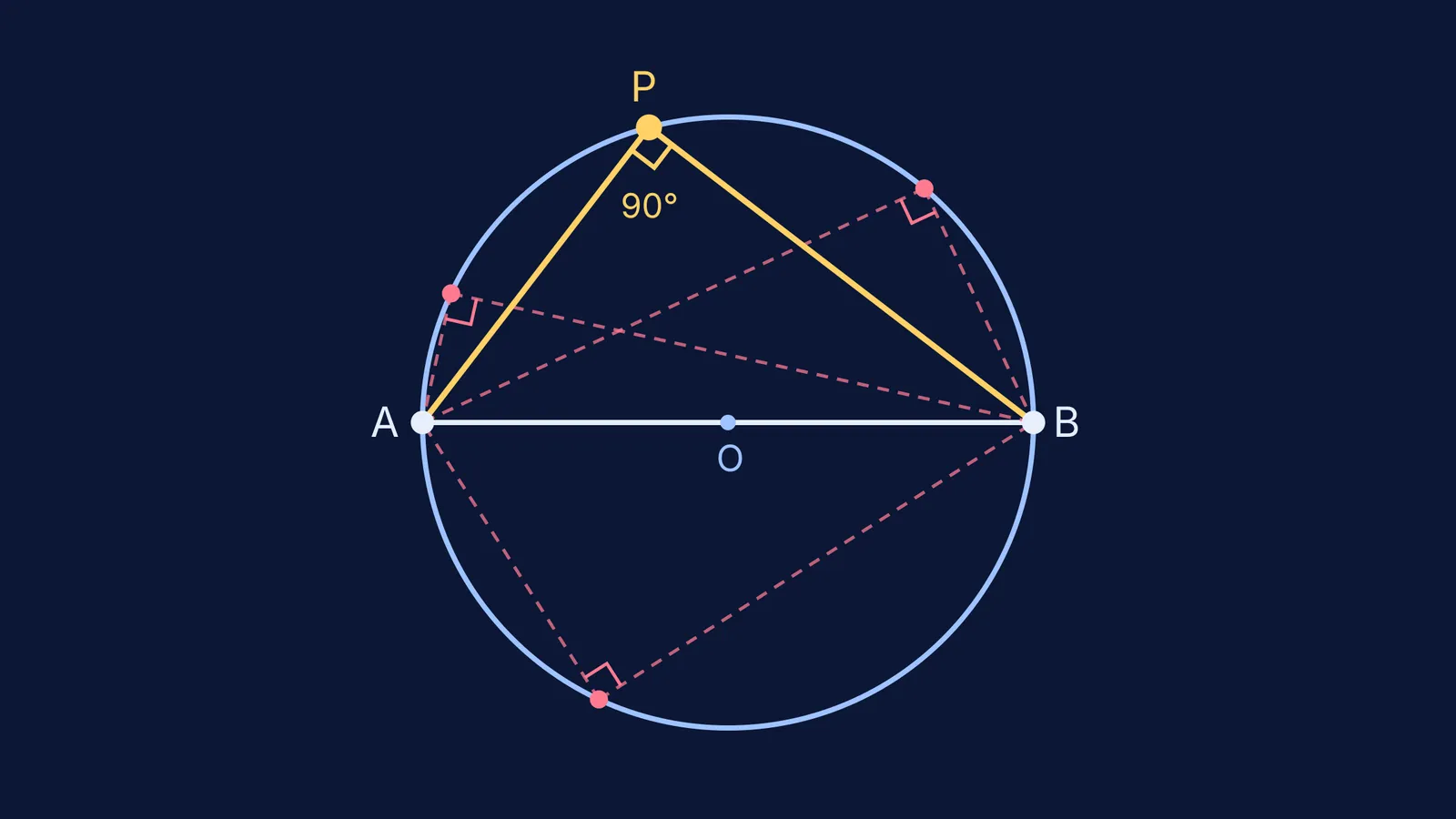
Angle in a semicircle: an angle drawn from the two ends of a diameter to any point on the circle is a right angle (Euclid III.31).
Angles in the same segment: angles standing on the same chord, with their vertices on the same side of it, are equal (Euclid III.21).
Cyclic quadrilateral: if all four corners of a quadrilateral lie on a circle, each pair of opposite angles adds up to 180° (Euclid III.22).
One rule sits under all three. The angle at the centre is double the angle at the circumference standing on the same arc (Euclid III.20). Put another way, an angle at the circumference equals half the arc it faces, meaning the arc on the far side of the chord. Keep that sentence in mind and you can predict every angle below.
Why predict the angle before you measure it?
In a 2004 study, Catherine Crouch, Eric Mazur and colleagues at Harvard compared different ways of showing students classroom demonstrations (Crouch et al., American Journal of Physics). Students who only watched a demonstration understood the idea no better than students who never saw it. Students who predicted the outcome before seeing it showed significantly greater understanding. That study used physics demonstrations, but dragging a point round a circle is a demonstration too, so the habit is worth trying: commit to a number first. It belongs with other forms of active learning, such as those in the 2014 Freeman meta-analysis.
Some ideas are easier to see than to read. The Fermi Simulation Lab has interactive simulations for that kind of idea, so you can move something and watch what changes.
How do you test the angle in a semicircle interactively?
Draw a circle with centre O. Describe each point by its position angle at O, measured anticlockwise from the rightmost point of the circle, as in trigonometry.
Experiment 1: angle in a semicircle. Put A at 180° and B at 0°, so AB is a diameter. Put P at 105°.
Predict angle APB. P faces a semicircle, an arc of 180°, so the angle is 90°.
Drag P to 50°, then 155°, predicting each time: still 90°.
Drag P below the diameter, to 245°. Predict 90°: it now faces the other semicircle, also 180°.
If you measure 88° or 92°, check that AB really passes through O.
Experiment 2: angles in the same segment. Put A at 200° and B at 340°, so AB is a chord below the centre.
Put P at 60°. The arc below the chord runs from 200° to 340°, which is 140°. Predict angle APB = 70°.
Drag P to 90°, then 120°. Predict 70° both times.
Drag P below the chord, to 270°. It now faces the upper arc, 360° − 140° = 220°. Predict 110°.
Notice that 70° + 110° = 180°: the next theorem, appearing early.
Experiment 3: a cyclic quadrilateral. Put A at 30°, B at 120°, C at 200° and D at 300°.
Angle A faces the arc from B through C to D, 120° to 300°, which is 180°. Predict 90°.
Angle C faces the arc from D through A to B, 300° round to 120°, which is 180°. Predict 90°.
Angle B faces the arc from C through D to A, 200° round to 30°, which is 190°. Predict 95°.
Angle D faces the arc from A through B to C, 30° to 200°, which is 170°. Predict 85°.
Check: 90° + 90° = 180° and 95° + 85° = 180°. Then drag D off the circle, inwards or outwards, and watch the sums stop being 180°.
What mistakes does dragging catch?
Switching sides of the chord. An angle on the far side of a chord is the supplement of one on the near side, not equal to it.
A diameter that is not a diameter. The 90° result needs the chord to pass through the centre, so look for O on the line.
A quadrilateral that only looks cyclic. The 180° rule needs all four vertices on the circle.
Reading the wrong arc. Always take the arc on the far side of the chord from the vertex.
For worked examples on the Class 9 syllabus, read our guide to chords, arcs and cyclic quadrilaterals in Class 9 circles. For the story of the man the semicircle theorem is often named after, see Thales and the five theorems. If a step in a proof doesn't make sense, the Fermi Concept Library has a lesson for every concept in mathematics.