

On this page
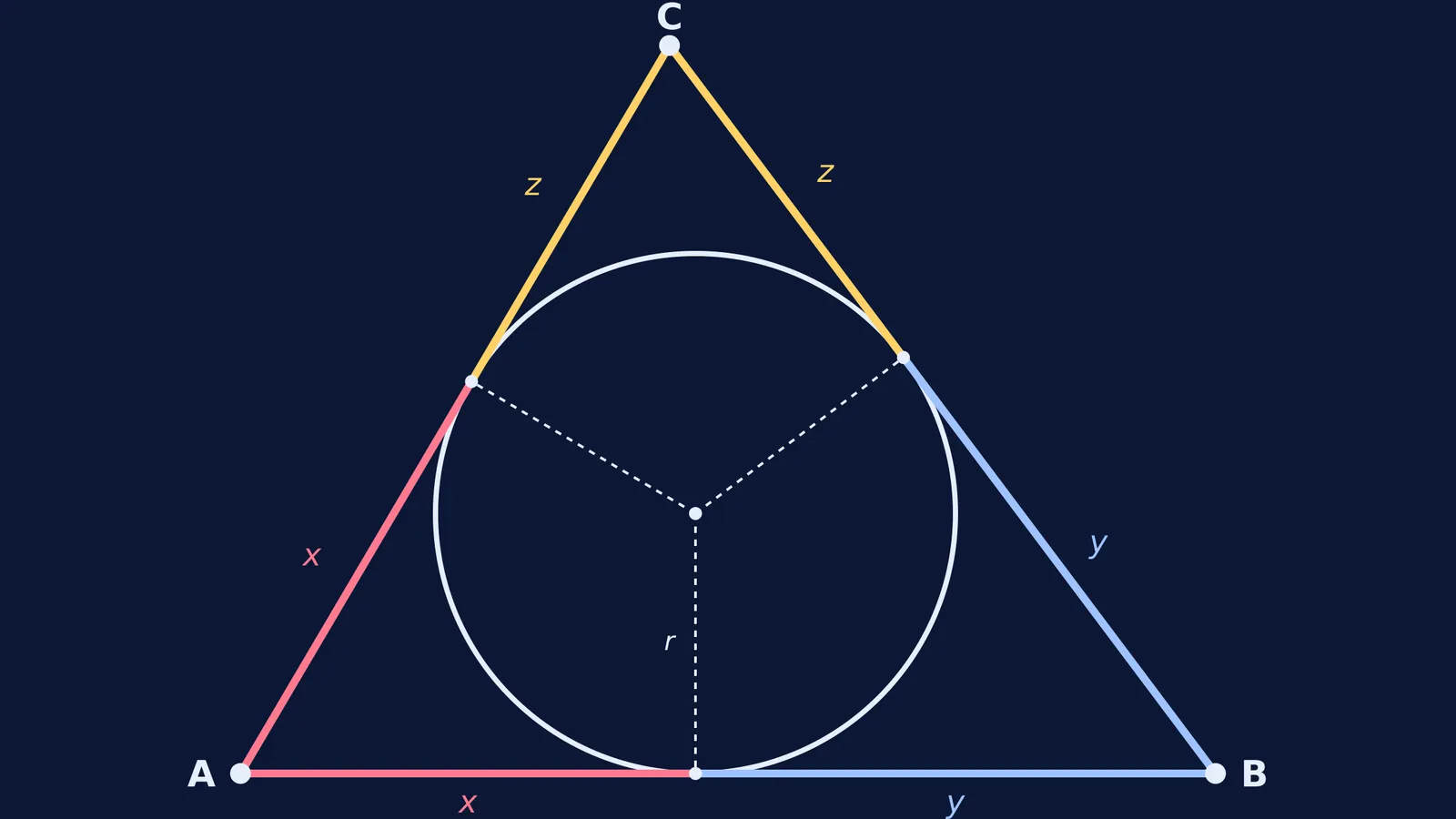
When a circle is inscribed in a triangle, it touches all three sides. The centre of this incircle is the incenter, where the triangle's angle bisectors meet. The points where the circle touches the sides divide each side into two smaller segments.
By looking at these segments, we find a neat mathematical relationship that solves many geometry problems in competitive exams.
Why are the tangent segments equal?
A fundamental property in geometry is that the two tangent segments drawn from an external point to a circle are exactly equal in length.
In our triangle, each vertex acts as an external point. This means the two tangent segments originating from vertex A (one on side AB, one on side AC) are identical in length. The same rule applies to the segments from vertex B and vertex C.
Let us call the lengths of these tangent segments x, y and z:
From vertex A: length x
From vertex B: length y
From vertex C: length z
Notice that the side lengths of the triangle, a, b and c, are simply made up of these segment pairs. The side opposite A is a = y + z, the side opposite B is b = x + z, and the side opposite C is c = x + y.
How do you find side lengths from the semiperimeter?
Because the perimeter of the triangle is the sum of all its sides, we can write a + b + c = 2x + 2y + 2z. The semiperimeter, denoted as s, is exactly half of this perimeter, so s = x + y + z.
This gives us a very direct way to find the length of any tangent segment if you know the side lengths. By rearranging s = x + y + z and substituting the side lengths, we get:
x = s - a
y = s - b
z = s - c
If a question gives you the lengths of the tangent segments, you simply add them up in pairs to find the sides of the triangle. From there, you can tackle more complex geometry, such as finding the circle through three given points or calculating the area of a triangle using determinants.
What is the link to the inradius?
The radius of the inscribed circle, known as the inradius (r), connects to the points of tangency at a right angle (90°).
If you split the main triangle into three smaller triangles using the incenter as a common vertex, the altitudes of these smaller triangles are all equal to r. The total area of the triangle (A) is the sum of the areas of these three smaller triangles: A = (1/2)ar + (1/2)br + (1/2)cr, which simplifies to A = rs.
This simple formula, r = A / s, is often the fastest route to the inradius. When practicing geometry problems, this method is cleaner and less error-prone than heavy trigonometry. You can even combine this with Heron's formula, which calculates the area A = √[s(s - a)(s - b)(s - c)] using the exact same tangent segment lengths (s - a, s - b and s - c) that we found earlier. This elegant connection shows why the semiperimeter is so central to triangle geometry.
Can we see a worked example?
Suppose you are given a triangle with side lengths a = 7, b = 8 and c = 9. You need to find the lengths of the tangent segments from each vertex to the inscribed circle, as well as the inradius.
First, we calculate the semiperimeter, s. The perimeter is 7 + 8 + 9 = 24. Therefore, the semiperimeter is half of that, which gives s = 12.
Now we can apply our formulas for the tangent segments:
The segment from vertex A is x = s - a = 12 - 7 = 5.
The segment from vertex B is y = s - b = 12 - 8 = 4.
The segment from vertex C is z = s - c = 12 - 9 = 3.
You can verify these answers by checking if they add up correctly. The side opposite A is made of y and z. Adding 4 and 3 gives 7, which matches the side length a. The side opposite B is made of x and z. Adding 5 and 3 gives 8, matching b. Finally, the side opposite C is made of x and y. Adding 5 and 4 gives 9, matching c.
Next, let us find the inradius, r. We know that the area A is equal to rs. We can find the area using Heron's formula:
A = √[s(s - a)(s - b)(s - c)] A = √[12 × 5 × 4 × 3] A = √720 A = 12√5
Using the relation r = A / s, we divide the area by the semiperimeter:
r = 12√5 / 12 r = √5
This shows how quickly you can solve for the tangent segments and the inradius without drawing a single altitude or using a single trigonometric function. By breaking the triangle down into these simple segments, the geometry becomes straightforward arithmetic.
If you need help visualising geometry patterns, the Fermi Concept Library explains every concept in mathematics with its own lesson and interactive tools. And if you want to strengthen your geometric intuition and work through problems step by step, the Fermi Problem Library is a great place to start.


