

On this page
Most common tangent questions come down to one number: the distance d between the two centres. Compare it with the sum and the difference of the radii and you know how many tangents there are, which kinds, and how long they are.
How many common tangents do two circles have?
Call the radii r₁ and r₂ and the distance between centres d. The Wikipedia article on tangent lines to circles lists the five possible arrangements, and this summary of the conditions turns each one into a test on d:
d > r₁ + r₂ (circles fully apart): 4 common tangents.
d = r₁ + r₂ (touching externally): 3 common tangents.
|r₁ − r₂| < d < r₁ + r₂ (cutting at two points): 2 common tangents.
d = |r₁ − r₂| (touching internally): 1 common tangent.
d < |r₁ − r₂| (one circle inside the other): 0 common tangents.
A circle lying inside another has no common tangent, because a tangent to the outer circle never meets the inner one (Wikipedia). Concentric circles with unequal radii (d = 0) fall in this case too.
What is the difference between direct and transverse common tangents?
An external (direct) common tangent has both circles on the same side of it, and an internal (transverse) common tangent has them on opposite sides (Wikipedia). The transverse ones cross the segment joining the centres; the direct ones do not.
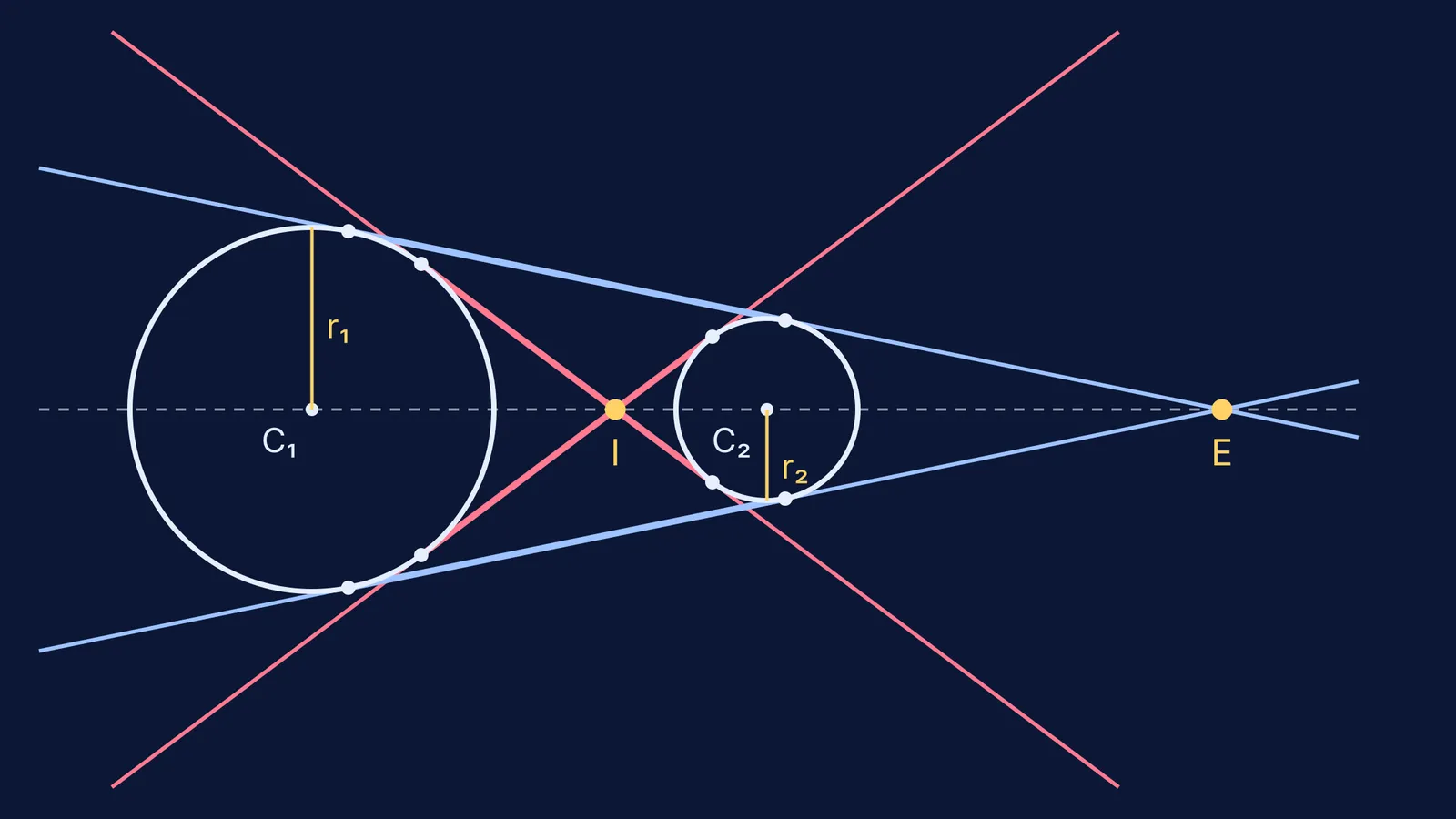
Each pair meets at a point on the line of centres. The direct tangents meet at a point that divides the line of centres externally in the ratio r₁ : r₂, and the transverse tangents meet at a point that divides it internally in the same ratio (source). These are the external and internal homothetic centres, and every common tangent passes through one of them (Wikipedia). So to write tangent equations, find the meeting point with the section formula, then set the distance from a centre equal to the radius. When r₁ = r₂ the direct tangents are parallel, so there is no external point.
How do you find the length of a common tangent?
The length means the segment between the two points of contact. Both radii to the contact points are perpendicular to the tangent. Slide the tangent segment until it starts at one centre and you get a right triangle with hypotenuse d. Its short side is r₁ − r₂ for a direct tangent (radii point the same way) and r₁ + r₂ for a transverse one (radii point opposite ways). That gives the standard formulas (source):
Length of a direct common tangent = √(d² − (r₁ − r₂)²)
Length of a transverse common tangent = √(d² − (r₁ + r₂)²)
If d² − (r₁ + r₂)² is negative, the circles overlap and there is no transverse tangent. Because (r₁ + r₂)² is larger than (r₁ − r₂)², a transverse tangent is always shorter than a direct one for the same pair of circles.
Worked example: finding all four tangents
Take x² + y² = 16 and x² + y² − 20x + 96 = 0, drawn at the top of this post.
Centres and radii: C₁(0, 0), r₁ = 4; C₂(10, 0), r₂ = √(100 − 96) = 2.
Count: d = 10 > r₁ + r₂ = 6, so four common tangents.
Lengths: direct √(100 − 4) = 4√6, about 9.8; transverse √(100 − 36) = 8.
E divides C₁C₂ externally in the ratio 4 : 2, so E = (4·10 − 2·0)/(4 − 2) = 20, giving E(20, 0).
Direct tangents: y = m(x − 20) at distance 4 from the origin gives 20|m|/√(1 + m²) = 4, so m² = 1/24, and the tangents are x ± 2√6y = 20.
I divides C₁C₂ internally in the ratio 4 : 2, so I = (20/3, 0).
Transverse tangents: y = m(x − 20/3) at distance 4 from the origin gives m = ±3/4, so 3x ± 4y = 20.
Check: the distance from (10, 0) to 3x + 4y = 20 is |30 − 20|/5 = 2, which is r₂.
For the basics behind steps 1 and 5, revise circles in coordinate geometry: tangents, chords and families or the Class 10 tangent theorems.
What should you do first in an exam question?
Complete the square to get both centres and radii.
Compute d, r₁ + r₂ and |r₁ − r₂| before drawing anything.
Read off the count from the five cases.
For lengths: minus for direct, plus for transverse.
For equations, find E and I, then set distance from a centre equal to the radius.
Check with the other circle.
If you keep getting the external ratio the wrong way round, the Fermi Problem Library has worked problems with a step-by-step solver that explains the reasoning rather than printing an answer. For the section formula or point-to-line distance, the Fermi Concept Library gives each concept its own lesson.
Next, see how this fits the wider chapter in our five-step method for conic sections problems.


