

On this page
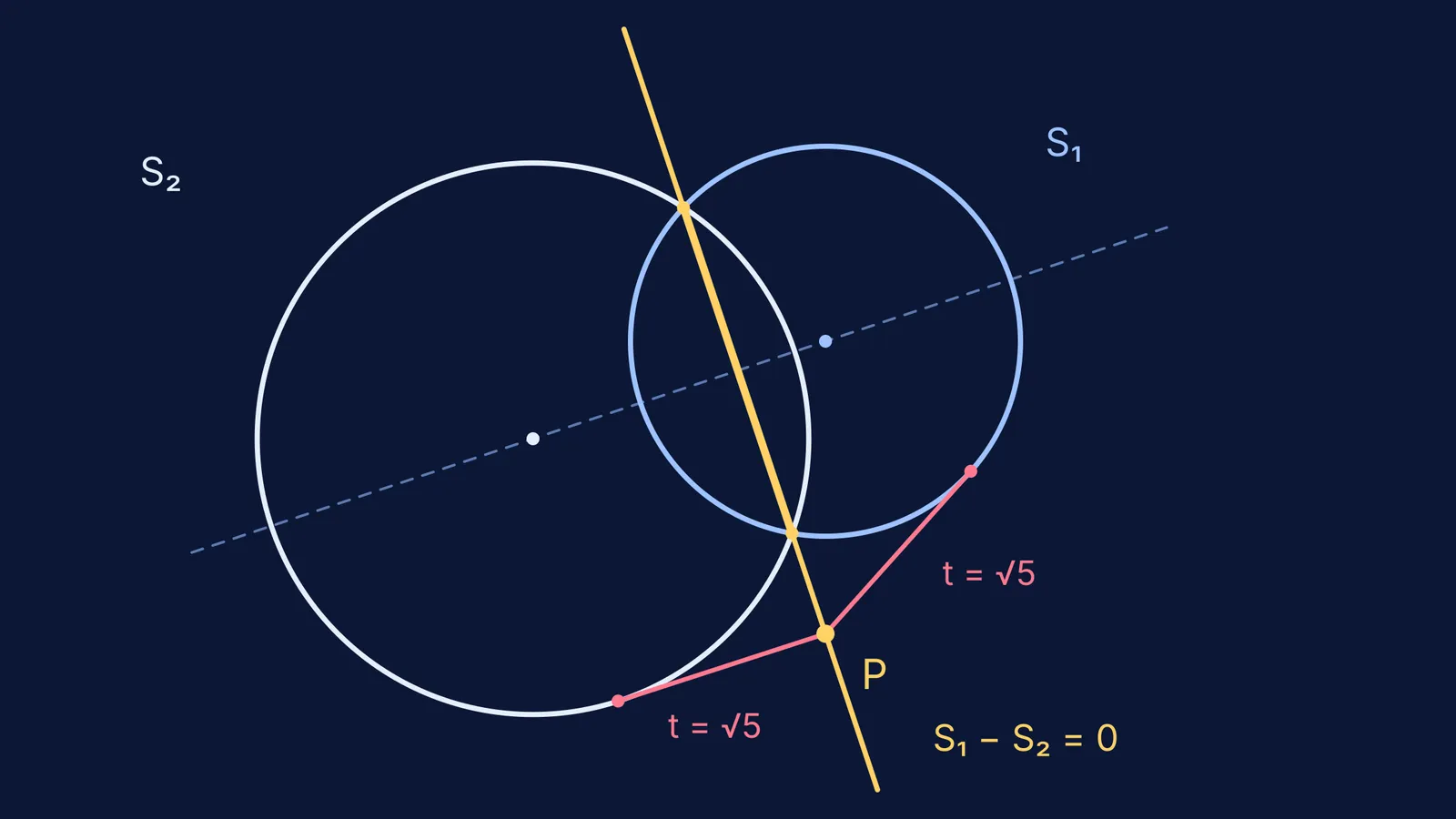
Mark the points from which the tangents to two circles are equally long. They form a straight line, the radical axis, which turns up in JEE common-chord, tangent-length and three-circle questions.
What is the radical axis of two circles?
The radical axis of two non-concentric circles is the set of points whose power with respect to the two circles is equal (Wikipedia: Radical axis).
The power of a point P with respect to a circle with centre O and radius r is |PO|² − r²: positive outside the circle, zero on it, negative inside (Wikipedia: Power of a point). For a point outside, the power equals the square of the tangent length. Our post on the tangent-secant theorem and PA × PB = PT² proves the tangent part.
Put the two facts together and you get the property exams test most: from any point on the radical axis outside both circles, the tangents to the two circles are equal in length. The axis is always perpendicular to the line of centres (MathWorld: Radical Line).
Why does S₁ − S₂ = 0 give the radical axis?
Write a circle as S = x² + y² + 2gx + 2fy + c = 0, with centre C(−g, −f) and r² = g² + f² − c. Put in a point P(x₁, y₁) and complete the square:
S(x₁, y₁) = (x₁ + g)² + (y₁ + f)² − (g² + f² − c) = |PC|² − r²
So substituting a point into a circle's equation gives its power. Equal power means S₁ = S₂, that is S₁ − S₂ = 0. The x² and y² terms cancel, leaving 2(g₁ − g₂)x + 2(f₁ − f₂)y + (c₁ − c₂) = 0, a straight line. Its normal (g₁ − g₂, f₁ − f₂) is parallel to the line of centres, so the axis is perpendicular to it. For concentric circles the x and y terms vanish too, so there is no axis.
A worked example: common chord and equal tangents
Take S₁: x² + y² − 4x − 6y + 9 = 0 (centre (2, 3), radius 2) and S₂: x² + y² + 2x − 4y − 3 = 0 (centre (−1, 2), radius 2√2).
Subtract: −6x − 2y + 12 = 0, so the radical axis is 3x + y = 6.
Do they meet? The centre distance √10 ≈ 3.16 lies between 2√2 − 2 ≈ 0.83 and 2√2 + 2 ≈ 4.83, so they cut at two points and 3x + y = 6 is the common chord.
Chord length: (2, 3) is 3/√10 from the axis, so the chord is 2√(4 − 0.9) ≈ 3.52.
Equal tangents: P(2, 0) is on the axis. S₁(2, 0) = 4 − 8 + 9 = 5 and S₂(2, 0) = 4 + 4 − 3 = 5, so both tangents from P have length √5.
Is the radical axis always the common chord?
No. The line exists for every pair of non-concentric circles, but its role changes (Wikipedia: Radical axis):
Circles cut at two points: the axis is the common chord.
Circles touch: the axis is the common tangent at the point of contact.
Circles do not meet: the axis carries no chord, but tangent-length questions still work.
For how many common tangents each case has, see common tangents of two circles: how many, and how long.
How do you find the radical centre of three circles?
For three circles with non-collinear centres, the three pairwise radical axes meet at one point, the radical centre (MathWorld: Radical Center). When it lies outside the circles, it has the same tangent length to all three (Wikipedia: Radical axis).
Two subtractions are enough: if S₁ = S₂ and S₁ = S₃ at a point, then S₂ = S₃ there too. Add S₃: x² + y² − 10x − 6y + 21 = 0 (centre (5, 3)).
S₁ − S₃ = 6x − 12 = 0, so x = 2.
With 3x + y = 6, y = 0. The radical centre is (2, 0).
Check: S₃(2, 0) = 4 − 20 + 21 = 5. All three tangent lengths are √5.
So the circle with centre (2, 0) and radius √5 cuts all three circles at right angles. Our post on the condition for orthogonal circles works through that algebra.
A 60-second exam checklist
Make the x² and y² coefficients 1 in both equations.
Compare the centre distance with r₁ + r₂ and |r₁ − r₂|: chord, tangent or neither.
For three circles, subtract twice, solve, then check in the third equation.
If your line came out different, the Fermi Problem Library has worked problems with a step-by-step solver that explains the reasoning rather than printing an answer. To revisit power of a point, the Fermi Concept Library gives each concept its own lesson.


