

On this page
When a line just touches a circle and another line cuts right through it from the same starting point, their lengths are locked in a strict ratio. This rule is the tangent-secant theorem, a staple of geometry in exams like the JEE and a fast way to find missing distances without trigonometry.
Here is how the segments relate, how to prove the formula using similar triangles, and how it connects to the broader idea of the power of a point.
What is the tangent-secant theorem?
If you draw two lines from a single point outside a circle—one that merely touches the edge (a tangent) and one that cuts across the circle (a secant)—the theorem gives you an exact equation for their lengths.
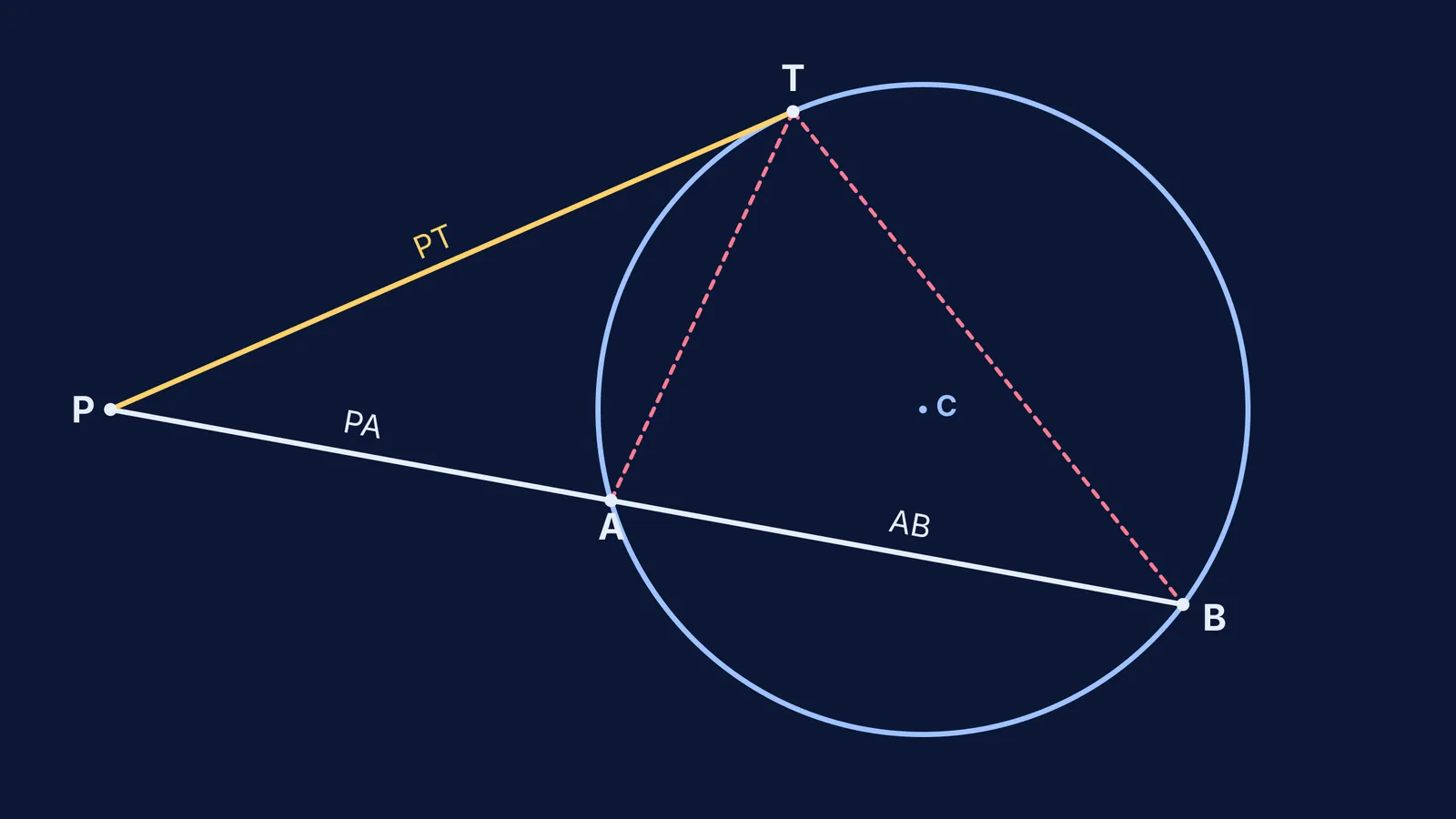
Let the external point be P. Let the tangent touch the circle at point T, giving you a tangent segment of length PT.
Let the secant line pass through the circle, hitting the near edge at A and the far edge at B. The secant gives you two lengths measured from the starting point: the external part PA, and the entire segment PB.
The theorem states that the square of the tangent equals the product of the secant's external part and its total length: PA × PB = PT².
A common mistake is to multiply the external part by the internal chord (PA × AB). The theorem always measures from the external point P, so you must use the total length PB (which is PA + AB).
If you find it hard to picture which segments to multiply or where the lines cross, the Fermi Concept Library maps out every geometry concept with its own lesson.
How does the tangent secant theorem prove PA × PB equals PT squared?
The simplest way to prove the tangent-secant theorem is by identifying similar triangles. You do this by drawing two extra lines (chords) inside the circle.
Draw a line from T to A, and another from T to B. This creates two triangles: ∆PTA and ∆PBT.
Both triangles share the angle at P.
By the alternate segment theorem (also known as the tangent-chord theorem), the angle between the tangent PT and the chord TA (which is ∠PTA) is exactly equal to the angle in the alternate segment (which is ∠PBT).
Because ∆PTA and ∆PBT share two angles, they are similar triangles (AA similarity).
Since the triangles are similar, the ratio of their corresponding sides must be equal. The side opposite the shared angle in the small triangle is TA, and in the large triangle it is TB. The side opposite the alternate angle in the small triangle is PA, and in the large triangle it is PT. The side opposite the third angle in the small triangle is PT, and in the large triangle it is PB.
Equating the second and third ratios gives: PA / PT = PT / PB
Cross-multiplying this fraction gives the final result: PA × PB = PT².
When setting up similar triangles, Fermi's AI tutor can help you spot the shared angles by drawing the figure and checking your reasoning as you go, rather than just showing you the final proof.
How do you apply the theorem to find missing lengths?
Exam questions usually give you two of the three lengths and ask for the third.
Example problem: A tangent and a secant are drawn from an external point P. The tangent segment PT is 12 cm. The secant intersects the circle at A and B, and the internal chord AB is 10 cm. Find the length of the external segment PA.
Solution:
Let the length of PA be x.
The total length of the secant from P is PB = x + 10.
Set up the equation: PA × PB = PT².
Substitute the knowns: x(x + 10) = 12².
Expand the bracket: x² + 10x = 144.
Rearrange into a quadratic equation: x² + 10x − 144 = 0.
Factorise the quadratic: (x + 18)(x − 8) = 0.
Since a length cannot be negative, x = 8. The external segment PA is 8 cm.
To practice these exam problems, the Fermi Problem Library has worked problems with a step-by-step solver that explains the reasoning for geometric lengths and quadratic roots.
Why is it called the power of a point?
The tangent-secant equation is a specific case of a broader mathematical rule. In 1826, the Swiss mathematician Jakob Steiner introduced the concept of the "power of a point".
Steiner defined the power of a point P with respect to a circle as a constant real number based on its distance from the centre. If the circle has radius r and its centre is at distance d from P, the power of point P is d² − r².
For a point outside the circle, this constant is always positive. Steiner showed that this single number equals the square of the tangent (PT²). It also equals the product of the segments of *any* secant drawn through P (such as PA × PB). No matter how you tilt the secant line, the product of its segments from P remains locked to that same constant value.
This principle of invariant distances links straight lines to circles. It allows you to relate a circle through three given points to lines outside it, or to predict how many roots a geometric equation will have based on whether the point lies inside, on, or outside the boundary.


