

On this page
Coordinate geometry questions often ask whether two circles cut at right angles, or for a circle that cuts two given circles at right angles. Both rest on 2g₁g₂ + 2f₁f₂ = c₁ + c₂. Know where it comes from and you will not mix up the signs under exam pressure.
What does it mean for two circles to cut orthogonally?
Orthogonal circles are circles that cut one another at right angles, according to Wolfram MathWorld.
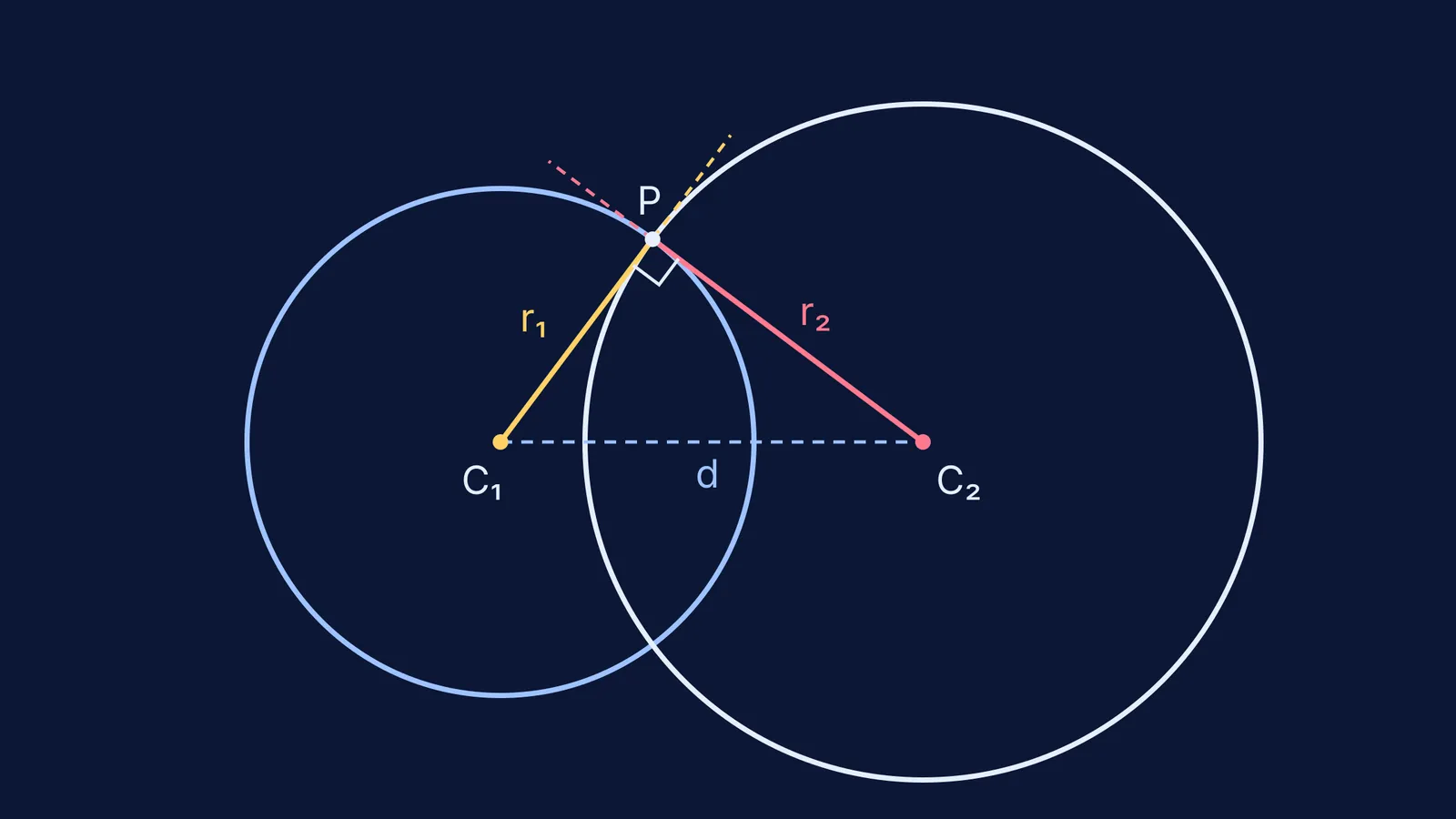
The angle between two curves where they meet is the angle between their tangents there. For a circle, the tangent at any point is perpendicular to the radius to that point. So the two tangents at an intersection point P are perpendicular exactly when the two radii to P are perpendicular.
That gives a right angle at P in the triangle formed by the centres C₁, C₂ and P. Pythagoras finishes the job: the circles are orthogonal when d² = r₁² + r₂², where d is the distance between the centres, the same condition MathWorld gives.
Read it another way: C₂P is perpendicular to C₁P, so C₂P is a tangent to circle 1. The tangent from one centre to the other circle equals that centre's own radius.
How do you derive 2g₁g₂ + 2f₁f₂ = c₁ + c₂?
Write the circles as x² + y² + 2g₁x + 2f₁y + c₁ = 0 and x² + y² + 2g₂x + 2f₂y + c₂ = 0. Their centres are (−g₁, −f₁) and (−g₂, −f₂), and r₁² = g₁² + f₁² − c₁, r₂² = g₂² + f₂² − c₂.
Distance between centres: d² = (g₁ − g₂)² + (f₁ − f₂)² = g₁² + g₂² + f₁² + f₂² − 2g₁g₂ − 2f₁f₂.
Sum of squared radii: r₁² + r₂² = g₁² + f₁² + g₂² + f₂² − c₁ − c₂.
Set them equal. The squared terms cancel, leaving −2g₁g₂ − 2f₁f₂ = −c₁ − c₂.
Multiply by −1: 2g₁g₂ + 2f₁f₂ = c₁ + c₂.
The tangent picture gives the same result. The squared tangent length from a point to a circle is the power of the point, |PO|² − r², and the circle centred at that point with radius equal to the tangent length cuts the original circle orthogonally, as the Wikipedia article on power of a point sets out. In coordinates, that power is S₁ evaluated at the point. Put the centre of circle 2 into S₁ and set it equal to r₂²: g₂² + f₂² − 2g₁g₂ − 2f₁f₂ + c₁ = g₂² + f₂² − c₂, the same condition again.
How do you find a circle orthogonal to two given circles?
Let the unknown circle be x² + y² + 2gx + 2fy + c = 0. It has three unknowns, so you need three conditions: orthogonal to circle 1, orthogonal to circle 2, and usually a point it passes through. Each condition is linear in g, f and c.
Worked example: find the circle through (1, 1) that cuts x² + y² − 6x + 5 = 0 and x² + y² − 6y + 5 = 0 orthogonally.
Circle 1 has g₁ = −3, f₁ = 0, c₁ = 5. Orthogonality gives 2g(−3) + 2f(0) = c + 5, so −6g = c + 5.
Circle 2 has g₂ = 0, f₂ = −3, c₂ = 5. Orthogonality gives −6f = c + 5.
From steps 1 and 2, g = f.
Through (1, 1): 1 + 1 + 2g + 2f + c = 0, so c = −2 − 4g.
Substitute into −6g = c + 5: −6g = 3 − 4g, so g = −3/2. Then f = −3/2 and c = 4.
The answer is x² + y² − 3x − 3y + 4 = 0, with centre (3/2, 3/2) and r² = 1/2.
Check it with distances. Circle 1 has centre (3, 0) and r₁² = 4. The squared distance from (3/2, 3/2) to (3, 0) is 9/4 + 9/4 = 9/2, and 4 + 1/2 = 9/2. It works.
The centre (3/2, 3/2) also lies on y = x, the line you get by subtracting one given equation from the other. That is no accident: the centres of circles orthogonal to two given circles lie on their radical axis, as the Wikipedia article on the radical axis explains.
What mistakes cost marks here?
Reading g and f with the wrong sign. In x² + y² − 6x + 5 = 0, g = −3, not 3.
Writing c₁ − c₂ instead of c₁ + c₂. Redo step 3 of the derivation and the plus sign comes back.
Treating the angle-between-circles formula as separate. From the cosine rule in triangle C₁PC₂, cos θ = (r₁² + r₂² − d²)/(2r₁r₂), and orthogonality is just θ = 90°.
If circles still feel shaky, start with our guide to circles in coordinate geometry, then try finding the circle through three points, which uses the same three-unknowns method. For why a tangent is perpendicular to the radius, see tangent theorems in Class 10.
When the three equations will not come out, the Fermi Problem Library has worked problems with a step-by-step solver that explains the reasoning rather than printing an answer. If the gap is an earlier idea, such as power of a point, look it up in the Fermi Concept Library.


