On this page
Practical organic chemistry is one of the shortest units in the JEE (Advanced) 2026 syllabus. It asks you to find out what is in an unknown compound: which elements, then which functional group. That syllabus says it is unchanged from 2025. The 2027 syllabus is not published yet (as of 19 November 2026); the official JEE (Advanced) site says JEE (Advanced) 2027 will be held on 23 May 2027, organised by IIT Delhi.
What does the JEE Advanced syllabus list for practical organic chemistry?
The 2026 syllabus lists exactly this under "Practical Organic Chemistry":
Detection of elements (N, S, halogens)
Detection and identification of the following functional groups: hydroxyl (alcoholic and phenolic), carbonyl (aldehyde and ketone), carboxyl, amino and nitro
It names no bench tests here. Elsewhere, the Amines unit names the "Carbylamine reaction" and the "Hinsberg test", and the Aldehydes and Ketones unit names the "Haloform reaction".
Compare the JEE (Main) 2027 syllabus: its Unit 20 lists the same elements and groups but not nitro, and adds preparations, titrations and salt analysis. So nitro is the extra item for Advanced; our practical chemistry guide for JEE Main covers the Main-only topics.
Which tests should you know for each group?
For elements, NCERT Class 11 Chemistry, Unit 8 describes Lassaigne's test: the sodium fusion extract gives Prussian blue for nitrogen, a black lead sulphide precipitate or a violet colour with sodium nitroprusside for sulphur, a blood-red colour when nitrogen and sulphur are both present, and silver halide precipitates for halogens. Know why the extract is boiled with nitric acid before the halogen test if N or S is present; we explain it in why nitric acid is boiled before silver nitrate.
For groups, the NCERT Class 12 laboratory manual gives:
Alcoholic –OH: red colour with ceric ammonium nitrate; iodoform and Lucas tests to tell alcohols apart
Phenolic –OH: colour with neutral ferric chloride; phthalein dye test
Carbonyl: yellow to orange-red precipitate with 2,4-DNP; aldehydes alone give Schiff's, Fehling's and Tollens' tests, and aromatic aldehydes do not give Fehling's
Carboxyl: blue litmus turns red, effervescence with sodium hydrogencarbonate, ester test
Amino: dissolves in dilute HCl; carbylamine test for primary amines; azo dye test for aromatic primary amines
The manual has no separate nitro test. Use the link the syllabus itself gives: its Amines unit lists preparation of amines from nitro compounds. Reduce the nitro group, then run the amino tests.
How does JEE Advanced test this unit?
JEE (Advanced) 2026 had two compulsory papers of three hours each (2026 Information Brochure). Question types change yearly; see our guide to JEE Advanced question types. Two original examples:
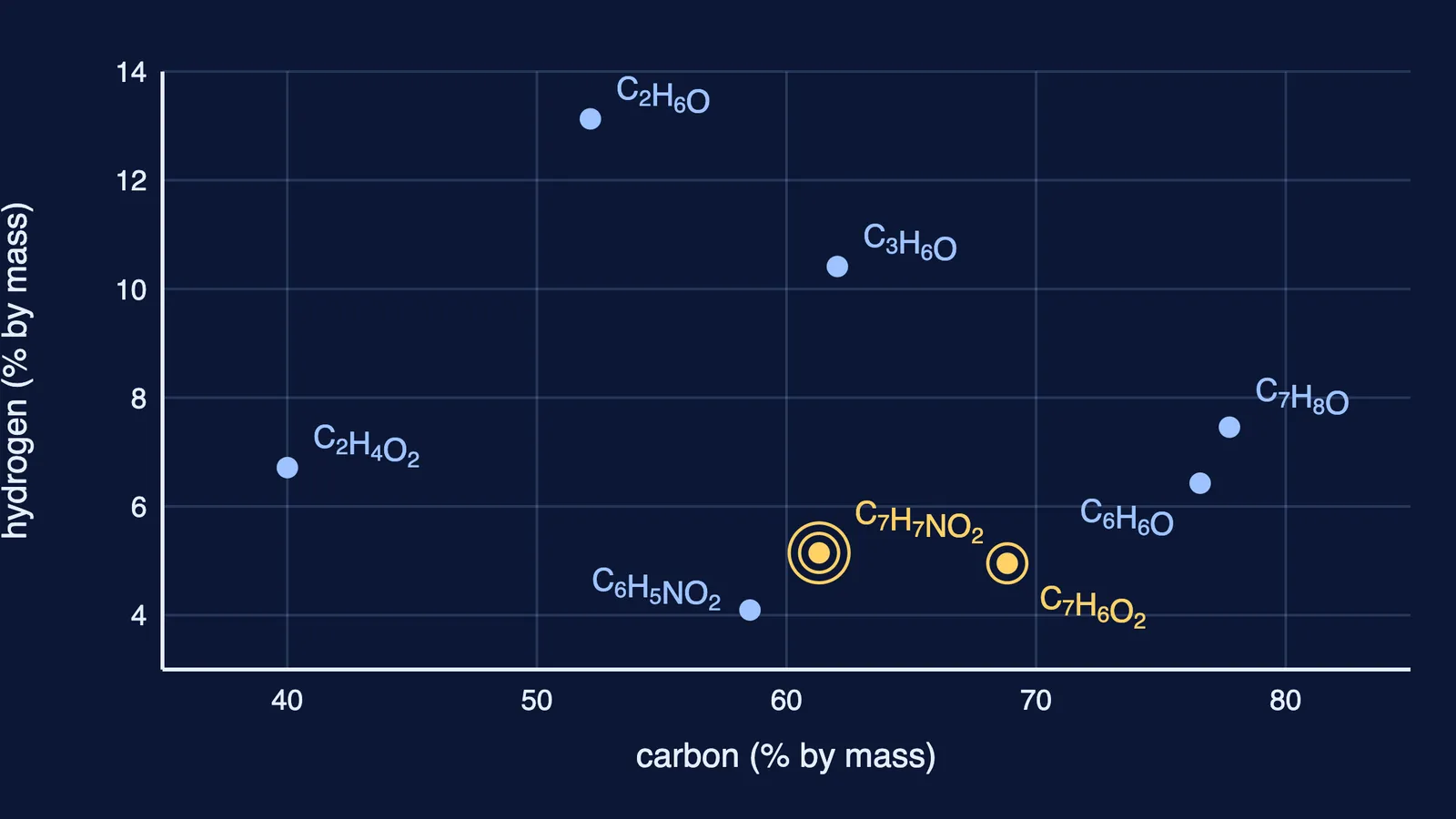
Example 1. Compound P contains only C, H and O and has molar mass 122 g/mol. Burning 0.244 g gives 0.616 g CO2 and 0.108 g H2O. P gives an orange precipitate with 2,4-DNP, a silver mirror with Tollens' reagent and a colour with neutral FeCl3, but no effervescence with NaHCO3. Which is true: (A) P gives a brick-red precipitate with Fehling's solution; (B) P is a hydroxybenzaldehyde?
Moles: C = 0.616/44 = 0.014; H = 2 × 0.108/18 = 0.012; O = (0.244 − 0.168 − 0.012)/16 = 0.004. Ratio 3.5 : 3 : 1, so C7H6O2, molar mass 122. Benzoic acid has the same formula, which is the trap: combustion cannot separate them. No NaHCO3 effervescence rules out the acid; DNP and Tollens show an aldehyde; FeCl3 shows a phenol. B is true. A is false, since aromatic aldehydes do not give Fehling's.
Example 2. Three bottles hold C7H7NO2: 4-nitrotoluene, 4-aminobenzoic acid and 2-hydroxybenzamide. All three give Prussian blue. Sort them with the fewest tests.
NaHCO3 effervescence picks out 4-aminobenzoic acid (carboxyl). Neutral FeCl3 colour picks out 2-hydroxybenzamide (phenolic –OH). The neutral one left, 4-nitrotoluene, gives carbylamine and azo dye tests only after reduction to 4-methylaniline.
Stuck on why a reagent behaves the way it does? The Fermi Problem Library has worked problems with a step-by-step solver that explains the reasoning rather than printing an answer.
What should you practise, and in what order?
A sodium fusion extract gives a blood-red colour with Fe3+ but no Prussian blue. Which elements are present?
Compound R (C, H, O; molar mass 108 g/mol): 0.216 g burns to 0.616 g CO2 and 0.144 g H2O. R gives a red colour with ceric ammonium nitrate and none with neutral FeCl3. Formula and group?
Phenol, 2,4-dinitrophenol, benzoic acid, aniline, benzaldehyde: how many dissolve in sodium hydrogencarbonate solution?
Answers: (1) nitrogen and sulphur together, as thiocyanate (NCERT). (2) C7H8O, an alcoholic –OH such as benzyl alcohol. (3) Two: benzoic acid and 2,4-dinitrophenol, which the lab manual notes is acidic enough to dissolve.
A two-week plan:
Days 1-3: Lassaigne's test, every equation and colour.
Days 4-7: one group per day from the lab manual; write each test's reagent, sign and the look-alike it rules out.
Days 8-10: combustion-plus-test puzzles like Example 1, with your own numbers.
Days 11-14: mixed multiple-correct sets; for every wrong option, write which test would have caught it.