On this page
Hydrogen and the s-block remain in JEE Advanced but have left JEE Main and NCERT, so they are easy to skip. Here: the official list, three solved problems and a plan.
What is in the JEE Advanced syllabus for periodicity, hydrogen and s-block?
The official JEE (Advanced) 2026 syllabus lists three units:
Classification of Elements and Periodicity in Properties: "Modern periodic law and the present form of periodic table; electronic configuration of elements; periodic trends in atomic radius, ionic radius, ionization enthalpy, electron gain enthalpy, valence, oxidation states, electronegativity, and chemical reactivity."
Hydrogen: "Position of hydrogen in periodic table, occurrence, isotopes, preparation, properties and uses of hydrogen; hydrides – ionic, covalent and interstitial; physical and chemical properties of water, heavy water; hydrogen peroxide-preparation, reactions, use and structure; hydrogen as a fuel."
s-Block Elements: "Alkali and alkaline earth metals-reactivity towards air, water, dihydrogen, halogens, acids; their reducing nature including solutions in liquid ammonia; uses of these elements; general characteristics of their oxides, hydroxides, halides, salts of oxoacids; anomalous behaviour of lithium and beryllium; preparation, properties, and uses of compounds of sodium (sodium carbonate, sodium chloride, sodium hydroxide, sodium hydrogen carbonate) and calcium (calcium oxide, calcium hydroxide, calcium carbonate, calcium sulphate)."
The document notes it is unchanged from 2025. The 2027 syllabus has not been published yet (as of 19 November 2026). JEE (Advanced) 2027 will be held on 23 May 2027 (Sunday), organised by IIT Delhi. To appear, you must be among the top 2,50,000 successful candidates in the B.E./B.Tech. paper of JEE (Main) 2027.
What is beyond JEE Main and NCERT here?
The JEE (Main) 2027 syllabus has no unit on hydrogen or the s-block, and its periodicity unit leaves electronegativity to chemical bonding. The current NCERT Class 11 Chemistry textbook (Reprint 2026-27) has nine units, none on either. The Advanced list is your checklist. For periodicity, start from our periodic trends guide for JEE Main.
JEE (Advanced) 2026 had two compulsory papers of three hours each (2026 Information Brochure). Question types and marking are announced in the paper itself; read how partial marking works in multiple-correct questions.
Habits:
Explain each exception with a configuration.
Track electrons. Hydride is H⁻; H₂O₂ can oxidise or reduce; alkali metals in liquid ammonia release solvated electrons.
Check a limiting case.
Worked examples at Advanced level
Ionisation energies are from the NIST Atomic Spectra Database; molar masses use IUPAC abridged atomic weights (H 1.008, C 12.011, O 15.999, Na 22.990).
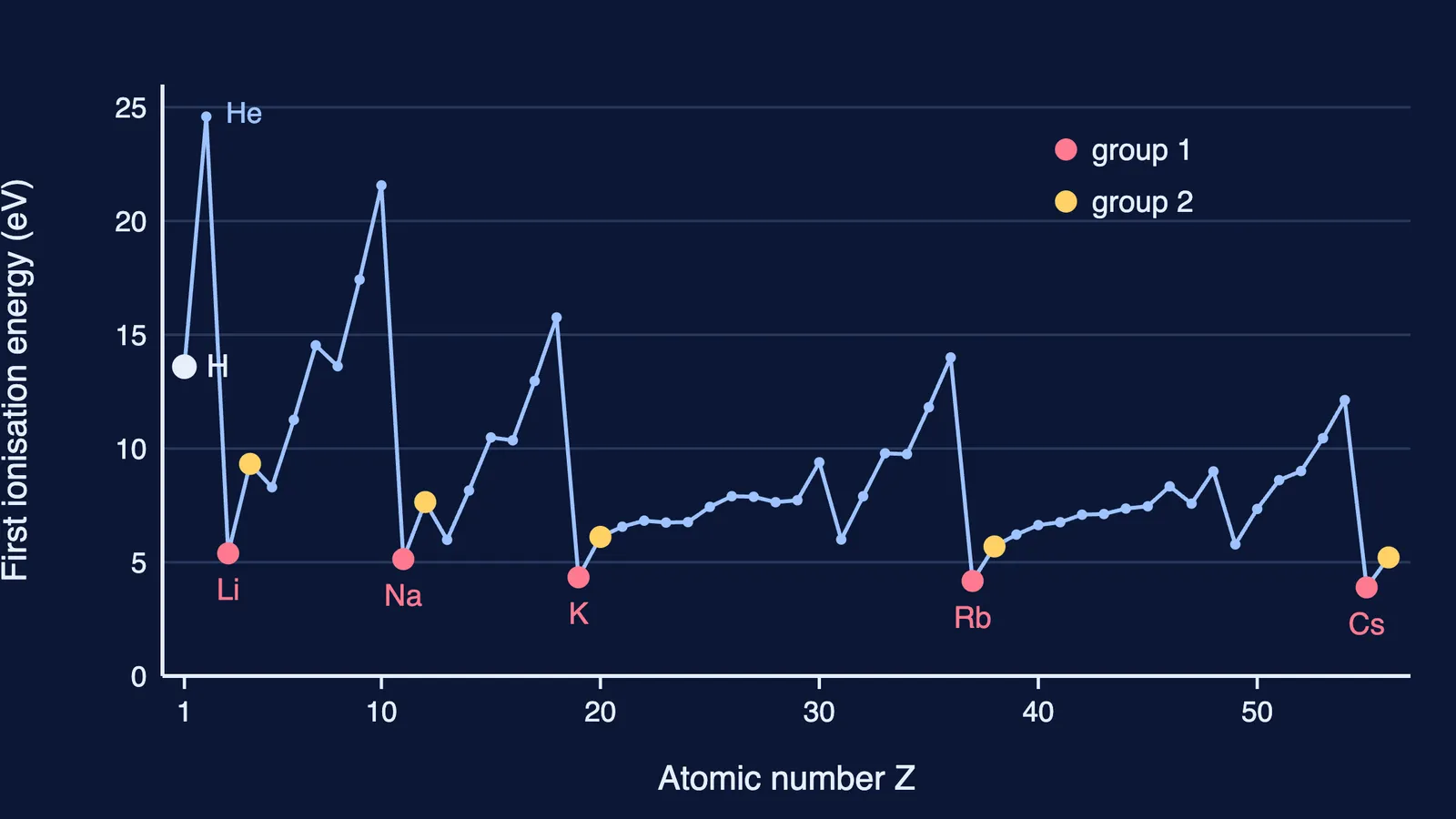
1. Real data, multiple correct. First ionisation energies (eV): Li 5.392, Be 9.323, B 8.298, N 14.534, O 13.618, Na 5.139, K 4.341, Rb 4.177, Cs 3.894. Which are correct? (A) Be exceeds B because boron loses a higher-energy 2p electron. (B) N exceeds O because oxygen's fourth 2p electron is paired. (C) Down group 1, the largest fall is Na to K. (D) Li to Na falls more than Na to K. The falls are 0.253, 0.798, 0.164 and 0.283 eV: A, B and C. Trap: assuming a smooth trend; the 3d electrons before Rb shield poorly.
2. Volume strength and a hidden convention. "15 volume" H₂O₂ gives 15 L of O₂ per litre at STP (2H₂O₂ → 2H₂O + O₂). Books differ on STP: at 273.15 K and 1 bar a mole fills 22.711 L; at 1 atm, 22.414 L. Taking 1 bar: O₂ = 0.660 mol, [H₂O₂] = 1.321 M. Dilute 10.0 mL to 100 mL and titrate 20.0 mL with 0.0200 M acidified KMnO₄: 2MnO₄⁻ + 5H₂O₂ + 6H⁺ → 2Mn²⁺ + 5O₂ + 8H₂O. H₂O₂ = 2.642 × 10⁻³ mol, MnO₄⁻ = 1.057 × 10⁻³ mol: 52.8 mL.
3. Heating a carbonate mixture. 10.00 g of Na₂CO₃ and NaHCO₃ loses 1.55 g on heating to constant mass. Only 2NaHCO₃ → Na₂CO₃ + H₂O + CO₂ loses mass: 62.02 g per 168.01 g. NaHCO₃ = 1.55 × 168.01/62.02 = 4.20 g, or 42.0%. Limiting case: pure NaHCO₃ would lose 3.69 g, so more signals an error. The 8.45 g residue is Na₂CO₃ (0.0797 mol), needing 0.159 mol HCl to a methyl orange end point.
Stuck on why a step works? The Fermi Problem Library has worked problems with a step-by-step solver that explains the reasoning rather than printing an answer.
How should you practise this unit?
Week 1, periodicity: revise with our Class 11 guide to classification of elements, then explain each dip in the chart above with a configuration.
Week 2, hydrogen: hydrides, water, heavy water, H₂O₂, volume strength.
Week 3, s-block: reactions, liquid ammonia, lithium and beryllium anomalies, and the eight named compounds as balanced equations.
Then mixed multiple-correct sets.
Practice:
Find the molarity of "20 volume" H₂O₂ at 1 atm, and at 1 bar.
5.00 g of Na₂CO₃/NaHCO₃ loses 0.93 g on heating. Find % NaHCO₃. Could it lose 2.00 g?
First ionisation energies (eV): Be 9.323, Mg 7.646, Ca 6.113, Sr 5.695, Ba 5.212. Which step falls most?
Answers: 1.785 M and 1.761 M; 50.4%, and no (the maximum is 1.85 g); Be to Mg, 1.677 eV.