On this page
JEE (Advanced) 2027 is on 23 May 2027 (Sunday), organised by IIT Delhi, says the official JEE (Advanced) website. The 2027 syllabus is not published yet (as of 19 November 2026), so this guide uses the JEE (Advanced) 2026 syllabus, which says it is unchanged from 2025. For the basics, start with our guide to lines, planes and distances in 3D geometry for JEE.
What does the JEE Advanced syllabus include for vectors and 3D geometry?
The official 2026 syllabus has two Mathematics entries for this unit:
Vectors: "Addition of vectors, scalar multiplication, dot and cross products, scalar and vector triple products, and their geometrical interpretations."
Three dimensions: "Distance between two points, direction cosines and direction ratios, equation of a straight line in space, skew lines, shortest distance between two lines, equation of a plane, distance of a point from a plane, angle between two lines, angle between two planes, angle between a line and the plane, coplanar lines."
NTA's JEE (Main) 2027 syllabus covers lines and skew lines but no planes, and its vector unit stops at scalar and vector products. So planes, coplanar lines and triple products need fresh practice.
JEE (Advanced) 2026 had two compulsory papers of three hours each (2026 Information Brochure). Question types change yearly; see our explainer on JEE Advanced question types.
How do JEE Advanced questions mix lines and planes?
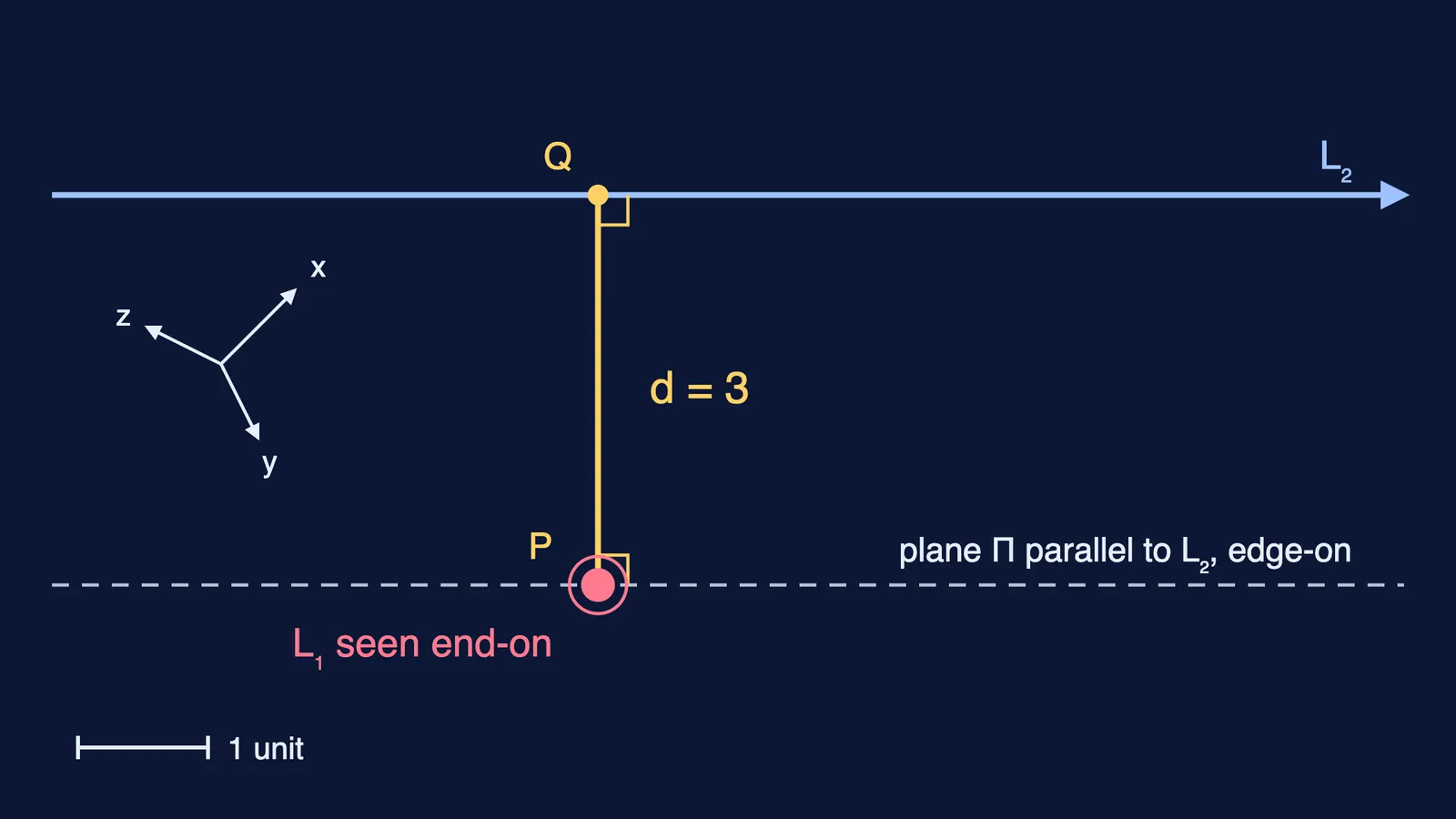
Worked example 1 (multiple correct). L₁: r = (î + 2k̂) + s(î + 2ĵ + 2k̂) and L₂: r = (4î − 2ĵ + k̂) + t(2î + ĵ − 2k̂). (A) Shortest distance 3. (B) The common perpendicular meets L₁ at (2/3, −2/3, 4/3). (C) The plane containing L₁ parallel to L₂ is 2x − 2y + z = 4. (D) The lines intersect.
b₁ × b₂ = (−6, 6, −3), magnitude 9. (a₂ − a₁) · (b₁ × b₂) = (3, −2, −1) · (−6, 6, −3) = −27, so d = 3. A true, D false.
Make PQ perpendicular to both lines: s = −1/3, t = −2/3, so P = (2/3, −2/3, 4/3) and Q = (8/3, −8/3, 7/3). B true, and |PQ| = 3 agrees.
The plane through (1, 0, 2) with normal (2, −2, 1) is 2x − 2y + z = 4, and (4, −2, 1) on L₂ is 3 from it. C true.
Answer: A, B, C. Three routes giving 3 is the check.
Some ideas are easier to see than to read. The Fermi Simulation Lab has interactive simulations for the ideas that are easier to see than to read.
How should you handle triple products in numerical-answer questions?
Worked example 2 (numerical answer). a = î + ĵ, b = ĵ + 2k̂, c = 2î + k̂. V₁ is the volume of the tetrahedron on edges a + b, b + c, c + a; V₂ is the volume of the parallelepiped on a × b, b × c, c × a. Find V₁ + V₂ to two decimals.
[a b c] = 1(1 − 0) − 1(0 − 4) + 0 = 5.
[a + b, b + c, c + a] = 2[a b c] = 10, so V₁ = 10/6 = 5/3.
[a × b, b × c, c × a] = [a b c]² = 25, so V₂ = 25.
V₁ + V₂ = 80/3 ≈ 26.67.
Checks: if c lay in the plane of a and b, both volumes must be 0, and both identities give 0. Units: V₂ is length⁶, like [a b c]².
Which traps cost marks in this unit?
Cosine for a line-plane angle. It is sin θ = |b · n| / (|b||n|).
The skew-line formula for parallel lines (b₁ × b₂ = 0). Use |(a₂ − a₁) × b| / |b|.
Forgetting that swapping two vectors flips a triple product's sign.
Stopping after one correct option in a multiple-correct question.
Same slip in every long solution? The Fermi Problem Library has worked problems with a step-by-step solver that explains the reasoning rather than printing an answer.
What is a good two-week practice plan?
Days 1-3: forms of a plane; point-plane distance.
Days 4-6: lines with planes: angles, feet of perpendiculars, coplanar lines.
Days 7-9: triple products, coplanarity, volumes.
Days 10-12: timed mixed sets, multiple-correct and numerical.
Days 13-14: redo your error log without notes.
Practice:
For what λ are r = k̂ + s(î + λĵ + k̂) and r = î + ĵ + t(î + ĵ + 2k̂) coplanar? Answer: λ = 1; they meet at (3, 3, 4).
Angle between (x − 1)/2 = y/1 = (z + 2)/(−2) and the plane x + y + z = 1? Answer: sin θ = √3/9, θ ≈ 11.1°.
If [a b c] = 3, find [2a − b, b + c, c]. Answer: 6.
Redo any you missed a week later, without notes.