On this page
These short units cost marks because questions mix thermodynamics, equilibrium and observation. JEE (Advanced) 2027 is on 23 May 2027, organised by IIT Delhi, according to the official JEE (Advanced) website. Its syllabus is not published yet, so this guide works from the 2026 one.
What does the JEE Advanced syllabus list for metallurgy and salt analysis?
The JEE (Advanced) 2026 syllabus notes that it is the same as 2025's. It lists, word for word:
Isolation of Metals: metal ores and their concentration; extraction of crude metal from concentrated ores: thermodynamic (iron, copper, zinc) and electrochemical (aluminium) principles of metallurgy; cyanide process (silver and gold); refining.
Principles of Qualitative Analysis: Groups I to V (only Ag⁺, Hg²⁺, Cu²⁺, Pb²⁺, Fe³⁺, Cr³⁺, Al³⁺, Ca²⁺, Ba²⁺, Zn²⁺, Mn²⁺ and Mg²⁺); nitrate, halides (excluding fluoride), carbonate and bicarbonate, sulphate and sulphide.
JEE (Advanced) 2026 had two compulsory papers of three hours each, according to the 2026 Information Brochure. Question types are announced in the paper; see our guide to JEE Advanced question types.
Are these topics still in NCERT and JEE Main?
Only partly.
Metallurgy: the JEE (Main) 2027 syllabus has no unit on isolation of metals. The NCERT Class 12 chemistry books (Part I, Part II, Reprint 2025-26) have ten units and none on it. The CBSE 2026-27 curriculum keeps it for formative assessment only.
Salt analysis: JEE Main 2027 keeps it in Unit 20 (practical chemistry) with a different list: cations Pb²⁺, Cu²⁺, Al³⁺, Fe³⁺, Zn²⁺, Ni²⁺, Ca²⁺, Ba²⁺, Mg²⁺ and NH₄⁺; anions CO₃²⁻, S²⁻, SO₄²⁻, NO₃⁻, NO₂⁻, Cl⁻, Br⁻ and I⁻.
Ag⁺, Hg²⁺, Cr³⁺, Mn²⁺ and bicarbonate are on the Advanced list only; learn those from scratch.
How do you study extraction of metals for JEE Advanced?
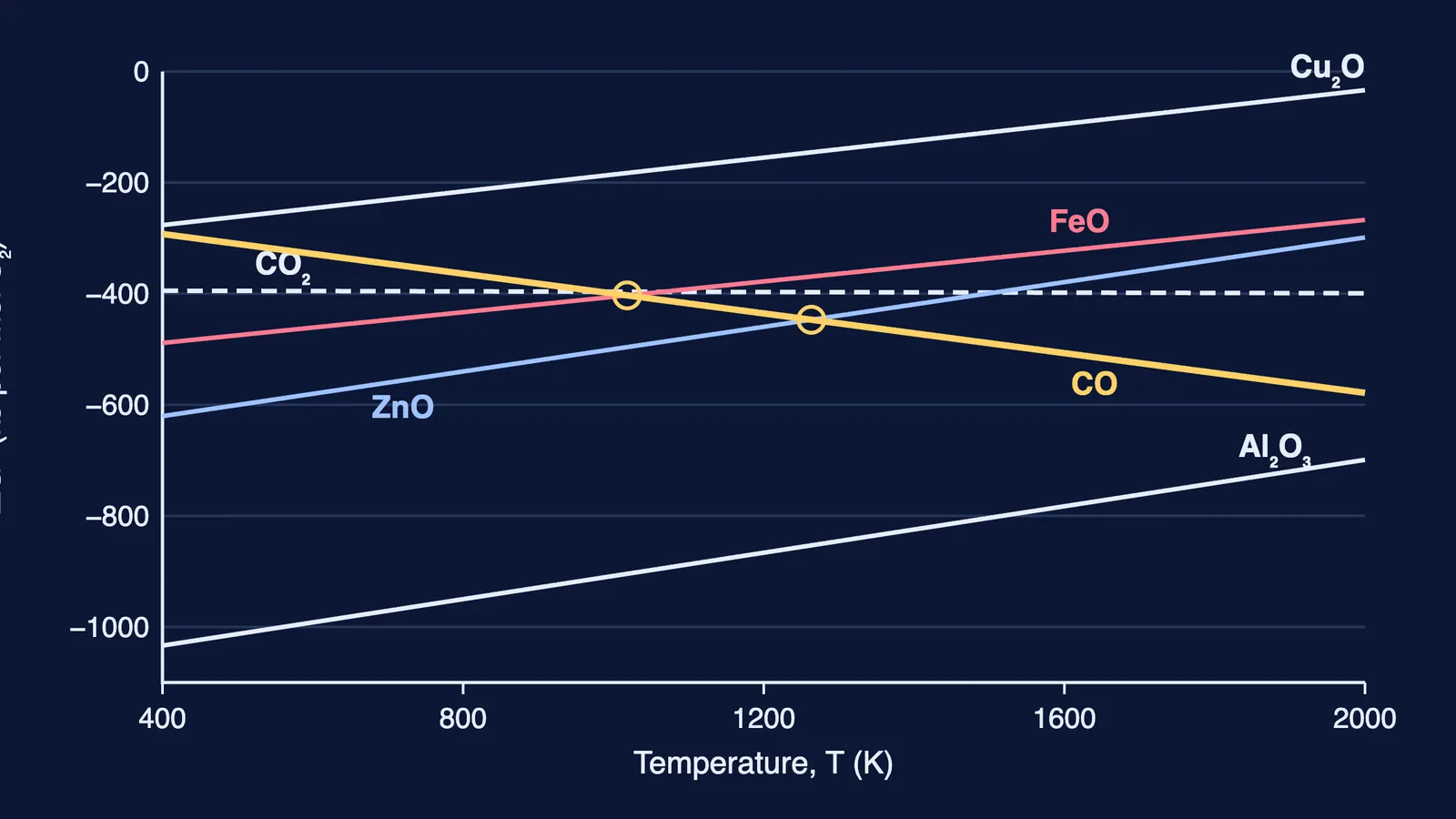
Treat it as applied thermodynamics. An Ellingham diagram plots ΔG° for forming oxides against temperature, all for the same amount of oxygen (usually one mole of O₂); a lower line can reduce the oxide of a higher one. The 2C + O₂ → 2CO line slopes down because it makes gas, so carbon gets stronger as temperature rises.
Worked example 1. Above what temperature can carbon reduce FeO to iron, giving CO? Use 298 K values from the LibreTexts thermodynamic table and assume ΔH° and ΔS° stay constant.
For FeO + C → Fe + CO: ΔH° = (−110.5) − (−272.0) = +161.5 kJ; ΔS° = 197.7 + 27.3 − 60.7 − 5.7 = +158.6 J/K. ΔG° < 0 when T > 161.5/0.1586 ≈ 1018 K. At 298 K, ΔG° ≈ +114 kJ.
Worked example 2. In the cyanide process, gold dissolves by the Elsner equation, 4Au + 8NaCN + O₂ + 2H₂O → 4Na[Au(CN)₂] + 4NaOH (gold cyanidation). How much NaCN and O₂ does 3.94 g of gold need? With CIAAW atomic weights (Au 196.97), that is 0.0200 mol Au, so 0.0400 mol NaCN (1.96 g) and 0.00500 mol O₂. Zinc dust then precipitates the metal.
How do you crack qualitative analysis questions?
Learn each ion as a chain of observations. Our post on salt analysis precipitate colours shows how to predict before you check.
Three traps from LibreTexts' characteristic reactions:
Zn(OH)₂ dissolves in excess NaOH and in excess ammonia; Al(OH)₃ dissolves in excess NaOH, so NaOH alone cannot tell them apart.
AgCl dissolves in aqueous ammonia; ammonia first precipitates brown Ag₂O from Ag⁺, which dissolves in excess.
PbCl₂ is only slightly soluble: 10 g/L at 20 °C but 33.5 g/L at 100 °C (lead ions).
Worked example 3. A Group I precipitate weighs 1.20 g, mostly PbCl₂. You wash it with 50.0 mL of water. At 20 °C up to 0.50 g can dissolve; at 100 °C up to 1.68 g, so all the PbCl₂ can. Wash sparingly cold; extract hot to separate lead from AgCl.
What does a two-week plan look like?
Days 1-3: write the syllabus list from memory; derive the CO and FeO lines.
Days 4-6: extraction of iron, copper, zinc and aluminium as reactions, plus the cyanide process and refining.
Days 7-10: one chain card per cation and anion; drill the Advanced-only ions.
Days 11-14: timed mixed sets; note what rules out each wrong option.
Not sure why a line slopes the way it does? The Fermi Concept Library has every concept in physics, chemistry, biology, mathematics and computing, each with its own lesson and its place in the map. See also how deep to study chemistry for JEE Advanced.
Practice (original):
Using the same table and ZnO data from NIST (ΔfH° −350.46 kJ/mol, S° 43.65 J/mol K), where does the 2C + O₂ → 2CO line cross the 2Zn + O₂ → 2ZnO line? Answer: about 1263 K (same assumptions).
A 150 kA aluminium cell runs 1.00 h at 92% current efficiency. What mass of aluminium forms? Use F = 96485 C/mol (NIST) and Al 26.982 (CIAAW). Answer: about 46.3 kg.
A white precipitate with dilute HCl partly dissolves in hot water; the rest dissolves in aqueous ammonia. Which listed cations are present? Answer: Pb²⁺ and Ag⁺.