On this page
Here is what JEE Advanced asks in amines, biomolecules and polymers beyond JEE Main, with three original worked problems.
The JEE (Advanced) 2026 syllabus states that it is the same as the 2025 syllabus. The 2027 syllabus is not yet published (as of 19 November 2026), so prepare from the 2026 list. The official JEE (Advanced) website says JEE (Advanced) 2027 will be held on 23 May 2027, organised by IIT Delhi.
What does the JEE Advanced syllabus list for amines, biomolecules and polymers?
The official syllabus lists:
Amines: Preparation from nitro compounds, nitriles and amides; Reactions: Hoffmann bromamide degradation, Gabriel phthalimide synthesis; Reaction with nitrous acid, Azo coupling reaction of diazonium salts of aromatic amines; Sandmeyer and related reactions of diazonium salts; Carbylamine reaction, Hinsberg test, Alkylation and acylation reactions.
Biomolecules: Carbohydrates: Classification; Mono- and di-saccharides (glucose and sucrose); Oxidation; Reduction; Glycoside formation and hydrolysis of disaccharides (sucrose, maltose, lactose); Anomers. Proteins: Amino acids; Peptide linkage; Structure of peptides (primary and secondary); Types of proteins (fibrous and globular). Nucleic acids: Chemical composition and structure of DNA and RNA.
Polymers: Types of polymerization (addition, condensation); Homo and copolymers; Natural rubber; Cellulose; Nylon; Teflon; Bakelite; PVC; Bio-degradable polymers; Applications of polymers.
How is JEE Advanced different from JEE Main for this unit?
The JEE (Main) 2027 syllabus covers amines and diazonium salts in general terms in Unit 18, while Advanced names each reaction. Polymers has its own Advanced entry but no JEE Main unit, and Advanced adds glycoside formation and anomers.
JEE Main's Unit 19, though, adds vitamins, hormones, enzymes and tertiary and quaternary protein structure, which the Advanced Biomolecules entry does not list. Keep your notes from our JEE Main amines guide and JEE Main biomolecules guide, then add the named reactions and polymers.
JEE (Advanced) 2026 had two compulsory papers of three hours each, according to the 2026 Information Brochure. Question types change from year to year; see our guide to JEE Advanced question types.
What do Advanced-level problems on this unit look like?
Molar masses use the IUPAC standard atomic weights.
Example 1: amide to amine to nitrogen gas. Hoffmann degradation of 2.92 g of a saturated, open-chain amide RCONH2 gives an amine that, with excess nitrous acid, releases 0.896 L of N2 at 273 K and 1 atm. Assuming complete reactions, find the amide, the amine and the Br2 used.
N2 = 0.896 / 22.4 = 0.0400 mol. The alkyl diazonium ion from a primary aliphatic amine is too unstable to keep, which loses N2: one mole per mole of amine.
Amide molar mass = 2.92 / 0.0400 = 73.0 g/mol: propanamide, C3H7NO (73.1 g/mol).
Hoffmann degradation gives a primary amine with one carbon fewer: ethylamine, C2H5NH2, not propylamine.
RCONH2 + Br2 + 4NaOH → RNH2 + Na2CO3 + 2NaBr + 2H2O, so Br2 = 0.0400 × 159.8 = 6.39 g.
Example 2: a tripeptide and a pH check. A tripeptide hydrolyses to two glycine and one alanine; its N-terminal residue is chiral. Find its sequence, molar mass, and free glycine's charge sign at pH 7.4.
Glycine is the only common amino acid that is not chiral, so the answer is Ala-Gly-Gly.
Each peptide bond releases one water. Two bonds: 2(75.067) + 89.094 − 2(18.015) = 203.2 g/mol.
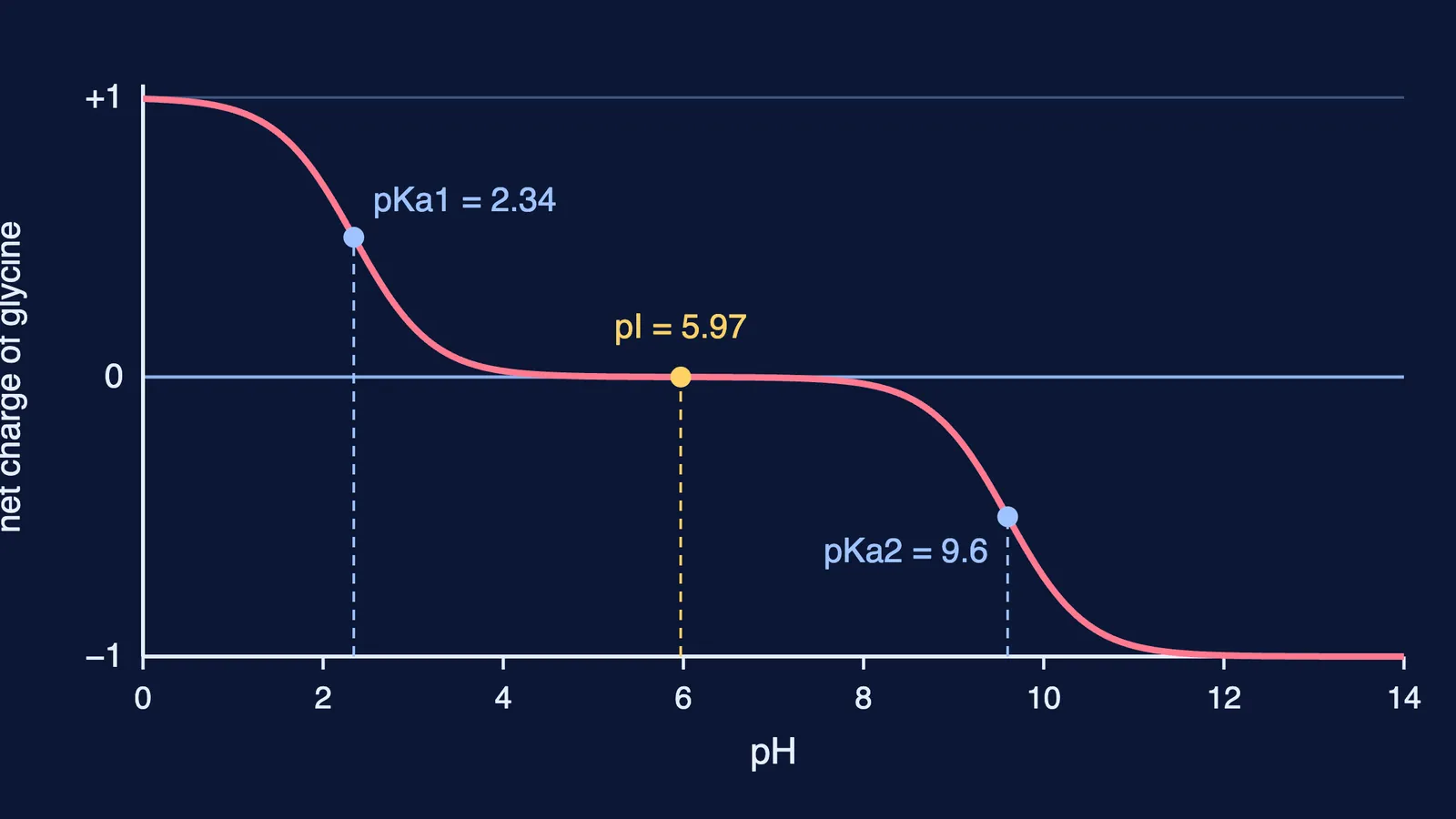
Glycine's pKa values are 2.34 (carboxyl) and 9.6 (amino), so pI = (2.34 + 9.6) / 2 = 5.97. At pH 7.4, above the pI, the net charge is slightly negative (about −0.006).
Example 3: counting water in nylon-6,6. Nylon 66 is made by condensing hexamethylenediamine with adipic acid. Find the molar mass of one linear chain made from 120 molecules of each.
240 monomers in a line are joined by 239 amide bonds, so 239 waters leave, not 240.
With C6H16N2 = 116.208 and C6H10O4 = 146.142 g/mol, molar mass = 120(116.208) + 120(146.142) − 239(18.015) ≈ 27,176 g/mol. Using 120 × 226.32 gives 27,158 and misses one water.
How should you practise this unit over four weeks?
Week 1: write each named amine reaction as reagent, product and change in carbons, and which amines it works on (the carbylamine reaction works only for primary amines).
Week 2: draw glucose anomers, the glycosidic links in sucrose, maltose and lactose, and peptides.
Week 3: for each named polymer, note monomers, addition or condensation, and homo- or copolymer.
Week 4: mixed sets joining a reaction chain to a mole calculation; judge every option in multiple-correct questions.
Stuck on why a step works? The Fermi Problem Library has worked problems with a step-by-step solver that explains the reasoning rather than printing an answer.
Practice
Hoffmann degradation of an open-chain saturated amide gives an amine of 59.11 g/mol. How many carbons had the amide, and which test confirms a primary amine?
How many waters leave when 50 molecules each of hexamethylenediamine and adipic acid form one chain?
Answers: 1. Four (the amine is C3H9N, plus the lost carbon); the carbylamine test. 2. 99.
Then add this unit to full mocks.