On this page
Biomolecules looks like recall, but JEE Main tests the reasoning: why glucose needs a ring, why sucrose fails Fehling's test, what boiling does to a protein.
What does the JEE Main 2027 syllabus include for Biomolecules?
Biomolecules is Unit 19 of the chemistry section of the NTA Syllabus for JEE (Main) - 2027. It covers carbohydrates (glucose, fructose and the units in sucrose, lactose and maltose), proteins (amino acids, peptide bond, the four structure levels, denaturation, enzymes), vitamins, nucleic acids and a general introduction to hormones.
The matching chapter is Unit 10, Biomolecules, in NCERT Class 12 Chemistry Part II (reprint 2026-27). Facts below come from it.
How do you prove the structure of glucose?
Learn each reaction as evidence for one feature of CHO–(CHOH)4–CH2OH:
Prolonged heating with HI gives n-hexane: six carbons in a straight chain.
Hydroxylamine gives an oxime, HCN a cyanohydrin: a carbonyl group.
Bromine water gives gluconic acid: the carbonyl is an aldehyde.
Acetic anhydride gives a pentaacetate: five –OH groups on different carbons.
Nitric acid gives saccharic acid, a dicarboxylic acid: a primary alcohol group.
The open chain fails on three counts. Glucose gives no Schiff's test and no NaHSO3 addition product, its pentaacetate does not react with hydroxylamine, and it crystallises in two forms. The answer is a ring: the –OH on C5 adds to the aldehyde, giving a six-membered cyclic hemiacetal (pyranose). The α and β forms differ only at C1, the anomeric carbon, so they are anomers. Both exist in equilibrium with the open chain.
Fructose is a ketohexose with its keto group at C2, forms a five-membered furanose ring, and is written D-(–)-fructose. D gives configuration, not the sign of rotation.
Which sugars are reducing, and which glycosidic linkage is where?
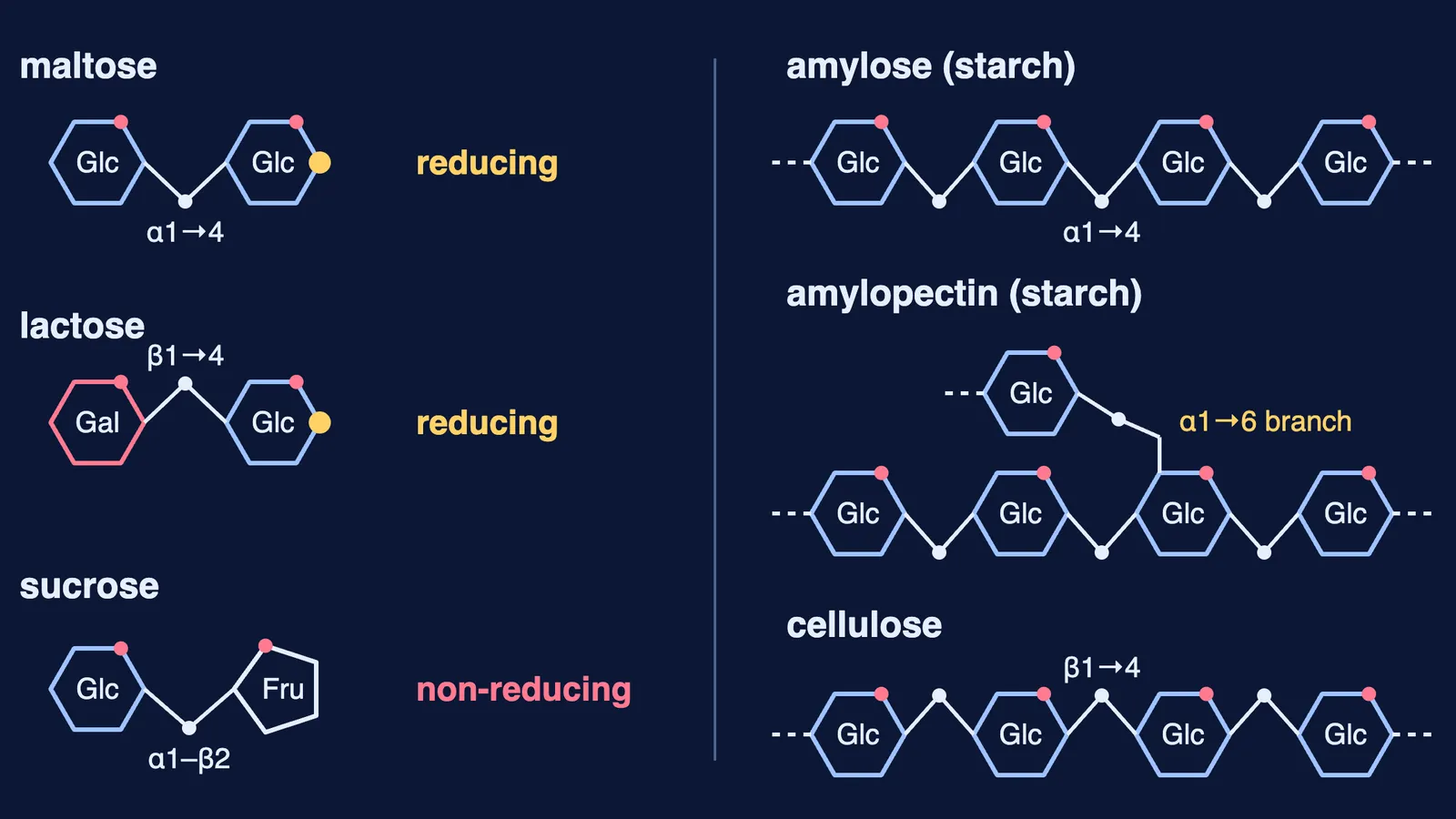
A reducing sugar reduces Fehling's solution and Tollens' reagent. Ketoses count too: all monosaccharides are reducing sugars. A disaccharide is reducing only if an anomeric carbon is left free. Both tests are covered in our guide to aldehydes, ketones and carboxylic acids for JEE Main.
Sucrose: C1 of α-D-glucose bonded to C2 of β-D-fructose. Both reducing groups are used, so it is non-reducing. Hydrolysis turns the rotation from dextro to laevo because fructose (–92.4°) outweighs glucose (+52.5°): invert sugar (NCERT Unit 10).
Maltose: two α-D-glucose units, C1 to C4. Reducing.
Lactose: β-D-galactose C1 to C4 of glucose. Reducing.
Starch: amylose is unbranched with α C1–C4 links; amylopectin adds α C1–C6 branches. See why branching matters in sticky rice and basmati.
Cellulose: a straight chain of β-D-glucose, C1 to C4.
What do you need to know about proteins, enzymes and vitamins?
Hydrolysing a protein gives α-amino acids and no others. In water they exist as zwitter ions. All except glycine are optically active; most natural ones are L.
A peptide bond, –CO–NH–, is an amide formed from the –COOH of one amino acid and the –NH2 of the next, with loss of water. Glycylalanine joins glycine's carboxyl to alanine's amino group. A tripeptide has two peptide bonds.
Primary: the amino acid sequence.
Secondary: α-helix or β-pleated sheet, held by hydrogen bonds between C=O and N–H groups.
Tertiary: overall folding into fibrous or globular shapes.
Quaternary: the arrangement of two or more subunits.
Heat or a pH change denatures a protein: the helices and folds (secondary and tertiary structure) are lost, while the amino acid sequence (primary structure) survives. Boiled egg white and curdled milk are examples. Enzymes are almost all globular proteins, specific to their substrate, and lower the activation energy.
Vitamins A, D, E and K are fat-soluble and stored in the liver and fat tissue. B-group vitamins and C are water-soluble and excreted in urine, so they must come regularly from food; B12 is the stored exception. Deficiency pairs: A, xerophthalmia and night blindness; B1, beriberi; B2, cheilosis; B6, convulsions; B12, pernicious anaemia; C, scurvy; D, rickets and osteomalacia; E, fragile red blood cells and muscle weakness; K, slower blood clotting.
How do DNA and RNA differ?
DNA's sugar is β-D-2-deoxyribose; RNA's is β-D-ribose. Both contain adenine, guanine and cytosine; DNA has thymine, RNA has uracil. A base on C1′ of the sugar is a nucleoside; phosphate at C5′ makes it a nucleotide; nucleotides join by 5′–3′ phosphodiester links. In the DNA double helix, A pairs with T and C with G. RNA is single-stranded and comes as mRNA, rRNA and tRNA.
How should you study Biomolecules in one week?
Day 1: glucose evidence, each reaction with the feature it proves.
Day 2: the ring, anomers, fructose, D/L versus (+)/(–).
Day 3: the sugar table from memory: units, linkage, reducing or not.
Day 4: amino acids, peptide bonds, structure levels, denaturation.
Day 5: vitamins and nucleic acids as flashcards; read the NCERT hormones section.
Days 6-7: previous-year questions, then reread the NCERT line behind each mistake.
If anomers will not settle, the Fermi Concept Library has every concept in physics, chemistry, biology, mathematics and computing, each with its own lesson. Preparing for NEET too? Our NCERT-first plan for Biomolecules for NEET covers the biology side.