On this page
This chapter rests on three ideas: a nucleophile attacking the carbonyl carbon, an α-hydrogen leaving as a proton, and a carboxylate ion spreading its charge. Learn those and the named reactions stop being a list. Below: the syllabus, worked examples, traps and a plan.
What does the JEE Main 2027 syllabus include for this chapter?
The chapter sits in Unit 17, Organic compounds containing oxygen, of the NTA's Syllabus for JEE (Main) - 2027. For aldehydes and ketones it names:
nucleophilic addition to the carbonyl group and the relative reactivity of aldehydes and ketones
HCN, NH₃ derivatives and Grignard reagents
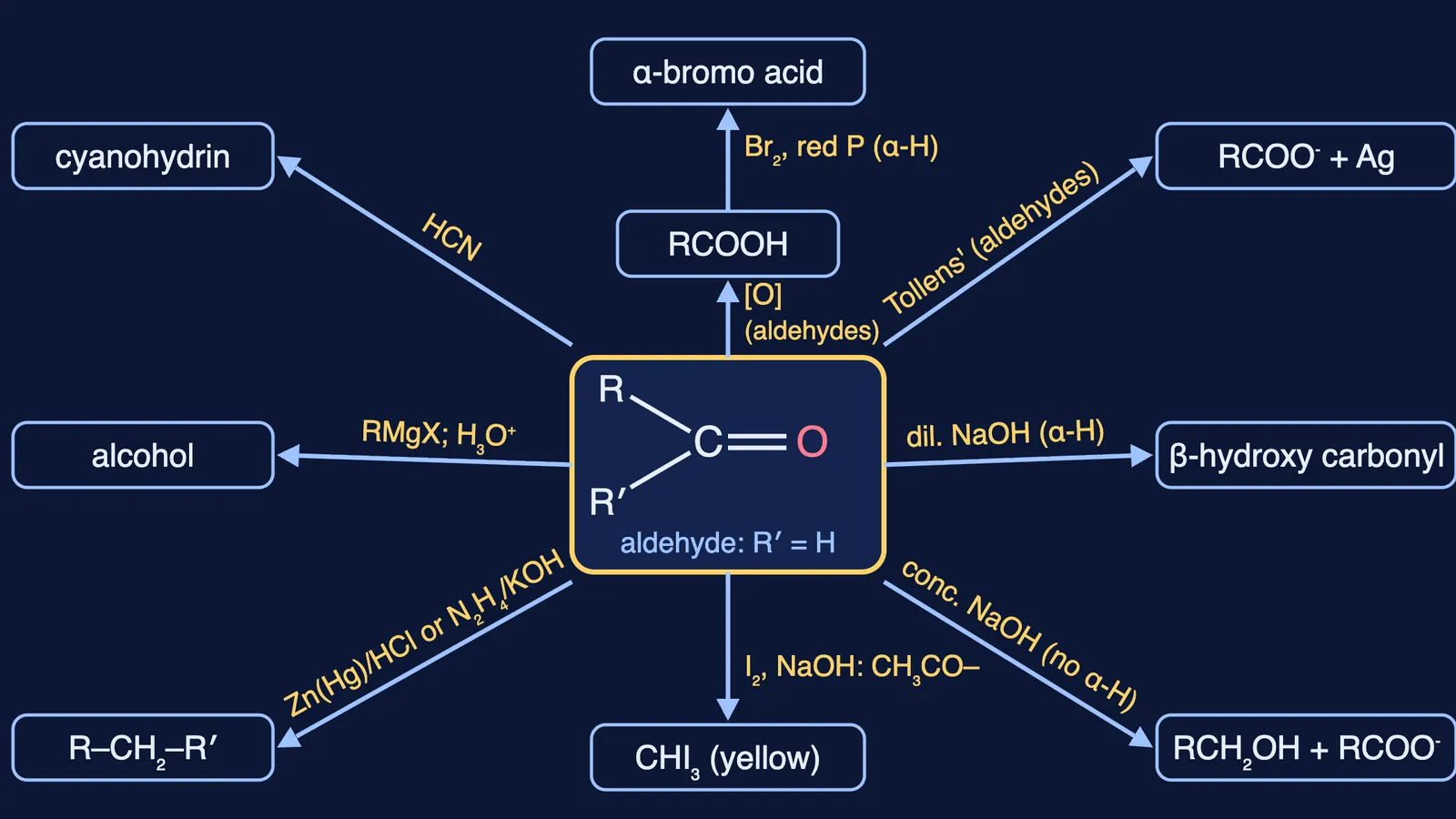
oxidation, and Clemmensen and Wolff-Kishner reduction
α-hydrogen acidity, aldol, Cannizzaro and haloform reactions
tests that tell aldehydes from ketones
For carboxylic acids it names acidic strength and what affects it. Your textbook is Unit 8, Aldehydes, Ketones and Carboxylic Acids, in NCERT Class 12 Chemistry Part II, 2026-27 reprint.
Why are aldehydes more reactive than ketones in nucleophilic addition?
The carbonyl carbon is electron-poor, so a nucleophile adds to it. Anything that crowds that carbon or pushes electrons into it slows the attack; a ketone has two such groups, an aldehyde one (NCERT Unit 8). Learn to justify these rankings:
HCHO > CH₃CHO > CH₃COCH₃: less crowding, less electron donation
propanal > benzaldehyde: the ring's resonance feeds electron density into the C=O
4-nitrobenzaldehyde > benzaldehyde > 4-methoxybenzaldehyde: a withdrawing group makes the carbon more positive, a donating group less
acetone > acetophenone > benzophenone: each aryl group adds bulk and resonance
Aldol or Cannizzaro: how do you decide which happens?
Count α-hydrogens first; they are acidic because the anion left behind is resonance-stabilised. With at least one α-hydrogen and dilute alkali, you get an aldol: a β-hydroxy aldehyde or ketone that loses water to give an α,β-unsaturated carbonyl compound. An aldehyde with none, heated with concentrated alkali, disproportionates: one molecule becomes an alcohol, the other a carboxylate salt (NCERT Unit 8).
Worked example: sort ethanal, butanone, methanal, benzaldehyde, 2,2-dimethylpropanal and benzophenone.
Ethanal and butanone have α-hydrogens: aldol. Ethanal gives 3-hydroxybutanal, then but-2-enal.
Methanal, benzaldehyde and 2,2-dimethylpropanal have none, so Cannizzaro.
Benzophenone has no α-hydrogen, but it is a ketone and Cannizzaro needs an aldehyde, so neither.
Traps: in a crossed Cannizzaro between methanal and benzaldehyde, methanal is oxidised to formate and benzaldehyde is reduced to benzyl alcohol. A cross aldol between two partners that both have α-hydrogens gives four products.
How do you tell aldehydes and ketones apart with chemical tests?
Three tests do most of the work (NCERT Unit 8):
Tollens' reagent (ammoniacal silver nitrate): aldehydes give a silver mirror; simple ketones do not.
Fehling's solution (copper sulphate with alkaline Rochelle salt): aliphatic aldehydes give a reddish-brown precipitate; aromatic aldehydes such as benzaldehyde do not.
Iodoform test (iodine with NaOH): yellow CHI₃ from a CH₃CO– group, or a CH₃CH(OH)– group that oxidises to one.
So ethanal is the only aldehyde giving iodoform; ethanol and propan-2-ol give it; butan-2-one does and pentan-3-one does not. To tell benzaldehyde from ethanal apart, use Fehling's or iodoform, not Tollens'. The story behind the silver mirror is in our post on Bernhard Tollens and his reagent.
What makes one carboxylic acid stronger than another?
Acid strength follows the stability of the carboxylate ion. Withdrawing groups spread its charge and strengthen the acid; donating groups weaken it. NCERT gives pKa values of 4.76 for acetic acid, 4.19 for benzoic acid, 3.41 for 4-nitrobenzoic acid and 4.46 for 4-methoxybenzoic acid; a lower pKa means a stronger acid (NCERT Unit 8). On the same scale phenol is about 10 and ethanol about 16.
More electronegative halogen, stronger acid: FCH₂COOH > ClCH₂COOH > BrCH₂COOH.
More withdrawing groups, stronger acid: CCl₃COOH > CHCl₂COOH > ClCH₂COOH.
Closer is stronger: ClCH₂COOH > ClCH₂CH₂COOH, as the inductive pull fades with distance.
Alkyl groups donate: HCOOH > CH₃COOH > CH₃CH₂COOH.
If the inductive effect is shaky, revisit GOC for JEE Main. NCERT also covers the Hell-Volhard-Zelinsky reaction: an acid with an α-hydrogen, treated with chlorine or bromine and a little red phosphorus, is halogenated at the α-carbon. Propanoic acid gives 2-bromopropanoic acid; benzoic acid, with no α-hydrogen, cannot.
How should you practise this chapter in two weeks?
Days 1-2: redraw the reaction map above from memory, with conditions.
Days 3-4: ten reactivity rankings a day, each with a one-line reason.
Days 5-6: sort 30 compounds into aldol, Cannizzaro or neither.
Days 7-8: predict Tollens', Fehling's and iodoform results for 12 compounds.
Days 9-10: acidity rankings and HVZ products.
Days 11-12: multi-step conversions, such as propanal to 2-methylpent-2-enal.
Days 13-14: a timed mixed set; tag each error as a concept gap or a wrong method.
For wrong-method errors, the Fermi Problem Library has worked problems with a step-by-step solver that explains the reasoning rather than printing an answer. For concept gaps, the Fermi Concept Library gives every concept in chemistry its own lesson and its place in the map.