On this page
The official JEE (Advanced) 2026 syllabus lists alkyl halides, alcohols, phenols and ethers as separate topics, and notes that it is the same as the 2025 syllabus. The 2027 syllabus is not yet published; the JEE (Advanced) website says the 2027 exam will be held on 23 May 2027, organised by IIT Delhi.
What does the JEE Advanced syllabus list for this unit?
As the 2026 syllabus words it:
Alkyl halides: rearrangement reactions of alkyl carbocation; Grignard reactions; nucleophilic substitution reactions and their stereochemical aspects.
Alcohols: physical properties; esterification, dehydration (formation of alkenes and ethers); reactions with sodium, phosphorus halides, ZnCl2/concentrated HCl, thionyl chloride; conversion into aldehydes, ketones and carboxylic acids.
Phenols: physical properties; preparation; halogenation, nitration and sulphonation; Reimer-Tiemann and Kolbe reactions; esterification; etherification; aspirin synthesis; oxidation and reduction.
Ethers: preparation by Williamson's synthesis; C-O bond cleavage reactions.
Elimination appears under alkenes, as "preparation by elimination reactions", so study it alongside substitution.
What does Advanced add beyond JEE Main?
NTA's JEE (Main) syllabus covers haloalkanes through general methods, the nature of the C-X bond and mechanisms of substitution. For ethers it lists only structure. Its phenol line names acidity, electrophilic substitution and Reimer-Tiemann.
The Advanced list names more: carbocation rearrangements, the stereochemical outcome of substitution, Williamson's synthesis, C-O cleavage, the Kolbe reaction, aspirin synthesis, and specific alcohol reagents such as thionyl chloride and Lucas reagent. For the Main-level basics, start with our guides to haloalkanes and haloarenes for JEE Main and alcohols, phenols and ethers for JEE Main.
How should you study substitution, elimination and rearrangement?
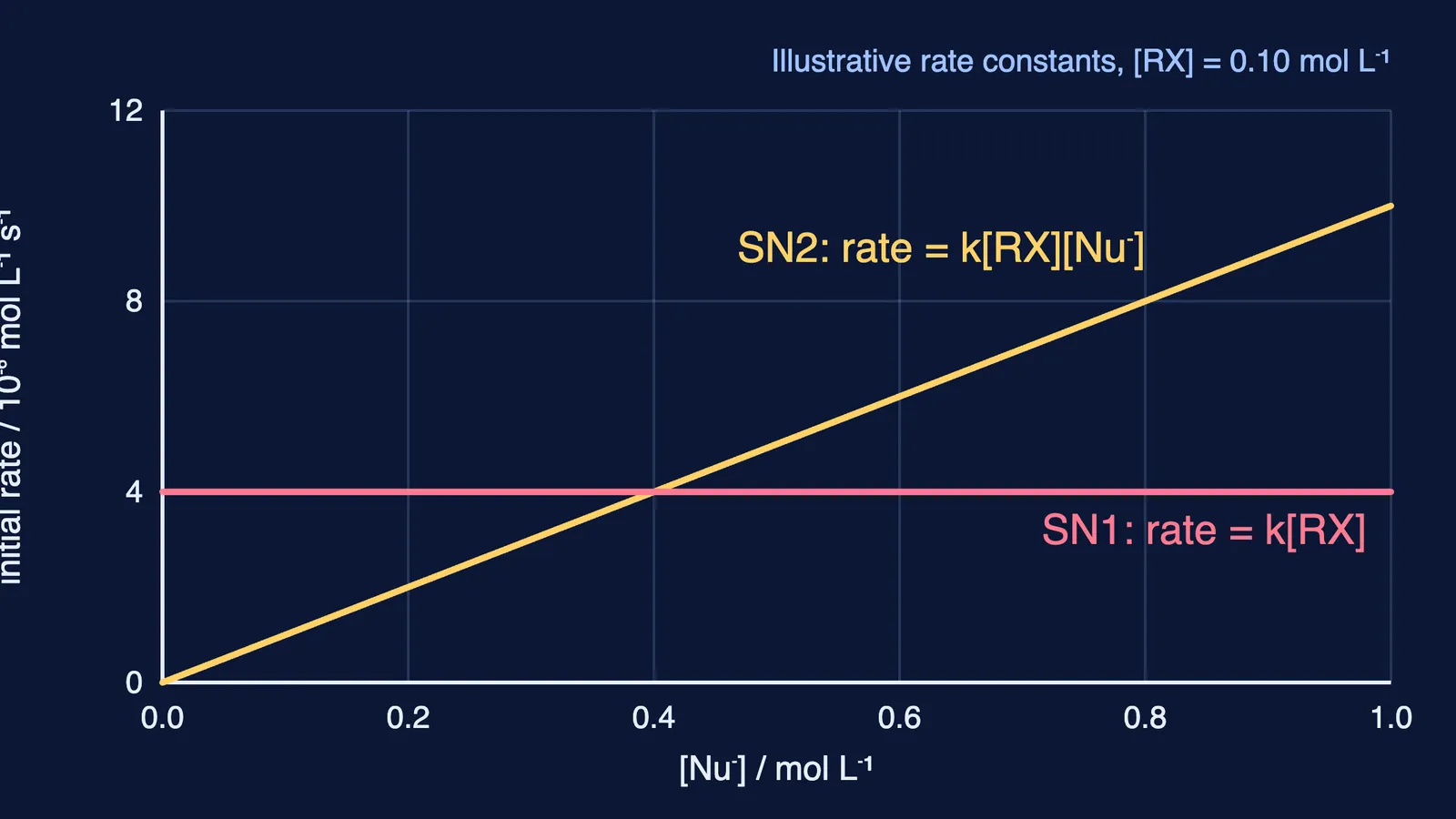
Learn the two mechanisms by their rate laws. NCERT's haloalkanes chapter states that SN2 follows second-order kinetics, with the rate depending on both reactants, while SN1 depends on the concentration of the alkyl halide only. The same chapter says SN2 at a chiral carbon gives inversion of configuration and SN1 gives racemisation.
For every substrate, ask four questions in order:
Is the carbon primary, secondary, tertiary, allylic or benzylic?
Is the reagent a strong base, a good nucleophile, or both?
If a carbocation forms, can a hydride or methyl shift make it more stable?
Was the starting carbon a stereocentre, and what happens to it?
NCERT's alcohols chapter gives a sharp Williamson rule: with a tertiary alkyl halide, an alkene is the only product and no ether forms, because alkoxides are strong bases as well as nucleophiles.
Worked examples: what do multi-concept questions look like?
Example 1 (planning an ether). You want benzyl cyclohexyl ether, C6H5CH2-O-C6H11, from 2.00 g of cyclohexanol. Which Williamson route works, what mass forms at 75% yield, and what does 1 equivalent of HI give?
Route A, sodium cyclohexoxide with benzyl bromide: attack at a primary benzylic carbon with no β-hydrogen, so substitution wins.
Route B, sodium benzyloxide with bromocyclohexane: a secondary halide, where elimination competes and cyclohexene forms. Choose route A.
Cyclohexanol (100.16 g/mol): 2.00 / 100.16 = 0.01997 mol. The ether is C13H18O (190.29 g/mol), so 0.01997 × 0.75 × 190.29 = 2.85 g.
HI first protonates the ether oxygen. Iodide then attacks the benzylic CH2 (by SN2, or SN1 via the stabilised benzyl cation), not the secondary cyclohexyl carbon, so the products are benzyl iodide and cyclohexanol.
Example 2 (rearrangement meets stereochemistry). A single enantiomer of 2-methylpentan-3-ol, CH3CH2-CH(OH)-CH(CH3)2, is shaken with ZnCl2/concentrated HCl. Give the major product, its mass percentage of chlorine, and whether it is optically active.
Loss of water gives a secondary cation at C3.
A hydride shift from C2 gives a more stable tertiary cation at C2.
Chloride adds there: 2-chloro-2-methylpentane, C6H13Cl (120.62 g/mol), with 35.45 / 120.62 = 29.4% chlorine.
C2 now carries two methyl groups, so the product has no stereocentre and is optically inactive.
The trap: writing 3-chloro-2-methylpentane.
Not sure where a mechanism went wrong? The Fermi Problem Library has worked problems with a step-by-step solver that explains the reasoning rather than printing an answer.
How do you practise for multiple-correct and numerical questions?
JEE (Advanced) 2026 had two compulsory papers of three hours each (2026 Information Brochure); question types and marking have changed from year to year. Our guide to partial marking in multiple-correct questions explains the strategy. Judge each option separately, with a one-line mechanistic reason. For numerical answers, check units and molar masses before rounding.
Try these:
0.740 g of an alcohol C4H10O reacts with excess sodium and gives immediate turbidity with Lucas reagent. Name the alcohol and find the volume of H2 at 273.15 K and 1 bar.
1.88 g of phenol is converted to aspirin through the Kolbe reaction and then acetylation, with 60% overall yield. What mass of aspirin forms?
Answers: 1. 2-Methylpropan-2-ol; 0.00499 mol H2, about 113 mL. 2. 0.01998 mol phenol × 0.60 × 180.16 g/mol = 2.16 g.
A two-week plan: days 1 to 4, substitution, elimination and rearrangements; days 5 to 8, alcohol reagents and oxidation; days 9 to 10, phenols; days 11 to 12, ethers; days 13 to 14, mixed timed questions with an error log.