On this page
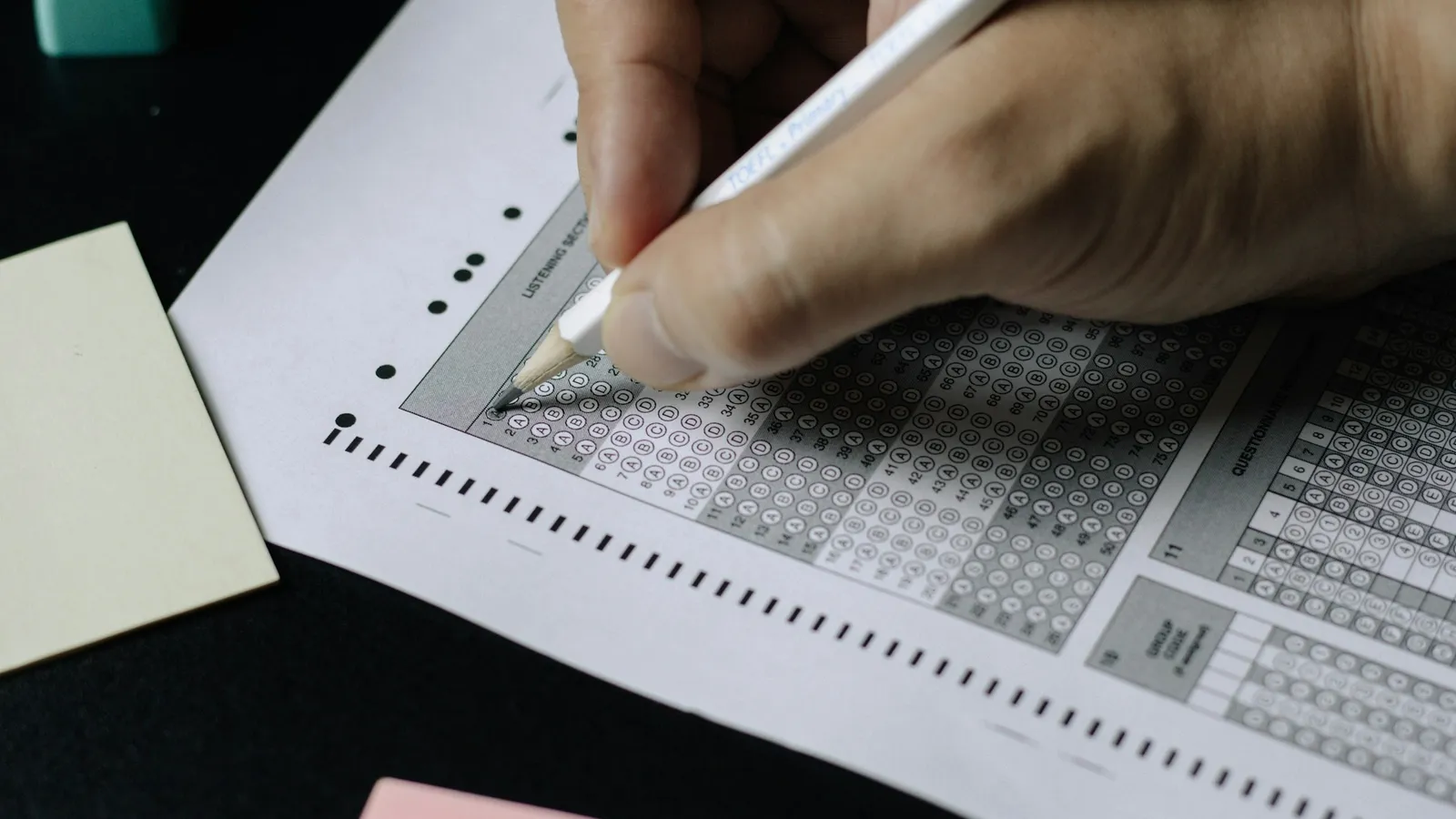
If you revise by rereading your notes, this study is about you. In 2006, Henry L. Roediger III and Jeffrey D. Karpicke of Washington University in St. Louis published "Test-Enhanced Learning: Taking Memory Tests Improves Long-Term Retention" in the journal Psychological Science. It is a classic paper on the testing effect: trying to recall something improves how well you remember it later.
What did Roediger and Karpicke test?
Does a test help memory only because it lets you see the material again? To rule that out, the control groups in the paper restudied the whole passage, while tested students only saw what they could pull from memory, with no feedback.
Who: 120 undergraduates aged 18 to 24 in Experiment 1, and 180 more in Experiment 2, all at Washington University in St. Louis.
What they learned: two short science passages, "The Sun" (256 words) and "Sea Otters" (275 words), taken from a TOEFL reading-comprehension prep book. Each was scored as 30 idea units.
Design: lab experiments. In Experiment 1, each student restudied one passage and took a recall test on the other. In Experiment 2, 30 students were assigned to each group: four 5-minute study periods (SSSS), three study periods then one recall test (SSST), or one study period then three recall tests (STTT).
Final test: a free-recall test 5 minutes, 2 days or 1 week later in Experiment 1, and 5 minutes or 1 week later in Experiment 2.
What did the testing effect study find?
In Experiment 1, after 5 minutes, students who had restudied recalled more than those who had been tested, 81% against 75%, as reported in Roediger and Karpicke (2006).
The picture flipped with time. After 2 days, the tested condition recalled 68% against 54% for restudying, and after 1 week it was 56% against 42%, with effect sizes (Cohen's d) of 0.95 and 0.83 in the paper.
Repeated testing widened the gap in Experiment 2. After 1 week, the STTT group recalled 61% of the passage, the SSST group 56% and the SSSS group 40% (Psychological Science, 2006). Yet the SSSS group had read through the passage about 14.2 times on average across its study periods, against 3.4 times for STTT. Measured as a share of what each group first knew, the readers forgot 52% in a week and the repeated testers forgot 14%.
What does the study not show?
Short lab study. One or two short passages per student, learned in a single session; a JEE syllabus is months of linked ideas.
US university students only. No school or Indian students.
Same format at practice and final test. Students practised free recall and were judged on free recall. The paper itself links the benefit to practising the very skill the test asks for. A 2018 meta-analysis on transfer looks at whether practice tests help on new kinds of questions.
Short-term cost. At 5 minutes, rereading won.
Has the testing effect been replicated?
Broadly, yes. A 2014 meta-analysis by Christopher Rowland in Psychological Bulletin compared testing with restudying across the literature and found that recall tests gave larger benefits than recognition tests such as multiple choice. A 2017 meta-analysis by Adesope, Trevisan and Sundararajan concluded that practice tests beat restudying and other comparison conditions, with effects that varied by test format and study features.
For classrooms, a 2021 systematic review by Agarwal, Nunes and Blunt coded 50 experiments with a total of 5,374 students and found that 57% of effect sizes showed medium or large benefits. The same review notes that only 6% of those experiments were run in non-WEIRD countries (outside Western, educated, industrialised, rich, democratic societies), so evidence from Indian schools is still thin. The 2013 Dunlosky review of ten study techniques covers practice testing alongside other methods.
How can JEE and NEET students use the testing effect?
What follows is our inference from the research, not a finding of the 2006 study.
Read once, then close the book. After a section of NCERT, write everything you remember on a blank page before you look again. Then check what you missed.
Turn rereading time into recall time. If you planned to reread a chapter three times, read it once and recall it twice, the way the STTT group did.
Recall, do not just recognise. Write a derivation, a reaction mechanism or a diagram from memory before you try MCQs, since recall tests showed larger benefits in the Rowland review.
Judge by what you recall days later. The benefit showed at 2 days and 1 week, not at 5 minutes, so a short recall session a few days after each topic is a reasonable habit to try.
Distrust the comfortable feeling. Test yourself on pages that feel easy too.
When a recall attempt shows a gap, check it against a clear explanation. The Fermi Concept Library has every concept in physics, chemistry, biology, mathematics and computing with its own lesson, so you can fix the gap before the next round. For a do-it-yourself trial, try this one-week rereading vs practice testing experiment.