On this page
This chapter rewards four habits: rank acidity by how well the anion holds its charge, judge alcohols by the carbocation they can form, treat phenol as a highly activated ring, and split ethers by asking which carbon the nucleophile can reach. Below: the syllabus, worked examples, traps and a two-week plan.
What does the JEE Main 2027 syllabus include for this chapter?
Alcohols, phenols and ethers sit in Unit 17, Organic compounds containing oxygen, of the NTA's Syllabus for JEE (Main) - 2027. It lists:
alcohols: telling primary, secondary and tertiary apart, and the mechanism of dehydration
phenols: acidic nature, and electrophilic substitution (halogenation, nitration, sulphonation, Reimer-Tiemann)
ethers: structure
Unit 20 of the same document adds lab detection of alcoholic and phenolic hydroxyl groups. Your textbook is Unit 7 of NCERT Class 12 Chemistry Part II, 2026-27 reprint, which also covers Kolbe's reaction, Williamson synthesis and ether cleavage. If carbocations and resonance feel shaky, revise them first with our guide to GOC for JEE Main.
How do you rank the acidity of alcohols and phenols?
Ask where the negative charge goes once the proton leaves. In an alkoxide it stays on oxygen, and alkyl groups push more electron density onto it, so acid strength among alcohols falls from primary to secondary to tertiary. Alcohols are weaker acids than water, while phenol is stronger than both, because the ring spreads the phenoxide's charge (NCERT Unit 7).
NCERT's table gives a pKa of 15.9 for ethanol and 10.0 for phenol (NCERT Unit 7). In the same table, p-nitrophenol is 7.1, o-nitrophenol 7.2, m-nitrophenol 8.3 and the three cresols 10.1 to 10.2.
Worked example: rank ethanol, phenol, 4-methylphenol, 3-nitrophenol and 4-nitrophenol, strongest acid first.
4-nitrophenol: the nitro group at para pulls the charge onto itself through resonance.
3-nitrophenol: at meta, the nitro group withdraws only inductively.
Phenol.
4-methylphenol: the methyl group donates electrons.
Ethanol: no ring to share the charge.
More practice: how to compare acidity in four steps.
How do the Lucas test and dehydration tell alcohols apart?
Both depend on how easily a carbocation forms. Lucas reagent is concentrated HCl with anhydrous ZnCl₂; the alcohol dissolves but the alkyl chloride does not, so the solution turns cloudy. Tertiary alcohols cloud at once and primary ones stay clear at room temperature (NCERT Unit 7). Secondary alcohols react more slowly than tertiary ones, and benzyl and allyl alcohols, though primary, react quickly because their carbocations are resonance-stabilised.
Acid-catalysed dehydration follows the same ranking: tertiary > secondary > primary. Ethanol needs concentrated H₂SO₄ at 443 K to give ethene; at 413 K the main product is ethoxyethane (NCERT Unit 7). For how alcohols become haloalkanes, see making haloalkanes from alcohols and alkenes.
Worked example: 3,3-dimethylbutan-2-ol with hot acid. The secondary carbocation shifts a methyl group to become tertiary, and losing a proton gives 2,3-dimethylbut-2-ene as the major product, the more substituted alkene.
What reactions of phenol does JEE Main test most?
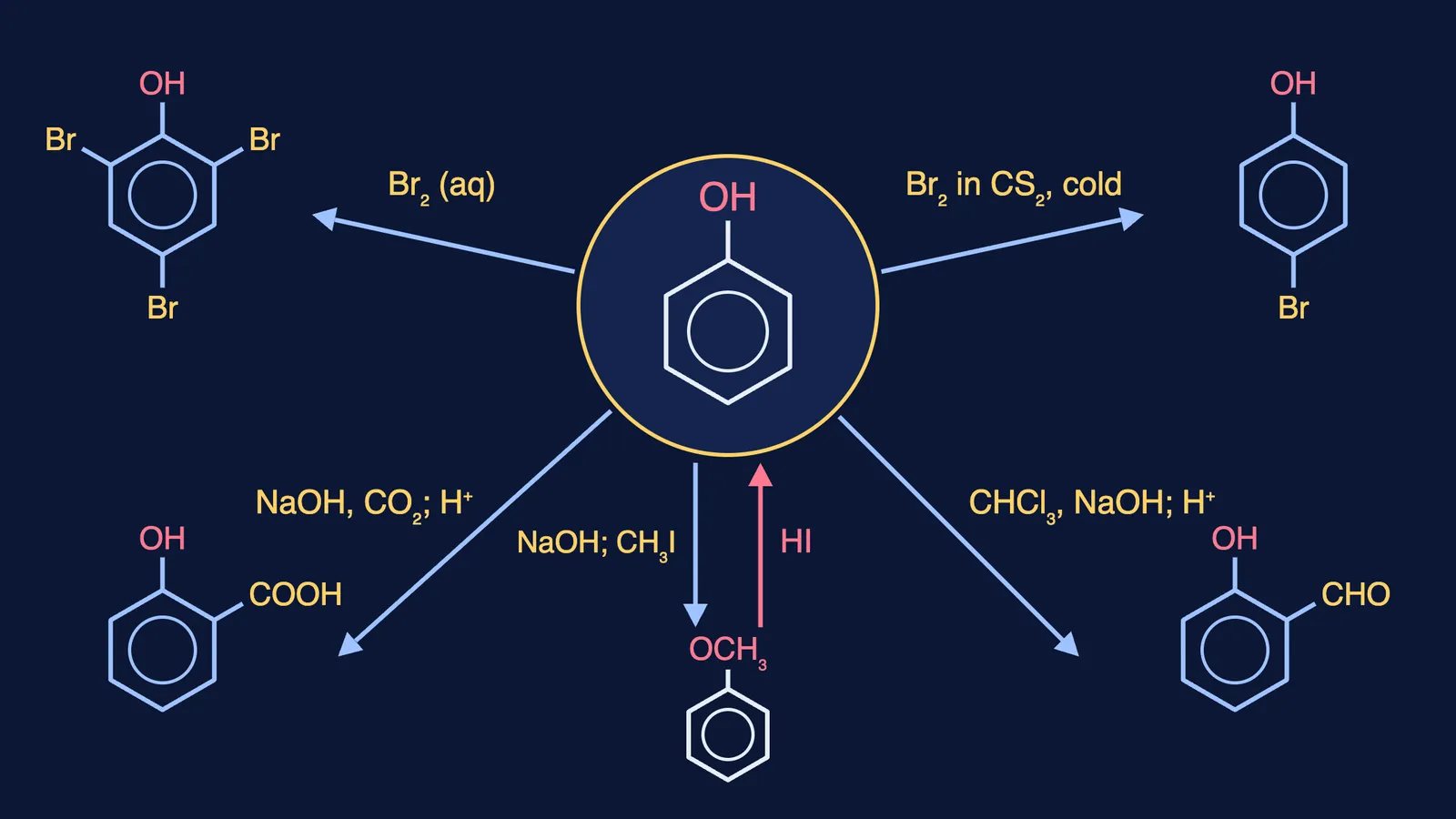
The OH group pushes electron density into the ring, so phenol substitutes at ortho and para far faster than benzene (NCERT Unit 7).
Bromine water: 2,4,6-tribromophenol, a white precipitate, with no Lewis acid needed.
Bromine in CS₂ or CHCl₃ at low temperature: monobromophenols, mostly para.
Dilute HNO₃ at 298 K: o- and p-nitrophenol, separable by steam distillation. Concentrated HNO₃ gives picric acid in poor yield.
Kolbe: sodium phenoxide with CO₂, then acid, gives salicylic acid.
Reimer-Tiemann: CHCl₃ and NaOH, then acid, gives salicylaldehyde.
Both put the new group ortho to the OH.
How are ethers made and split?
Williamson synthesis is an SN2 reaction of an alkoxide with an alkyl halide, so it works best with a primary halide. Secondary halides partly eliminate, and with a tertiary halide the alkoxide acts as a base and you get only an alkene (NCERT Unit 7). To make tert-butyl ethyl ether, use sodium tert-butoxide with ethyl bromide, not sodium ethoxide with tert-butyl bromide. For an aryl ether, the phenoxide supplies the oxygen; an aryl halide will not undergo SN2.
Ethers split with concentrated HI or HBr on heating, HI fastest. With two primary or secondary groups, iodide attacks the smaller one. With a tertiary group the reaction goes SN1 and the tertiary iodide forms. Anisole gives phenol and methyl iodide, never iodobenzene, because the ring carbon resists substitution (NCERT Unit 7).
What is a good two-week plan for this chapter?
Days 1-2: read the NCERT unit; list each reagent beside its product.
Days 3-4: rank 20 acidity sets, saying the reason aloud.
Days 5-6: Lucas, dehydration and rearrangements; draw each carbocation.
Days 7-8: phenol substitution, Kolbe and Reimer-Tiemann; redraw the reaction map from memory.
Days 9-10: Williamson and HI cleavage, including the tertiary and anisole cases.
Days 11-14: mixed timed sets; log every error as a wrong fact or a wrong mechanism.
When a mechanism goes wrong and you cannot see why, the Fermi Problem Library has worked problems with a step-by-step solver that explains the reasoning rather than printing an answer.