On this page
These eight original questions cover what the official JEE (Advanced) 2026 syllabus lists under "Vectors" and "Three dimensions": products, lines, planes and distances. They use single-correct, one-or-more-correct, numerical-value and list-match formats. JEE (Advanced) 2027 is on 23 May 2027, says the official website. For theory first, read our guide to preparing 3D geometry and vectors for JEE Advanced.
How should you use this practice set?
Attempt all eight in 30 minutes, on paper, before reading solutions.
In multiple-correct questions, test every option.
Read each trap line, even when you are right.
Log misses as concept, method or arithmetic; redo them in a week.
Easy: can you set up the plane and the cross product?
Q1 (easy, single correct). The plane containing x/2 = (y − 1)/(−1) = (z + 1)/3 and P(1, 1, 1) is at what distance from the origin?
(A) 2 (B) √6/6 (C) √6/3 (D) 2√3/3
Answer: (C). A(0, 1, −1) is on the line, direction (2, −1, 3). Normal = (2, −1, 3) × AP = (2, −1, 3) × (1, 0, 2) = (−2, −1, 1), so the plane is 2x + y − z = 2. Distance = 2/√6 = √6/3. Trap: (A) forgets to divide by |n|.
Q2 (easy, numerical value). |a| = 2, |b| = 5, a · b = 6. Find |(a + 2b) × (3a − b)|.
Answer: 56. The product is −a × b + 6(b × a) = −7(a × b). Lagrange's identity gives |a × b|² = 100 − 36 = 64, so the answer is 7 × 8 = 56. Trap: writing 6(b × a) as +6(a × b) gives 40.
Medium: where do lines, planes and vector equations meet?
Q3 (medium, one or more options correct). L₁: (x − 1)/1 = (y + 1)/2 = (z − 3)/(−1); L₂: (x − 4)/1 = (y + 1)/(−1) = (z − 6)/2.
(A) They meet at (2, 1, 2). (B) The acute angle between them is 60°. (C) The plane containing both is x − y − z + 1 = 0. (D) The acute-angle bisector has direction ratios (2, 1, 1).
Answer: (A), (B), (C). s = 1 on L₁ and t = −2 on L₂ both give (2, 1, 2). cos θ = −3/6 = −1/2, so the acute angle is 60°. The normal (1, 2, −1) × (1, −1, 2) = 3(1, −1, −1) through (2, 1, 2) gives C. The unit vectors make 120°, so their sum, along (2, 1, 1), bisects the obtuse angle; the acute bisector is along (0, 1, −1). Trap: adding unit vectors without checking the sign of their dot product.
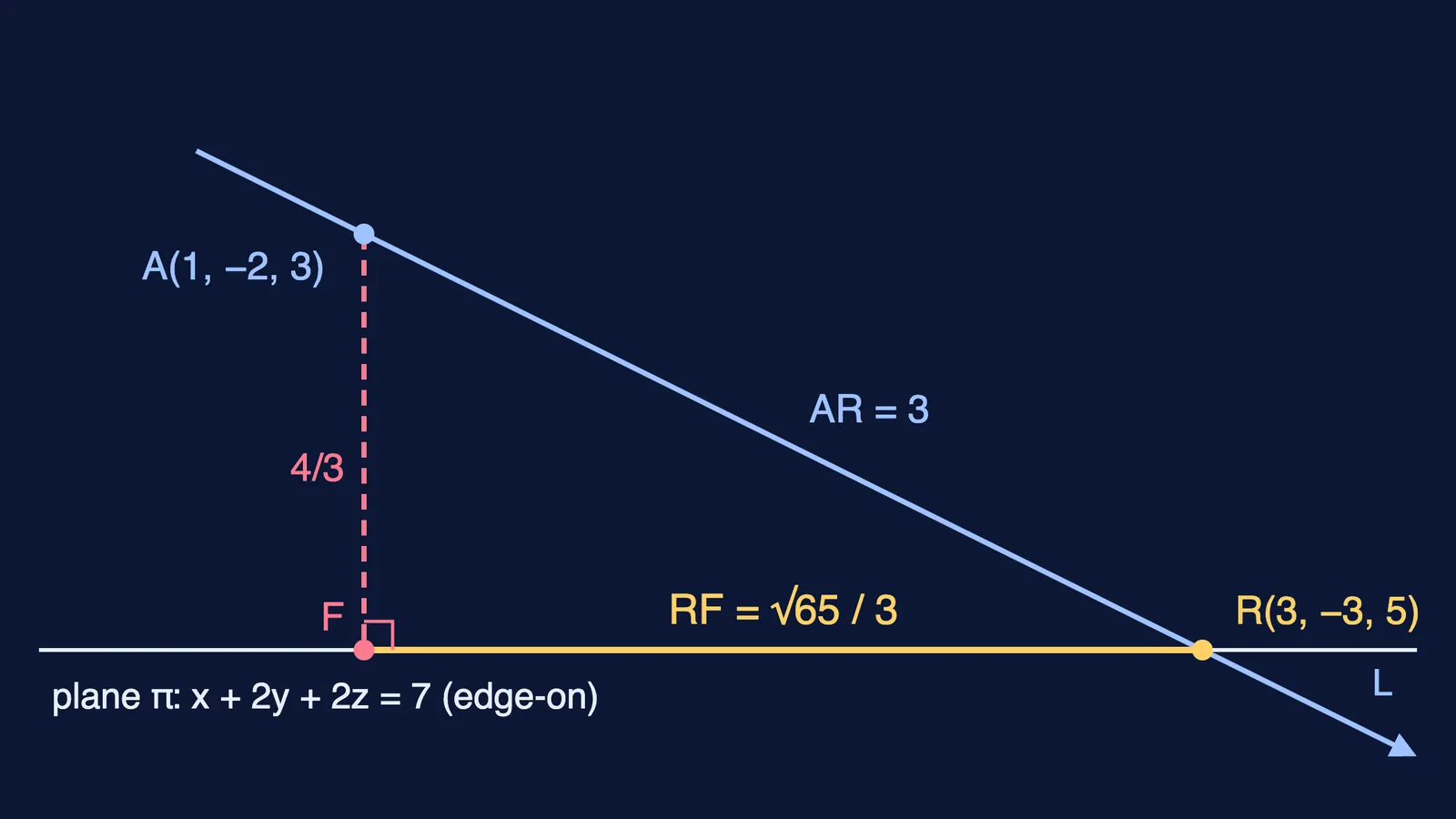
Q4 (medium, single correct). L: (x − 1)/2 = (y + 2)/(−1) = (z − 3)/2 meets the plane x + 2y + 2z = 7 at R. F is the foot of the perpendicular from A(1, −2, 3) to the plane. Find RF.
(A) √97/3 (B) √65/3 (C) 5/3 (D) 4/3
Answer: (B). Substituting gives t = 1, so R = (3, −3, 5) and AR = 3. AF = |1 − 4 + 6 − 7|/3 = 4/3. The right angle is at F, so RF = √(9 − 16/9) = √65/3. Trap: (A) adds the squares.
Q5 (medium, numerical value). a = î + 2ĵ − k̂, b = 3î + k̂, c = î + ĵ + k̂. If r × a = b × a and r · c = 0, find |r|².
Answer: 26. (r − b) × a = 0, so r = b + λa. Then 4 + 2λ = 0, λ = −2 and r = î − 4ĵ + 3k̂, so |r|² = 26. Trap: "cancelling" a to get r = b gives 10, but b · c ≠ 0.
Hard: can you combine three ideas in one question?
Q6 (hard, one or more options correct). O is the origin; A(1, 2, 0), B(0, 1, 2), C(2, 0, 1).
(A) Tetrahedron OABC has volume 3/2. (B) Triangle ABC has area 3√3. (C) O is √3 from plane ABC. (D) The shortest distance between lines OA and BC is 3√30/10.
Answer: (A), (C), (D). [A B C] = 9, so the volume is 9/6. AB × AC = (3, 3, 3): area 3√3/2, plane x + y + z = 3, distance √3. Check: (1/3)(3√3/2)(√3) = 3/2. OA × BC = (−2, 1, −5), and |OB · (−2, 1, −5)|/√30 = 9/√30. Trap: (B) drops the half.
Q7 (hard, list-match). Plane π: 2x + y − 2z = 4; A(1, 0, 2); line M through A along (1, 1, 0).
List-I: (P) distance of A from π; (Q) distance from A to where M meets π; (R) distance of O from π; (S) distance of O from the image of A in π.
List-II: (1) 2 (2) 2√2 (3) 4/3 (4) √141/3 (5) √2
(A) P1 Q5 R3 S4 (B) P2 Q1 R3 S4 (C) P1 Q2 R3 S4 (D) P1 Q2 R5 S4
Answer: (C). P = 6/3 = 2. M meets π at (3, 2, 2), 2√2 from A (θ = 45°, so 2/sin θ). R = 4/3. The image is (11/3, 4/3, −2/3), giving √141/3. Trap: (A) multiplies by sin θ.
Q8 (hard, numerical value). Skew lines L₁: r = î + s(ĵ + k̂) and L₂: r = ĵ + t(î − k̂). A line through A(0, 1, 4) meets L₁ at P and L₂ at Q. Find PQ².
Answer: 10. P = (1, s, s), Q = (t, 1, −t). Setting (P − A) × (Q − A) = 0 gives only s = 1, t = 2. So P = (1, 1, 1), Q = (2, 1, −2) and PQ² = 10. Check: Q − A = 2(P − A). Trap: using the common perpendicular, which ignores A.
What should you do after this set?
Missed Q5? Revise our vector triple product explainer. Missed Q3 or Q4? Revisit 3D geometry for JEE: lines, planes and distances. For more practice, the Fermi Problem Library has worked problems with a step-by-step solver that explains the reasoning rather than printing an answer.