On this page
A vector triple product takes three vectors and crosses one of them with the cross product of the other two. It looks like it should need a full determinant every time, but there is a short formula, and once you see why it works you will not forget the order of the letters.
What is the vector triple product formula?
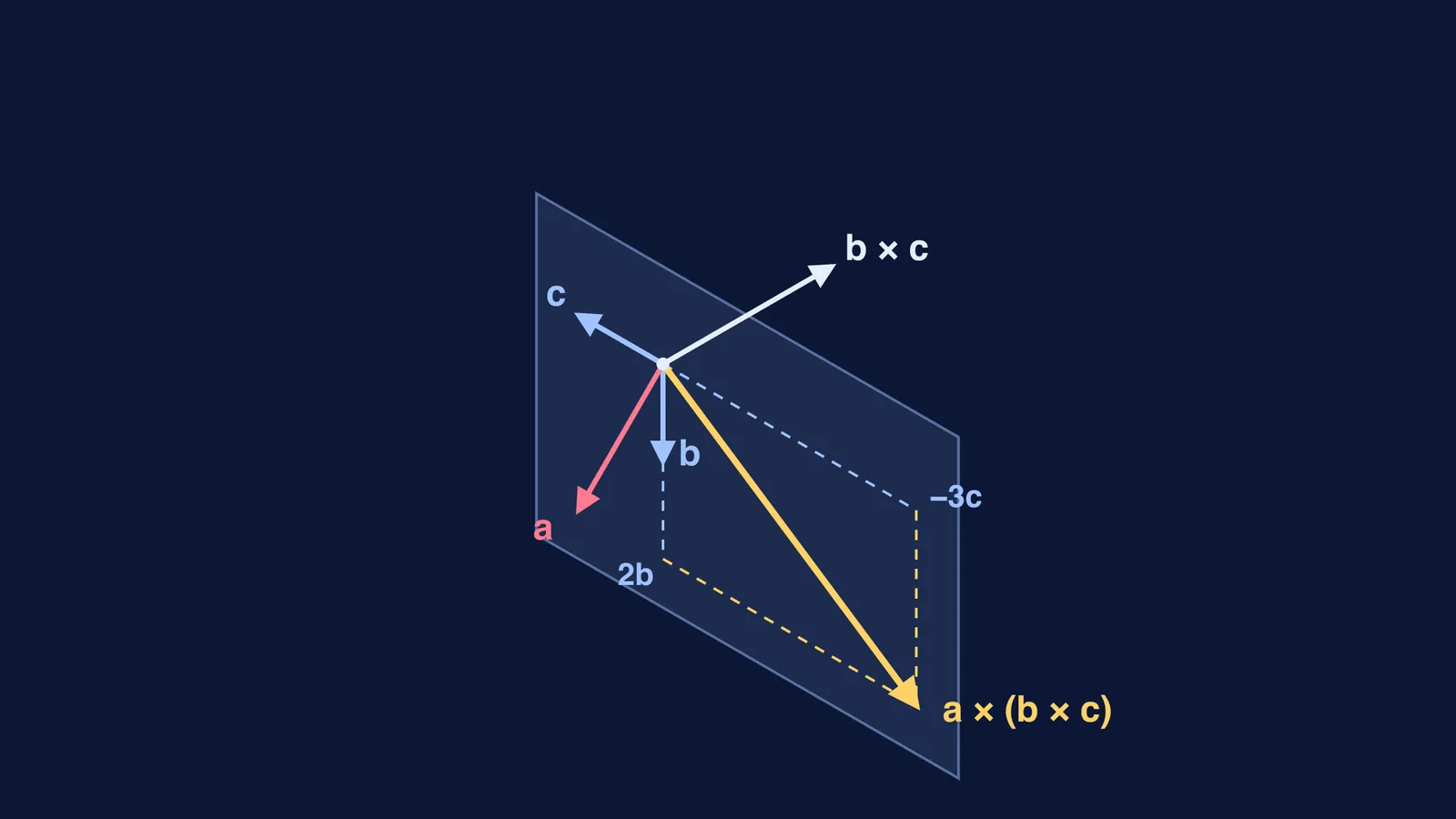
The expansion is a × (b × c) = b(a · c) − c(a · b), as listed on Wolfram MathWorld's vector triple product page, which notes it is also known as the BAC − CAB identity. Read the right-hand side aloud as "b a c minus c a b": the first vector outside the brackets goes in both dot products, and each of the two inner vectors gets multiplied by a dot product.
The same identity is called the triple product expansion or Lagrange's formula, according to Wikipedia's article on the triple product, which also points out that the name Lagrange's formula is used for several other results.
A quick way to check you have the sign right: the vector that appears in the middle of the brackets (b) takes the plus sign, and the one at the end (c) takes the minus sign.
How do you prove a × (b × c) = b(a · c) − c(a · b)?
A direct proof is to check one component and let symmetry do the rest. Write a = (a₁, a₂, a₃), and the same for b and c.
The components of b × c are (b₂c₃ − b₃c₂, b₃c₁ − b₁c₃, b₁c₂ − b₂c₁). If the determinant expansion still trips you up, our walk-through of expanding a cross product by determinant without sign errors covers it.
The x-component of a × (b × c) is a₂(b₁c₂ − b₂c₁) − a₃(b₃c₁ − b₁c₃).
Group the terms by b₁ and c₁: b₁(a₂c₂ + a₃c₃) − c₁(a₂b₂ + a₃b₃).
Add and subtract a₁b₁c₁: b₁(a₁c₁ + a₂c₂ + a₃c₃) − c₁(a₁b₁ + a₂b₂ + a₃b₃).
That is b₁(a · c) − c₁(a · b), the x-component of b(a · c) − c(a · b).
The y and z components follow the same steps with the indices shifted 1 → 2 → 3 → 1, so the identity holds for every component.
Why does the result lie in the plane of b and c?
You can see this without any algebra. The vector b × c is perpendicular to the plane that contains b and c; call it the normal n. Crossing a with n gives a vector perpendicular to n, and every vector perpendicular to n lies in the plane of b and c (as long as b and c are not parallel).
The formula says the same thing: b(a · c) − c(a · b) is just a number times b plus a number times c. The answer is also perpendicular to a, because it is a cross product with a.
Why do the brackets matter?
The cross product is not associative, so (a × b) × c is a different vector. Writing it as −c × (a × b) and applying BAC − CAB gives (a × b) × c = b(a · c) − a(b · c), the form shown in Wikipedia's triple product article. This one lies in the plane of a and b, the two vectors inside its brackets.
Here is a worked example with a = (1, 2, 0), b = (1, 1, 0) and c = (0, 1, 1).
Dot products: a · c = 2, a · b = 3, b · c = 1.
Directly: b × c = (1, −1, 1), so a × (b × c) = (2, −1, −3).
By BAC − CAB: 2b − 3c = (2, 2, 0) − (0, 3, 3) = (2, −1, −3). It matches.
Check: (2, −1, −3) · a = 2 − 2 + 0 = 0, so it is perpendicular to a, as it must be.
Other bracket: a × b = (0, 0, −1), so (a × b) × c = (1, 0, 0).
By the second formula: 2b − 1a = (2, 2, 0) − (1, 2, 0) = (1, 0, 0). It matches.
Same three vectors, two groupings, two different answers: (2, −1, −3) and (1, 0, 0).
Where does this show up in problems?
The expansion turns many cross-product questions into dot-product questions. If a question gives a × (b × c) = 0 with b and c not parallel, the formula forces a · c = 0 and a · b = 0, so a is perpendicular to both. If you need the part of a vector that lies along another one, see how to find the component of a vector along another vector; a × (a × b) with a unit vector a gives the part of b perpendicular to a, with a minus sign. And when a problem squares a cross product, Lagrange's identity, |a × b|² + (a · b)² = |a|²|b|², is the natural partner.
To practise, take any three vectors, compute both groupings by determinant, then check each with its formula and the plane test above. The Fermi Problem Library has worked problems with a step-by-step solver that explains the reasoning rather than printing an answer, so you can compare each line with yours. If dot and cross products themselves feel shaky, start with the lessons in the Fermi Concept Library.