On this page
Computing a cross product by hand means nine numbers, three small determinants and one minus sign that is easy to drop. Here is the layout, the sign rule that matters, a worked example and a quick check.
How do you write a × b as a determinant?
Put the unit vectors in the top row, the first vector in the second row and the second vector in the third row. For a = a₁i + a₂j + a₃k and b = b₁i + b₂j + b₃k, the layout is:
Row 1: i, j, k
Row 2: a₁, a₂, a₃
Row 3: b₁, b₂, b₃
Then expand along the top row. OpenStax Calculus Volume 3 gives the result as a × b = (a₂b₃ − a₃b₂)i − (a₁b₃ − a₃b₁)j + (a₁b₂ − a₂b₁)k.
Order matters. The vector written first goes in row 2. Swap rows 2 and 3 and every sign flips, because the cross product is anticommutative: b × a = −(a × b), as the same OpenStax section states. We explain this in more depth in why reversing the order of a cross product changes its sign.
Why does the j term get a minus sign?
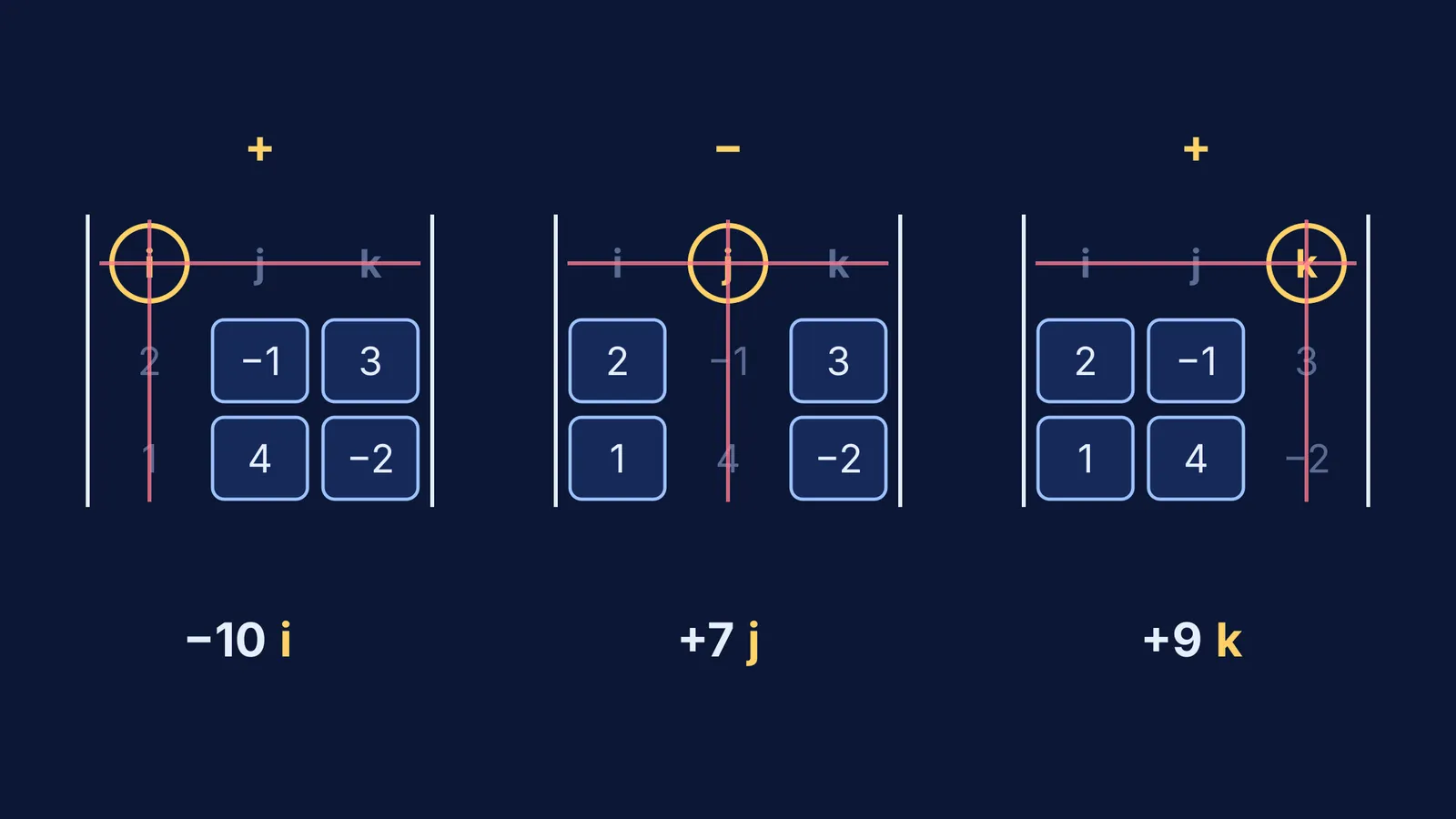
Each entry in the top row takes a sign from the checkerboard pattern, which reads +, −, + across the first row. To find the coefficient of i, cover the row and the column that i sits in; the four numbers left form a 2 × 2 determinant. Do the same for j and for k. Then attach the signs: +i, −j, +k.
The minus belongs to the position of j, not to the numbers. One easy slip: getting the j minor right, then forgetting the minus, or applying it twice by also reversing the order inside the bracket. If the checkerboard itself feels shaky, our post on the sign pattern for minors and cofactors walks through it step by step.
Worked example: what is a × b for a = 2i − j + 3k and b = i + 4j − 2k?
Set up the determinant:
Row 1: i, j, k
Row 2: 2, −1, 3
Row 3: 1, 4, −2
The i term: cover row 1 and column 1. Left over: −1, 3 above 4, −2. Determinant: (−1)(−2) − (3)(4) = 2 − 12 = −10. The sign is +, so you get −10i.
The j term: cover row 1 and column 2. Left over: 2, 3 above 1, −2. Determinant: (2)(−2) − (3)(1) = −4 − 3 = −7. The sign is −, so −(−7) = +7, giving +7j.
The k term: cover row 1 and column 3. Left over: 2, −1 above 1, 4. Determinant: (2)(4) − (−1)(1) = 8 + 1 = 9. The sign is +, so you get +9k.
So a × b = −10i + 7j + 9k. In step 2 two minus signs meet; forget the outer one and you write −7j.
How can you check a cross product quickly?
The cross product is perpendicular to both vectors you started with, as OpenStax shows. So its dot product with each of them must be zero.
With a: (2)(−10) + (−1)(7) + (3)(9) = −20 − 7 + 27 = 0
With b: (1)(−10) + (4)(7) + (−2)(9) = −10 + 28 − 18 = 0
Both are zero, so the answer passes. Now try a typical wrong answer, −10i − 7j + 9k. Its dot product with a is −20 + 7 + 27 = 14, not zero, so the check catches the dropped sign straight away.
The check has limits. If you put b in row 2 by mistake, every component flips and both dot products are still zero. So also confirm which vector went first.
Which cross product mistakes should you check before an exam?
The first vector named in the question is in row 2, the second in row 3.
Missing components are written as 0. For b = 3i + k, row 3 is 3, 0, 1.
Negative numbers are in brackets when you multiply, so (−1)(−2) does not become −2.
The j term carries exactly one minus sign.
The answer gives zero when dotted with both original vectors.
Once the components are right, the rest of the topic opens up. OpenStax gives the magnitude as |a × b| = |a||b| sin θ, which is why the cross product turns up in area problems; see finding the area of a triangle or parallelogram with the cross product.
If you want fresh problems to practise the layout on, the Fermi Problem Library has worked problems with a step-by-step solver that explains the reasoning rather than printing an answer, so you can compare each minor and each sign with your own working. If 2 × 2 and 3 × 3 determinants are the real gap, the Fermi Concept Library has a lesson for each concept in mathematics, so you can fix that first.