

On this page
Vector area questions give you two adjacent sides, two diagonals, or three corners. Each needs one cross product; the usual mistake is putting the wrong vectors into it.
What is the area of a parallelogram using vectors?
If a and b represent the adjacent sides of a parallelogram, its area is |a × b|, according to the Vector Algebra chapter of NCERT's Class 12 Mathematics Part II (NCERT, Chapter 10).
It is base |b| times height |a| sin θ, which is the magnitude of a × b.
For a triangle with adjacent sides a and b, the same chapter gives ½|a × b|.
How do you find the area of a parallelogram from its diagonals?
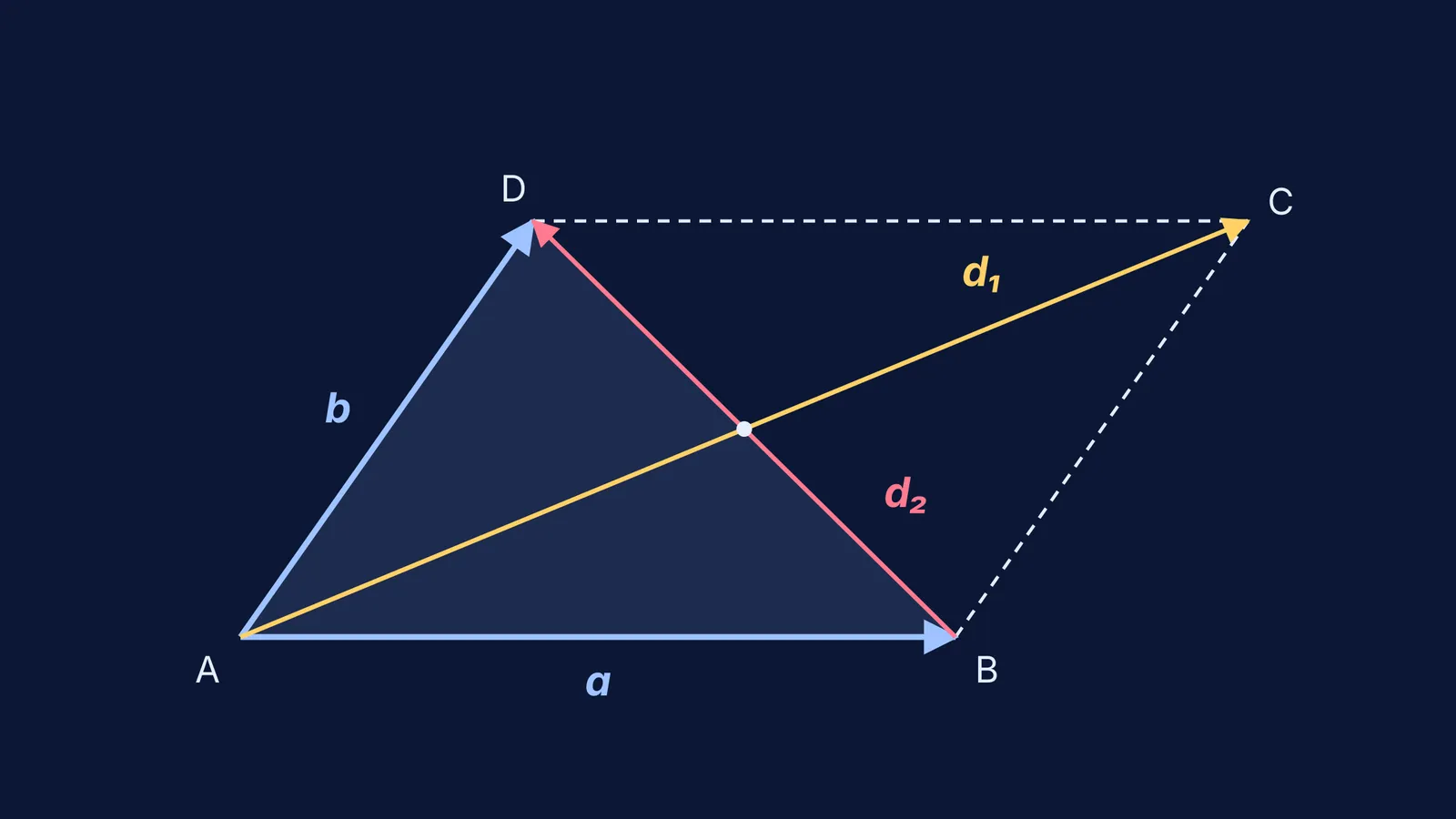
Call the sides a and b. The diagonals are d₁ = a + b and d₂ = b − a. Expand their cross product:
d₁ × d₂ = (a + b) × (b − a)
= a × b − a × a + b × b − b × a
= a × b − 0 + 0 + a × b
= 2(a × b)
Two facts from the NCERT chapter do the work here: a × a = 0 for any vector, and b × a = −(a × b) (NCERT, Chapter 10). The textbook even asks you to prove this identity, written as (a − b) × (a + b) = 2(a × b), in Exercise 10.4.
So |d₁ × d₂| is twice the area, and the area of the parallelogram is ½|d₁ × d₂|.
Which diagonal you call d₁ does not matter: swapping the order only flips the sign, as our post on why the order of a cross product matters explains, so the magnitude is unchanged.
Worked example: diagonals given
The diagonals of a parallelogram are d₁ = 3i + j − 2k and d₂ = i − 3j + 4k. Find its area.
Set up the determinant with rows (i, j, k), (3, 1, −2) and (1, −3, 4).
i component: (1)(4) − (−2)(−3) = −2.
j component: −[(3)(4) − (−2)(1)] = −14.
k component: (3)(−3) − (1)(1) = −10.
So d₁ × d₂ = −2i − 14j − 10k, and its magnitude is √(4 + 196 + 100) = √300 = 10√3.
Area = ½ × 10√3 = 5√3 square units.
Check by recovering the sides: a = (d₁ − d₂)/2 = i + 2j − 3k and b = (d₁ + d₂)/2 = 2i − j + k. Then a × b = −i − 7j − 5k, which is half of d₁ × d₂, with magnitude √75 = 5√3. Same answer, no half, because these are sides.
How do you find the area of a triangle from three points?
When a question gives vertices A, B and C, the points are not sides. Build two sides from one corner, AB = B − A and AC = C − A, and the area is ½|AB × AC|. NCERT works this method in Example 24 of the same chapter (NCERT, Chapter 10). If the subtraction step feels shaky, our explainer on why vector AB equals b minus a covers it.
Worked example: three points
Find the area of the triangle with vertices A(2, 1, 0), B(4, 3, 1) and C(1, 4, 2).
AB = (4 − 2, 3 − 1, 1 − 0) = 2i + 2j + k.
AC = (1 − 2, 4 − 1, 2 − 0) = −i + 3j + 2k.
AB × AC: i component (2)(2) − (1)(3) = 1; j component −[(2)(2) − (1)(−1)] = −5; k component (2)(3) − (2)(−1) = 8.
|AB × AC| = √(1 + 25 + 64) = √90 = 3√10.
Area = 3√10 / 2 square units.
If AB × AC comes out as the zero vector, the area is zero and the three points lie on one line. That is the same idea as in our post on when a cross product is zero.
Which formula should you use?
Name what you are given, then pick:
Two adjacent sides of a parallelogram: |a × b|
Two adjacent sides of a triangle: ½|a × b|
Two diagonals of a parallelogram: ½|d₁ × d₂|
Three vertices of a triangle: ½|AB × AC|
Four vertices of a parallelogram ABCD: |AB × AD|, using the two sides that meet at A
Common slips to watch for:
Crossing position vectors directly, OA × OB, instead of side vectors.
Halving when the sides of a parallelogram are given, or forgetting to halve with diagonals.
A sign error in the middle (j) term of the determinant.
Giving the vector a × b instead of its magnitude.
If you keep picking the wrong formula, work a few problems in the Fermi Problem Library, where a step-by-step solver explains the reasoning rather than printing an answer. If the cross product itself is the gap, the Fermi Concept Library has its own lesson for every concept in mathematics.
Derive the diagonal identity once on paper and you will not need to memorise it.


