

On this page
In arithmetic, 3 × 4 is the same as 4 × 3. But when you multiply two vectors in physics using a cross product, the order changes everything.
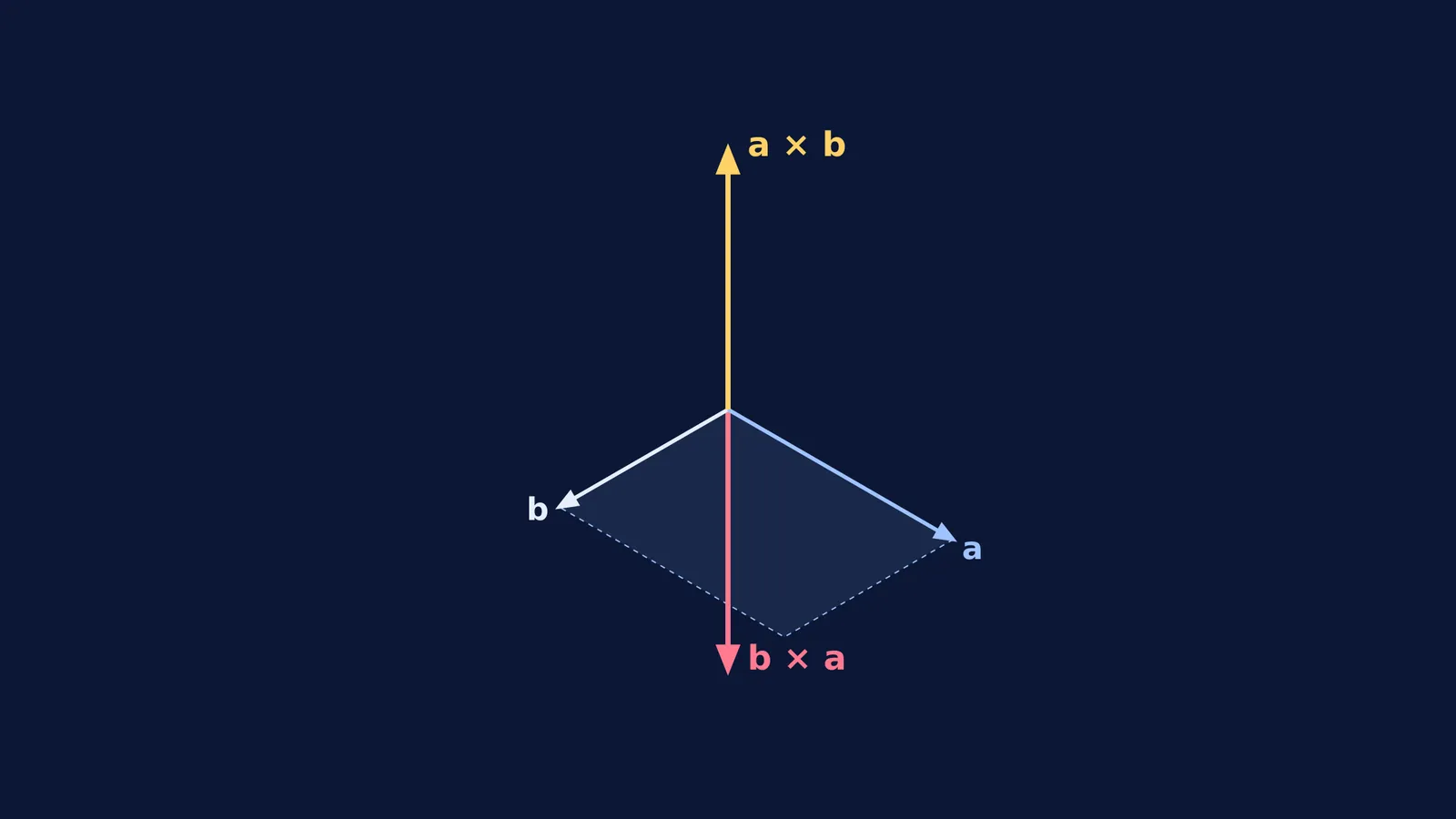
According to OpenStax's University Physics, the cross product is anticommutative: reversing the order of the vectors flips the direction of the result. This means that b × a = −(a × b).
Whether you are finding torque about a point with vectors or calculating the magnetic force on a moving charge, swapping the vectors gives you a force pointing the wrong way.
Why is a cross b not equal to b cross a?
The cross product a × b gives a new vector that is perpendicular to both a and b. Because there are two opposite directions that are perpendicular to a plane (up and down), the result depends on the right-hand rule.
If you point the fingers of your right hand along vector a and curl them towards vector b, your thumb points in the direction of a × b.
If you calculate b × a instead, you must start with your fingers pointing along b and curl them back towards a. To do this naturally, you have to turn your hand upside down. Your thumb now points in the exact opposite direction.
This physical flip is why a × b and b × a have the same magnitude (length) but opposite signs.
How does the right-hand rule apply to the i × j = k cycle?
This direction flip applies to the unit vectors i, j and k that represent the x, y and z axes.
If you multiply them in the standard x → y → z order, the result is positive:
i × j = k
j × k = i
k × i = j
If you multiply them against the usual order, the right-hand rule flips your thumb, and the result is negative:
j × i = −k
k × j = −i
i × k = −j
Keeping track of these cycles by hand is tedious. If you are learning the fundamentals and want to trace how these base vectors interact, the Fermi Concept Library provides lessons that break down the geometry behind the cross product.
How do you calculate cross products using a determinant?
When you have vectors with full i, j, k components, you can bypass the cycle rules entirely by arranging them in a 3×3 matrix and taking the determinant (a method also used to find the area of a triangle using determinants). The determinant naturally bakes in the anticommutative property; if you swap two rows in a matrix, the determinant changes sign.
Here is the safest layout. Write the unit vectors in the top row, the components of the first vector in the second row, and the components of the second vector in the bottom row.
For a = 2i + j − k and b = i − 2j + 3k, set up the determinant rows:
Top row: i, j, k
Middle row: 2, 1, −1
Bottom row: 1, −2, 3
Expand the determinant along the top row:
i(1 × 3 − (−1) × (−2)) = i(3 − 2) = 1i
−j(2 × 3 − (−1) × 1) = −j(6 − (−1)) = −7j
k(2 × (−2) − 1 × 1) = k(−4 − 1) = −5k
Result: a × b = i − 7j − 5k.
If you calculate b × a, the second and third rows swap, which perfectly flips every sign in the final answer to give −i + 7j + 5k.
If you need to check where a minus sign went missing in your own workings, the Fermi Problem Library offers a step-by-step solver that will review your determinant expansion and explain the reasoning where the error slipped in. (If you want to verify vectors without a cross product, you can use the position vector test for collinear points with vectors).
What is the best routine for cross products?
To avoid losing marks to a stray minus sign:
Always use the determinant layout for vectors with more than one component.
Put the first vector in the second row. The order matters.
Remember the minus on the j term. The determinant expansion is +i, −j, +k.
Use the right-hand rule for quick checks. If a is roughly on the x-axis and b is roughly on the y-axis, your answer should have a strong positive k component.


