

On this page
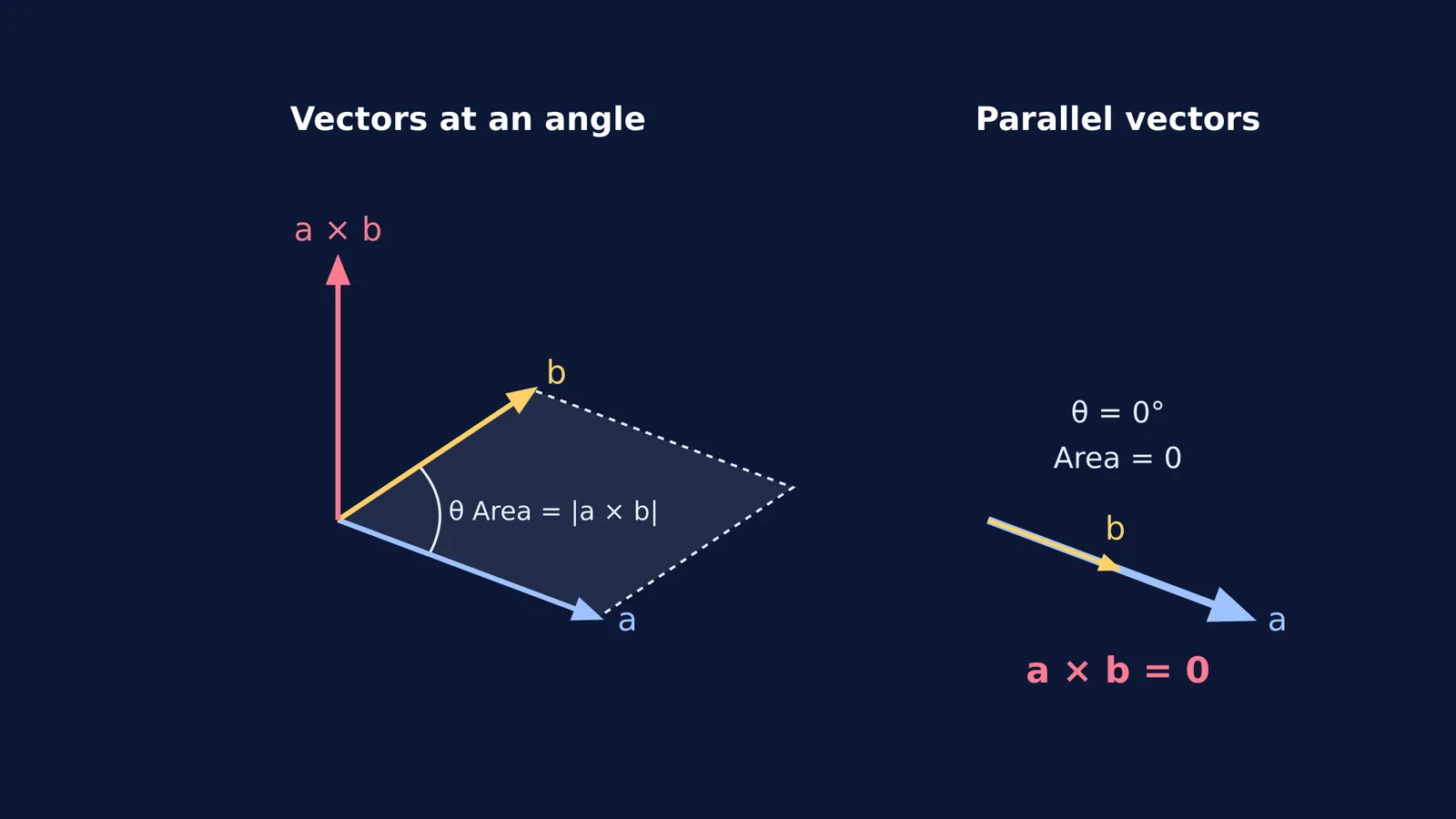
When the cross product of two vectors is zero (a × b = 0), it means the two vectors are perfectly parallel or anti-parallel to each other, assuming neither is the zero vector itself 1.
This rule is a quick, definitive test for parallel vectors in mathematics and physics. Whether you are dealing with a pure algebra problem in Class 12 or calculating rotational mechanics, such as Torque as r × F: finding torque about a point with vectors, knowing what a zero cross product implies is a fundamental step.
Why do parallel vectors have a zero cross product?
To understand why the cross product vanishes, it helps to look at what the operation actually measures. The magnitude of a cross product is given by the formula |a × b| = |a| |b| sin(θ), where θ is the angle between the two vectors 1.
Because the sine of 0° (when vectors point in the exact same direction) and 180° (when they point in perfectly opposite directions) is exactly zero, the entire magnitude formula evaluates to zero.
Geometrically, the magnitude of a cross product represents the area of the parallelogram formed by placing the two vectors tail-to-tail. If the vectors lie on the exact same line, they do not span any 2D space. The parallelogram is completely flattened, meaning there is no area, and thus the cross product is zero.
This geometric property is also why any vector crossed with itself is always zero (a × a = 0). Since the angle between a vector and itself is 0°, the area it spans with itself is zero. This concept is closely related to proving that three points lie on a single line. You can see another way to prove collinearity in our guide on Collinear points with vectors: the position vector test.
How do you use a zero cross product to find an unknown scalar?
In JEE and Class 12 board exams, you will frequently encounter problems where you are given two vectors with an unknown variable (like λ or μ), told that their cross product is zero, and asked to find the missing value.
Because parallel vectors are linearly dependent, one vector is simply a scaled-up or scaled-down version of the other 1. This means their corresponding components along the x, y, and z axes are strictly proportional. Instead of calculating the full matrix determinant for the cross product and equating all three resulting components to zero—which is slow and error-prone—you can use the much faster ratio method:
a₁ / b₁ = a₂ / b₂ = a₃ / b₃
Worked Example: Imagine you are given a = 2i + 3j − 4k and b = 4i + λj − 8k, and you are told that a × b = 0. What is the value of λ?
Because a × b = 0, you immediately know the vectors are parallel. Set up the component ratios from the coefficients of i, j, and k: 2 / 4 = 3 / λ = −4 / −8
Simplify the known fractions: 1/2 = 3 / λ = 1/2
Now, cross-multiply to solve for λ: λ = 6
What is the difference between a zero cross product and a zero dot product?
It is incredibly easy to confuse the rules for dot and cross products when you are under exam pressure. However, they serve entirely opposite geometric purposes.
Cross product is zero (a × b = 0): The vectors are parallel (θ = 0° or 180°). The cross product measures perpendicularity, so when vectors are perfectly aligned, it yields zero.
Dot product is zero (a · b = 0): The vectors are perpendicular (θ = 90°). The dot product measures alignment, so when vectors are at perfect right angles, there is zero alignment, yielding zero.
If you struggle to recall which is which during a test, fall back on the trigonometry. Dot products are calculated using cosines (cos 90° = 0), while cross products are calculated using sines (sin 0° = 0).
Understanding these foundational differences is crucial for moving on to harder physics topics, like magnetic forces on a moving charge (which use the cross product) or work done by a force (which uses the dot product). If you need to picture these vector properties, you can explore the Fermi Concept Library, where Fermi's AI tutor teaches the geometric proofs and checks your understanding as it goes.


