

On this page
If you are studying vectors for the first time, one of the most common rules you will use is that the vector from point A to point B is calculated by subtracting the start from the end. In textbooks, this is written as the position vector of B minus the position vector of A, or simply b − a.
But why does this subtraction order feel backward? When you read "vector AB", the letters go from A to B. Yet the formula flips them to B minus A. Understanding why this happens, rather than just memorising the formula, will save you from making frustrating sign errors in your physics and maths exams.
Why is it end minus start?
To find the vector AB, we need to describe the change in position from point A to point B.
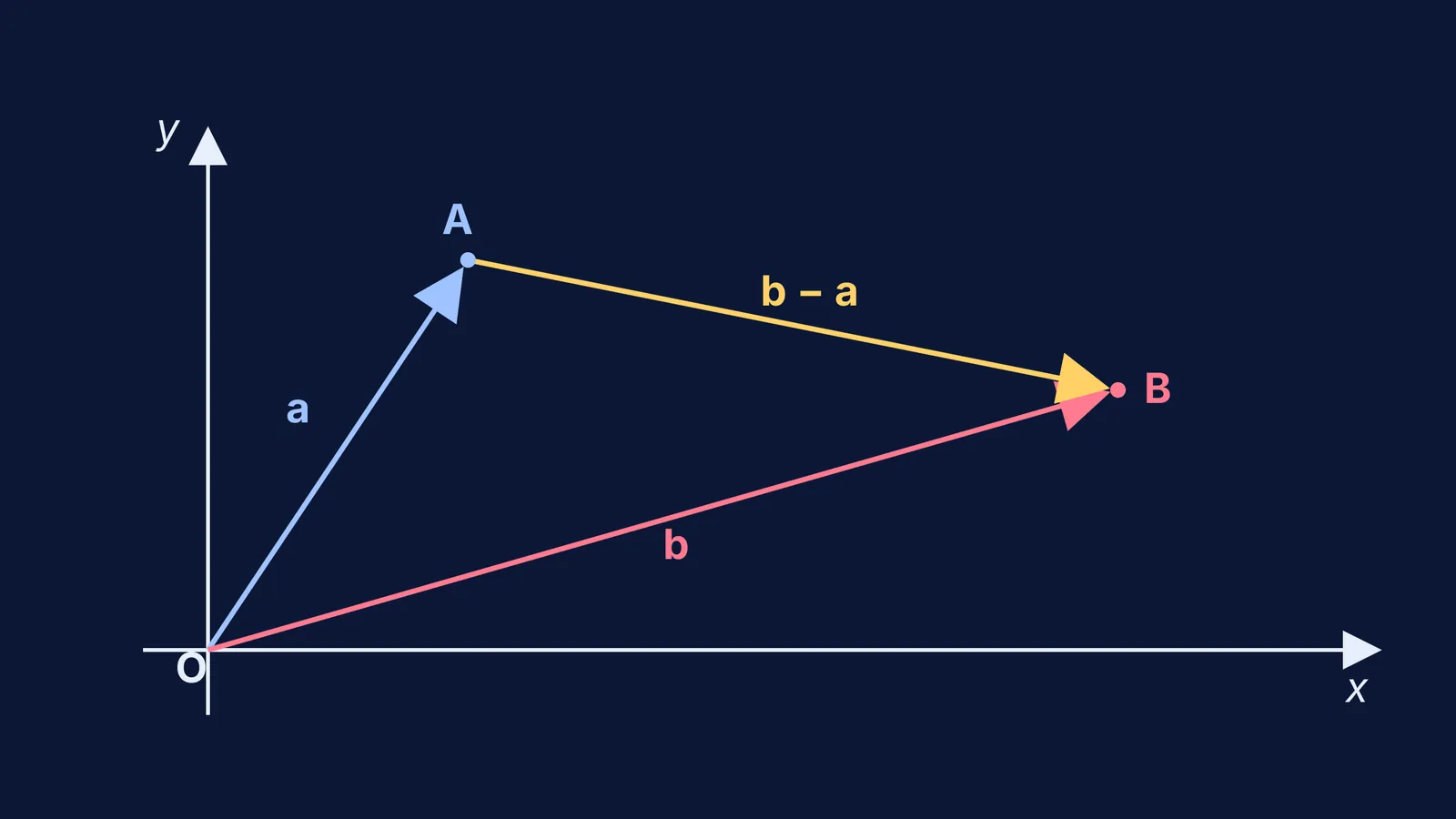
Every point in space has a position vector. According to OpenStax Calculus, a position vector is a specific type of vector where the initial point is at the origin (0, 0, 0) and the terminal point is at the given location. If you want to review the foundations, the Fermi Concept Library explains every concept in physics, chemistry, biology, mathematics and computing. Here, point A is described by vector a, and point B by vector b.
If you want to travel from point A to point B, you can imagine taking a detour through the origin. First, you travel backwards along vector a to reach the origin. Moving backwards against a vector flips its sign, so this step is −a. Next, you travel from the origin out to point B along vector b. This step is +b.
When you add these two legs of the journey together, you get −a + b. Rearranging this gives the familiar result:
Vector AB = b − a
This is why we always subtract the starting position from the ending position. It is simply the triangle law of vector addition at work: OA + AB = OB, which rearranges to AB = OB − OA.
What happens if you subtract in the wrong order?
In a busy exam, it is easy to accidentally calculate a − b instead of b − a. What happens when you do this?
When you subtract in the wrong order (start minus end), you are actually calculating vector BA, the vector that points from B back to A. This error reverses the direction of your vector.
In a coordinate geometry question, this might mean your line goes the wrong way. In physics, the consequences are worse: a flipped vector can reverse the direction of a force, turn acceleration into deceleration, or give you the wrong sign for work done. This is a common trap discussed in Vectors in JEE physics: common errors and how to avoid them.
If you struggle with these setups, Fermi's AI tutor can work out what you already know and build a plan for the session, so you sit down to a clear next step instead of a blank page.
How do you check your answer with a sketch?
When working with position vectors, calculating vector AB translates the segment so that its tail sits at the origin. If you have calculated it correctly, you can verify your result with a quick sketch.
Plot points A and B on a rough set of axes. Draw an arrow from A to B.
Take your calculated vector (b − a) and plot it starting from the origin (0, 0).
Compare them: The two arrows should have the exact same length and point in the exact same direction. If they point opposite ways, you have likely swapped the subtraction order.
Checking whether three points lie on the same line also relies heavily on these subtractions; you can see this in action with Collinear points with vectors: the position vector test. Similarly, finding the lever arm for rotation requires setting up the correct displacement vector, as shown in Torque as r × F: finding torque about a point with vectors.
A self-checking script for vector problems
If you frequently lose marks to sign errors, build this short checklist into your working:
Label your start and end points clearly: "Start = A, End = B".
Write down the formula before plugging in numbers: "Vector = End − Start".
Substitute the coordinates carefully, especially when the starting coordinates have negative signs that will turn positive upon subtraction.
Visualise the general direction: if B is higher and to the right of A, both the x and y components of your result must be positive.
By grounding your calculations in a clear physical picture, the "end minus start" rule stops being a confusing formula and becomes a reliable tool for navigating space.


