On this page
GOC questions in JEE Main hand you a structure and test whether you can apply one idea cleanly. Here are 8 original questions on Some Basic Principles of Organic Chemistry, six single-correct and two numerical-value, arranged from easy to hard.
The topics follow Unit 14 of the official JEE (Main) 2027 syllabus from NTA. The facts used match NCERT Class 11 Chemistry Unit 8 (Reprint 2026-27), and every count and order below was checked with a short Python script.
How should you use this JEE Main GOC set?
Hide the answers and give yourself about 90 seconds a question.
Before you read the options, write down your own answer, or the one rule you plan to use.
For the two numerical questions, write the whole list out (every isomer, every combination).
Read the trap line even when you were right.
New to the chapter? Start with GOC for JEE Main: how to prepare organic chemistry basics, then come back.
Easy: do you have the basic definitions straight?
Q1 (easy). In H₂C=C=CH–CH₂–C≡CH, how many carbon atoms are sp, sp² and sp³ hybridised?
(A) 3 sp, 2 sp², 1 sp³ (B) 2 sp, 3 sp², 1 sp³ (C) 2 sp, 2 sp², 2 sp³ (D) 1 sp, 4 sp², 1 sp³
Answer: (A). Count π bonds per carbon: none means sp³, one sp², two sp. C1 and C3 have one (sp²); the allene centre C2 and both alkyne carbons have two (sp); C4 has none (sp³). Trap: (B) treats the allene centre as sp², but two double bonds on one carbon make it sp.
Q2 (easy). Which of these is an elimination reaction?
(A) C₆H₆ + Br₂ (FeBr₃) → C₆H₅Br + HBr (B) CH₂=CH₂ + Br₂ → BrCH₂–CH₂Br (C) CH₃CH₂CH₂OH (conc. H₂SO₄, heat) → CH₃CH=CH₂ + H₂O (D) CH₃CH₂Cl + KCN → CH₃CH₂CN + KCl
Answer: (C). H and OH leave from neighbouring carbons and a C=C forms: elimination. (B) is addition and (D) is substitution. Trap: (A) also releases HBr, but Br has simply replaced an H on the ring, so it is substitution.
Q3 (easy). Which statement is true of the electromeric effect?
(A) It is a permanent polarisation present in the molecule's ground state. (B) It passes along σ bonds and fades rapidly with distance. (C) It is a temporary shift of a π-electron pair that occurs only when an attacking reagent is present. (D) It is the delocalisation of C–H σ electrons into an adjacent empty p orbital.
Answer: (C). NCERT describes it as a temporary effect shown by compounds with a multiple bond, only in the presence of an attacking reagent. Trap: (B) is the inductive effect and (D) is hyperconjugation; both are permanent.
Medium: can you apply priority and distance rules?
Q4 (medium). What is the IUPAC name of CH₃–CO–CH₂–CH(OH)–CH=CH₂?
(A) 4-hydroxyhex-5-en-2-one (B) 3-hydroxyhex-1-en-5-one (C) 5-oxohex-1-en-3-ol (D) 3-hydroxy-5-oxohex-1-ene
Answer: (A). In NCERT's priority order the ketone (>C=O) ranks above –OH, so "-one" is the suffix and OH becomes the prefix "hydroxy". Numbering from the left gives the ketone locant 2, not 5. Trap: (B) gives the double bond the lowest locant, but the principal group is numbered first.
Q5 (medium). Arrange the acids in decreasing order of strength: (I) CH₃CH₂CH(Cl)COOH (II) CH₃CH₂CH(F)COOH (III) ClCH₂CH₂CH₂COOH (IV) CH₃CH₂CH₂COOH
(A) II > I > III > IV (B) I > II > III > IV (C) IV > III > I > II (D) II > III > I > IV
Answer: (A). A halogen's –I effect stabilises the carboxylate. It grows with the halogen's electronegativity and shrinks with distance: NCERT notes that the effect decreases rapidly as the number of intervening bonds increases. F is more electronegative than Cl, so II beats I; Cl next to –COOH (I) beats Cl three carbons away (III); IV has no halogen. Trap: (B) ranks Cl above F, and (D) ignores distance.
Q6 (medium, numerical). Replace one hydrogen of 2-methylbutane, (CH₃)₂CH–CH₂–CH₃, with a –CHO group. How many structurally different aldehydes can form?
Answer: 4. The two CH₃ groups on C2 are equivalent, so 2-methylbutane has four kinds of hydrogen, giving 3-methylpentanal, 2,2-dimethylbutanal, 2,3-dimethylbutanal and 4-methylpentanal. Trap: 5 treats the two CH₃ groups on C2 as different; 6 counts the mirror-image forms of 3-methylpentanal and 2,3-dimethylbutanal, which are stereoisomers, not structural isomers.
Hard: can you combine resonance and stereochemistry?
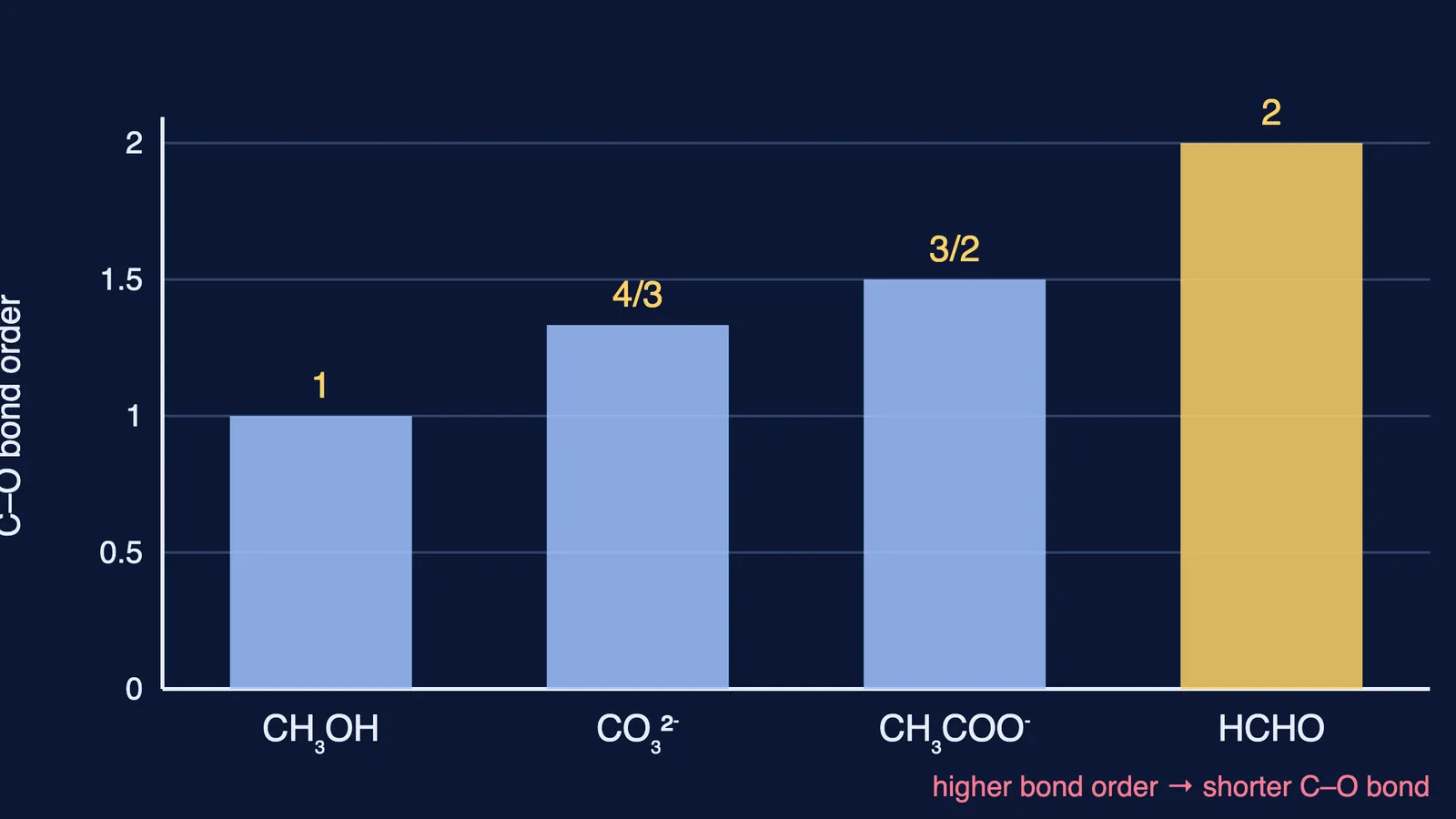
Q7 (hard). Arrange the C–O bond lengths from longest to shortest: (I) CH₃OH (II) CH₃COO⁻ (III) CO₃²⁻ (IV) HCHO
(A) I > III > II > IV (B) I > II > III > IV (C) IV > II > III > I (D) I > II = III > IV
Answer: (A). Resonance spreads the π bond equally over equivalent C–O bonds, so each is between a single and a double bond, as NCERT shows for the two equal N–O bonds of nitromethane. Bond orders: 1 in methanol, 4/3 in carbonate (one π bond over three C–O bonds), 3/2 in acetate (one over two), 2 in methanal. Lower bond order means a longer bond. Trap: (D) assumes every resonance hybrid has bond order 1.5, but carbonate shares its single π bond three ways.
Q8 (hard, numerical). How many stereoisomers does CH₃–CH(OH)–CH=CH–CH(OH)–CH₃ (hex-3-ene-2,5-diol) have?
Answer: 6. The molecule has two stereocentres (C2 and C5) and a C=C that can be E or Z. For each geometry, the configurations are (R,R), (S,S) and (R,S). Because the molecule reads the same from either end, (R,S) and (S,R) are one compound, an achiral meso form. So 3 for E plus 3 for Z gives 6. Trap: 8 comes from using 2³ without checking for symmetry.
What should you do after checking your answers?
7 or 8 right: mix these topics with Hydrocarbons and time yourself.
4 to 6 right: for each miss, write the one rule you broke (π-bond count, principal group first, distance, symmetry) and redo the question tomorrow without options.
3 or fewer: reread NCERT sections 8.2, 8.5 and 8.7, then try again in a week.
If Q5 slowed you down, the order of –I and +I effects, checked against pKa data goes deeper. Carbocations and isomer counting come back in the Hydrocarbons JEE Main practice questions.
For more practice on naming and isomer counts, the Fermi Problem Library has worked problems with a step-by-step solver that explains the reasoning rather than printing an answer.