On this page
These eight new questions climb from one-step recall to a two-clue identification. Each answer shows the working and the trap: the wrong option you are most likely to pick.
Hydrocarbons is Unit 15 of the chemistry section in NTA's Syllabus for JEE (Main) - 2027. The rules behind every answer below are those in Unit 9, Hydrocarbons, of NCERT Class 11 Chemistry Part II (2026-27 reprint). If you have not studied the chapter yet, read our guide on how to prepare Hydrocarbons for JEE Main first.
How should you use this Hydrocarbons practice set?
Set a timer for 15 minutes and attempt all eight before reading any solution.
For every reaction question, draw the intermediate (carbocation or radical) before you choose an option.
Q5 is a numerical-value question: the answer is a whole number.
A correct guess counts as wrong when you review.
Easy: do you know the rules cold?
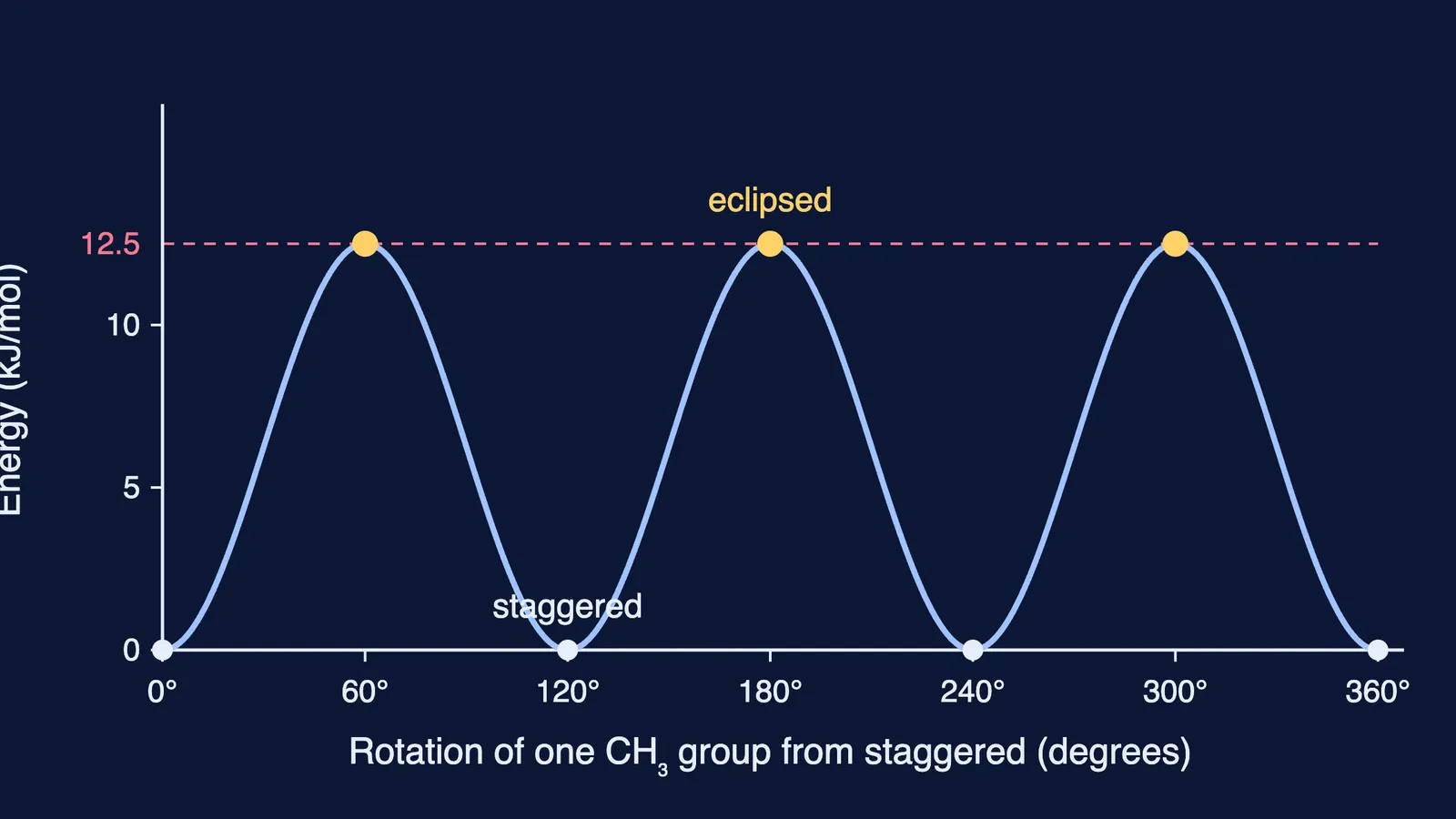
Q1 (easy). In ethane, one CH₃ group is turned through a full 360° about the C–C bond, starting from the staggered conformation. How many times does the molecule pass through an eclipsed conformation, and how much higher in energy is each eclipsed form than the staggered form?
(A) 2 times, 12.5 kJ mol⁻¹ (B) 3 times, 12.5 kJ mol⁻¹ (C) 6 times, 12.5 kJ mol⁻¹ (D) 3 times, 37.5 kJ mol⁻¹
Answer: (B). Eclipsed forms come every 120°: at 60°, 180° and 300°, with staggered forms between. The NCERT chapter gives the energy difference between the two extreme forms as about 12.5 kJ mol⁻¹. Trap: (C) counts every 60° stop, but half of those are staggered. (D) adds the three barriers together, though each one is climbed separately.
Q2 (easy). 2-Methylpropene is treated with HBr in the presence of benzoyl peroxide. The major product is
(A) 2-bromo-2-methylpropane (B) 1-bromo-2-methylpropane (C) 1,2-dibromo-2-methylpropane (D) 2-methylpropan-2-ol
Answer: (B). With a peroxide, the addition goes by a free-radical chain. A bromine radical adds to the CH₂ end, because that leaves the more stable tertiary radical on C2, which then takes H from HBr. Trap: (A) is the Markovnikov product you get without peroxide. NCERT notes the peroxide effect works only with HBr, not HCl or HI.
Q3 (easy). Which species is aromatic?
(A) cyclobutadiene (B) cycloheptatrienyl (tropylium) cation (C) cyclooctatetraene (D) cyclopentadienyl cation
Answer: (B). Hückel's rule needs a planar ring, complete delocalisation and (4n + 2) π electrons. The tropylium cation has 6 π electrons spread over seven sp² carbons (n = 1). Cyclobutadiene has 4, and cyclooctatetraene has 8 and is not planar. Trap: (D). The cyclopentadienyl anion is aromatic with 6 π electrons; the cation has only 4.
Medium: can you work backwards from the products?
Q4 (medium). An alkene C₆H₁₂ is treated with O₃ and then Zn–H₂O. The only products are propanone and propanal. The alkene is
(A) 2-methylpent-2-ene (B) 4-methylpent-2-ene (C) hex-3-ene (D) 2,3-dimethylbut-2-ene
Answer: (A). Remove the two oxygens and join the carbonyl carbons with a double bond: (CH₃)₂C= from propanone and =CHCH₂CH₃ from propanal give (CH₃)₂C=CHCH₂CH₃. Trap: (C) gives propanal only, and (D) gives propanone only, so each matches half the data. (B) gives ethanal and 2-methylpropanal.
Q5 (medium, numerical). 2,3-Dimethylpentane is chlorinated in sunlight. How many monochloro products are possible, counting structural isomers only (ignore stereoisomers)?
Answer: 6. Chlorine can replace a hydrogen on seven carbons, but two of them are equivalent: C1 and the methyl group on C2 are both CH₃ groups on C2. The distinct positions are C1, C2, C3, the methyl on C3, C4 and C5. Trap: 7 counts the two CH₃ groups on C2 separately; 5 forgets the methyl on C3.
Q6 (medium). Each alkyne is warmed with mercuric sulphate and dilute sulphuric acid at 333 K. Which give butan-2-one as the only carbonyl product? (i) but-1-yne (ii) but-2-yne (iii) pent-2-yne
(A) (i) only (B) (ii) only (C) (i) and (ii) (D) (i), (ii) and (iii)
Answer: (C). Water adds by Markovnikov's rule, so but-1-yne puts oxygen on C2 and gives butan-2-one. But-2-yne is symmetrical, so either carbon gives the same butan-2-one. Pent-2-yne is unsymmetrical and gives a mixture of pentan-2-one and pentan-3-one. Trap: (A) assumes only terminal alkynes give ketones; (D) misses that pent-2-yne's two ends differ.
Hard: can you plan a route and identify an unknown?
Q7 (hard). Which sequence, starting from benzene, gives 1-chloro-3-nitrobenzene as the major product?
(A) Cl₂ with anhydrous FeCl₃, then HNO₃ with H₂SO₄ (B) HNO₃ with H₂SO₄, then Cl₂ with anhydrous FeCl₃ (C) Cl₂ in UV light, then HNO₃ with H₂SO₄ (D) HNO₃ with H₂SO₄, then Cl₂ in UV light
Answer: (B). The first group on the ring decides where the second goes. –NO₂ is a meta director, so chlorinating nitrobenzene with a Lewis acid puts chlorine at position 3. Trap: (A). Chlorine slows the ring down but still directs ortho and para, so you get 1-chloro-2- and 1-chloro-4-nitrobenzene. In (C), Cl₂ in UV light adds to benzene, giving benzene hexachloride; (D) also uses UV addition conditions, not ring substitution.
Q8 (hard). Hydrocarbon X (C₅H₈) does not react with sodamide. With excess H₂ over nickel it gives 2-methylbutane, and on ozonolysis (O₃, then Zn–H₂O) methanal is one of its products. X is
(A) 3-methylbut-1-yne (B) 2-methylbuta-1,3-diene (C) cyclopentene (D) pent-2-yne
Answer: (B). Hydrogenation to 2-methylbutane fixes the branched skeleton and rules out (C) and (D). Ozonolysis of 2-methylbuta-1,3-diene cuts both double bonds: two molecules of methanal and one of 2-oxopropanal (CH₃COCHO). Trap: (A) has the same skeleton, but its hydrogen on a triply bonded carbon is acidic, so it reacts with sodamide.
What should you do with the questions you got wrong?
Sort each miss by cause, not by question number. A wrong rule (Q2, Q3, Q7) means rereading that NCERT section and writing the rule in one line. A wrong count or reconstruction (Q1, Q4, Q5, Q8) means redoing it on paper with every carbon drawn.
If radical and carbocation stability still feel shaky, our guide to organic chemistry basics (GOC) for JEE Main covers them. Once you can do sets like this cleanly, move on to timed papers with NTA's official mock tests.
For more reaction questions, the Fermi Problem Library has worked problems with a step-by-step solver that explains the reasoning rather than printing an answer.