On this page
This set has eight original NEET-style questions on Redox Reactions and Electrochemistry, ordered from easy to hard. Each has a worked solution and a trap line: the wrong option most students pick, and why.
How should you use this redox and electrochemistry practice set?
Redox Reactions and Electrochemistry is Unit 7 of Chemistry in the NMC Syllabus for NEET (UG)-2026. It runs from oxidation numbers and balancing to conductance, the Nernst equation, Gibbs energy and batteries; every question below stays inside it.
As in NEET-UG 2026, each question has four options and one correct answer, marked +4 for a correct answer and −1 for a wrong one, according to the NEET (UG)-2026 information bulletin.
Take E° values and ionic conductivities from Table 2.1 and Table 2.4 of the NCERT Class 12 Electrochemistry chapter, at 298 K, with 2.303RT/F = 0.059 V. The oxidation number rules are in NCERT Class 11 Redox Reactions.
Work on paper with a timer running.
Write n and the full reaction quotient before you substitute numbers.
Read every trap line, even where you were right.
New to the unit? Start with our guide on how to prepare Redox Reactions and Electrochemistry for NEET.
Easy: can you assign oxidation numbers and read a battery?
Q1 (easy). Phosphorus has an oxidation number of +3 in:
(A) H₃PO₂
(B) H₃PO₃
(C) H₃PO₄
(D) H₄P₂O₇
Answer: (B). With H = +1 and O = −2, H₃PO₃ gives 3 + x − 6 = 0, so x = +3. Trap: (A), from matching the "3" in H₃ to the answer. All three hydrogens count, so P in H₃PO₂ is +1.
Q2 (easy). Which reaction is a disproportionation?
(A) Hg₂²⁺(aq) → Hg(l) + Hg²⁺(aq)
(B) 2KClO₃(s) → 2KCl(s) + 3O₂(g)
(C) Zn(s) + CuSO₄(aq) → ZnSO₄(aq) + Cu(s)
(D) 2H₂(g) + O₂(g) → 2H₂O(l)
Answer: (A). Mercury at +1 goes to 0 and to +2: one element, in one species, is both reduced and oxidised. Trap: (B), because one reactant splits into two products. But chlorine is reduced (+5 to −1) while oxygen is oxidised (−2 to 0), two different elements.
Q3 (easy). While a lead storage battery discharges, the oxidation state of lead in the material at the cathode changes from:
(A) +4 to +2
(B) 0 to +2
(C) +2 to +4
(D) +2 to 0
Answer: (A). At the cathode PbO₂ (+4) is reduced to PbSO₄ (+2). Trap: (B), which is the anode, where Pb metal is oxidised to PbSO₄.
Medium: can you balance, combine conductivities and apply the Nernst equation?
Q4 (medium). In acid, MnO₄⁻ oxidises H₂S to sulphur and is reduced to Mn²⁺. In the balanced equation with whole-number coefficients, the coefficients of H⁺ and H₂O are:
(A) 16 and 8
(B) 6 and 8
(C) 6 and 4
(D) 8 and 4
Answer: (B). Mn gains 5 electrons and each S loses 2, so 2MnO₄⁻ react with 5H₂S. Balancing O and H gives 2MnO₄⁻ + 5H₂S + 6H⁺ → 2Mn²⁺ + 5S + 8H₂O. Trap: (A), which doubles the permanganate half-reaction and forgets that H₂S releases 10H⁺ of its own.
Q5 (medium). A 0.025 M acetic acid solution has conductivity 2.60 × 10⁻⁴ S cm⁻¹. With λ°(H⁺) = 349.6 and λ°(CH₃COO⁻) = 40.9 S cm² mol⁻¹, its degree of dissociation is closest to:
(A) 2.7 × 10⁻⁵
(B) 0.027
(C) 0.030
(D) 0.25
Answer: (B). Λm = 1000κ/c = 1000 × 2.60 × 10⁻⁴/0.025 = 10.4 S cm² mol⁻¹. Λ°m = 349.6 + 40.9 = 390.5, so α = 10.4/390.5 = 0.027. Trap: (C), from dividing by λ°(H⁺) alone instead of the sum for both ions.
Q6 (medium). For Al | Al³⁺ (0.0010 M) || Ag⁺ (0.10 M) | Ag at 298 K, with E°(Al³⁺/Al) = −1.66 V and E°(Ag⁺/Ag) = 0.80 V, the cell potential is:
(A) 2.46 V
(B) 2.50 V
(C) 4.06 V
(D) 0.86 V
Answer: (A). The reaction is Al + 3Ag⁺ → Al³⁺ + 3Ag, so n = 3 and E°cell = 0.80 − (−1.66) = 2.46 V. Q = [Al³⁺]/[Ag⁺]³ = 0.0010/0.0010 = 1, so log Q = 0 and E = E°. Trap: (B), from forgetting to cube [Ag⁺], which gives Q = 0.01.
Hard: can you link E°, ΔG° and equilibrium?
Q7 (hard). Given E°(O₂/H₂O) = 1.23 V (4e⁻) and E°(O₂/H₂O₂) = 0.68 V (2e⁻), in acid, E° for H₂O₂ + 2H⁺ + 2e⁻ → 2H₂O is:
(A) 0.55 V
(B) 0.96 V
(C) 1.78 V
(D) 1.91 V
Answer: (C). E° values do not add, but ΔG° = −nFE° does. Subtract the second from the first: −2F·E° = (−4F × 1.23) − (−2F × 0.68), so E° = (4.92 − 1.36)/2 = 1.78 V, the value NCERT Table 2.1 lists. Trap: (A), from subtracting the E° values without weighting by n.
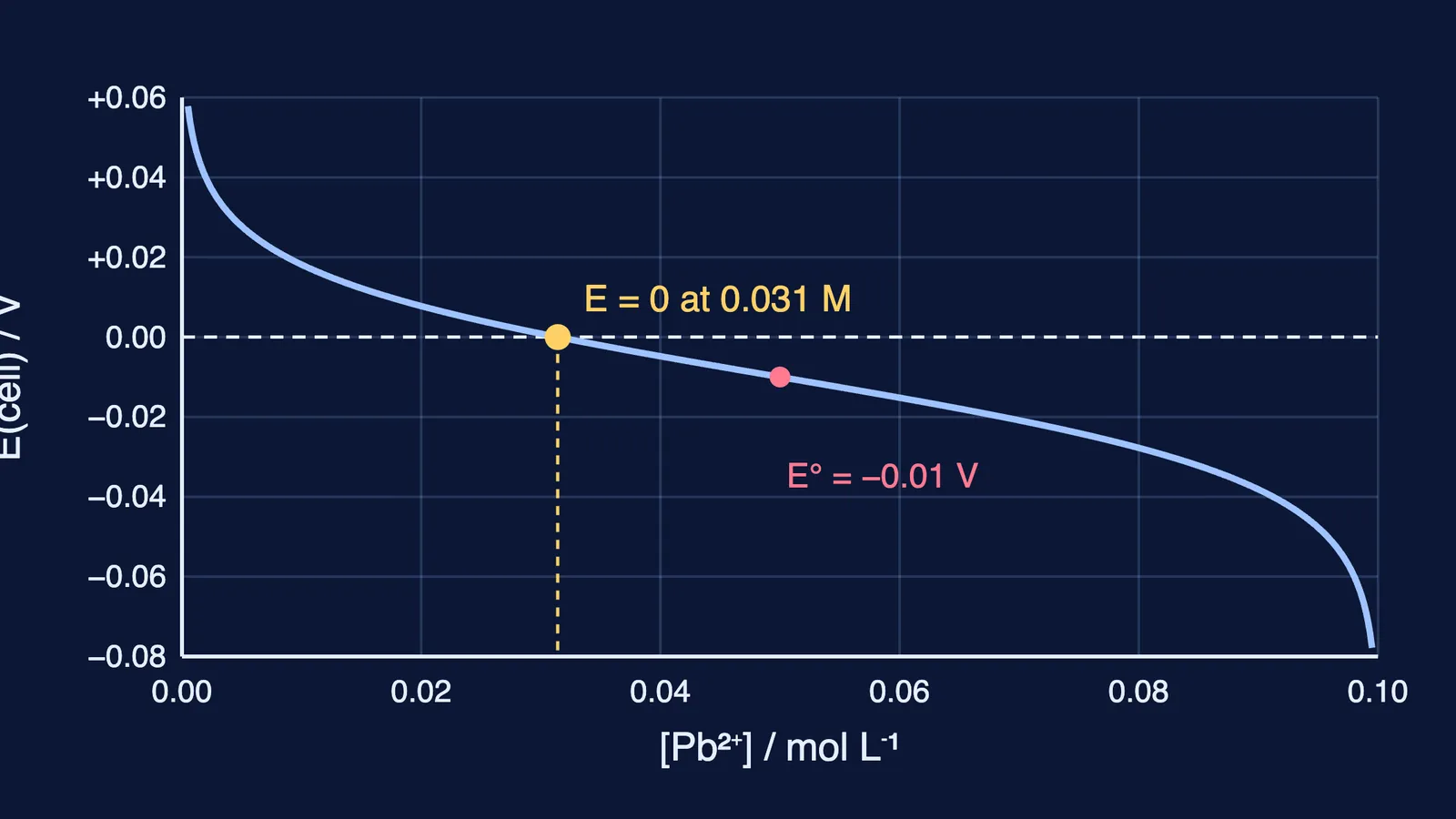
Q8 (hard). Excess lead powder is shaken with 0.10 M Sn²⁺ at 298 K until equilibrium (E°(Pb²⁺/Pb) = −0.13 V, E°(Sn²⁺/Sn) = −0.14 V). [Pb²⁺] at equilibrium is closest to:
(A) 0.031 M
(B) 0.046 M
(C) 0.069 M
(D) 0.10 M
Answer: (A). For Pb + Sn²⁺ ⇌ Pb²⁺ + Sn, E° = −0.14 − (−0.13) = −0.01 V and n = 2. log K = 2(−0.01)/0.059 = −0.34, so K = 0.46. Then x/(0.10 − x) = 0.46 gives x = 0.031 M. Trap: (C), from flipping the sign of E°, which gives K = 2.2. A negative E° does not mean "no reaction"; it means K is below 1.
What should you do after checking your answers?
Sort each miss into one of three bins: oxidation states and electron counting (Q1 to Q4), conductivity arithmetic (Q5), or n, Q and signs (Q6 to Q8). The fullest bin is this week's work. For the Class 11 basics, read our Redox Reactions Class 11 guide. Want longer numericals? Try the Electrochemistry JEE Main practice set; every question there is different from these.
If a whole method breaks down rather than one step, the Fermi Problem Library has worked problems with a step-by-step solver that explains the reasoning rather than printing an answer.
Redo your misses in two days, without the solutions.