On this page
Eight original NEET-UG Physics questions, from a radius ratio to the force on a loop beside a wire, each with the trap behind the tempting wrong option.
What does NEET ask from magnetic effects of current and magnetism?
The NMC syllabus for NEET (UG)-2026 lists this as Unit 13: the Biot-Savart and Ampere laws, forces on moving charges and currents, torque on a loop, the galvanometer, dipole fields, and para-, dia- and ferromagnetism with the effect of temperature. The questions stay inside it and NCERT Class 12 Physics Chapter 4, Moving Charges and Magnetism and Chapter 5, Magnetism and Matter. New to the unit? Start with our guide on how to prepare magnetic effects of current for NEET.
Take μ₀ = 4π × 10⁻⁷ T m A⁻¹, so μ₀/2π = 2 × 10⁻⁷ T m A⁻¹.
How should you use this practice set?
In NEET-UG 2026, each question had four options and one correct answer, with +4 for a correct answer and −1 for a wrong one, according to the NTA information bulletin.
Cover the answers; allow eight minutes.
Mark each one sure, unsure or guessed.
Read the trap line even when you were right.
Redo every miss two days later with new numbers.
Easy: radius, direction and temperature
Q1 (easy). A proton and an alpha particle (mass 4 u, charge +2e) enter the same uniform magnetic field with equal speeds, perpendicular to the field. The ratio of the alpha particle's path radius to the proton's is:
(A) 1/2 (B) 1 (C) 2 (D) 4
Answer: (C). r = mv/(qB), so with v and B the same, r is proportional to m/q: (4/2)/(1/1) = 2.
Trap: (D) uses the mass ratio and forgets the alpha particle's double charge.
Q2 (easy). An electron moves vertically upward through a horizontal magnetic field that points north. The magnetic force on it points:
(A) east (B) west (C) north (D) vertically downward
Answer: (A). For a positive charge, v × B is up × north, which points west. The electron is negative, so the force points east.
Trap: (B) is the force on a proton; the sign of the charge flips it.
Q3 (easy). A cobalt rod is heated above the temperature at which it stops being ferromagnetic, then held near one pole of a strong magnet. It is now:
(A) strongly repelled, being diamagnetic (B) weakly attracted, being paramagnetic (C) strongly attracted, still ferromagnetic (D) not affected at all
Answer: (B). NCERT Chapter 5 says a hot enough ferromagnet becomes a paramagnet, and paramagnets are weakly attracted towards a stronger field.
Trap: (D). Heating removes ferromagnetism, not all magnetism. Our heated magnet experiment shows the change.
Medium: crossed fields, a bent wire and a dipole
Q4 (medium). A beam of positive ions passes undeflected through a region where a uniform electric field of 3.0 × 10⁴ V/m is perpendicular to a uniform magnetic field of 0.15 T, both perpendicular to the beam. The speed of the ions is:
(A) 4.5 × 10³ m/s (B) 5.0 × 10⁻⁶ m/s (C) 2.0 × 10⁵ m/s (D) 2.0 × 10⁶ m/s
Answer: (C). No deflection means qE = qvB, so v = E/B = 3.0 × 10⁴/0.15 = 2.0 × 10⁵ m/s.
Trap: (A) multiplies E and B instead of dividing.
Q5 (medium). An L-shaped wire with perpendicular arms of 30 cm and 40 cm carries 2.0 A in a plane perpendicular to a uniform 0.50 T field. The net magnetic force on the wire is:
(A) 0.10 N (B) 0.50 N (C) 0.70 N (D) 0.35 N
Answer: (B). Each arm feels F = ILB, perpendicular to that arm: 2.0 × 0.30 × 0.50 = 0.30 N and 2.0 × 0.40 × 0.50 = 0.40 N. The two forces are at right angles, so the net force is √(0.30² + 0.40²) = 0.50 N, as on a straight wire joining the ends.
Trap: (C) adds the two forces as numbers and ignores their directions.
Q6 (medium). For a short bar magnet, what is the ratio of the field at a point on its axis at distance d to the field at a point on its equatorial line at distance 2d?
(A) 2 (B) 4 (C) 8 (D) 16
Answer: (D). The axial field is (μ₀/4π)2m/d³ and the equatorial field is (μ₀/4π)m/(2d)³. The ratio is 2 × 8 = 16.
Trap: (C) drops the factor 2 of the axial field. Our note on the bar magnet's axial and equatorial fields explains where it comes from.
Hard: can you use Ampere's law and add forces?
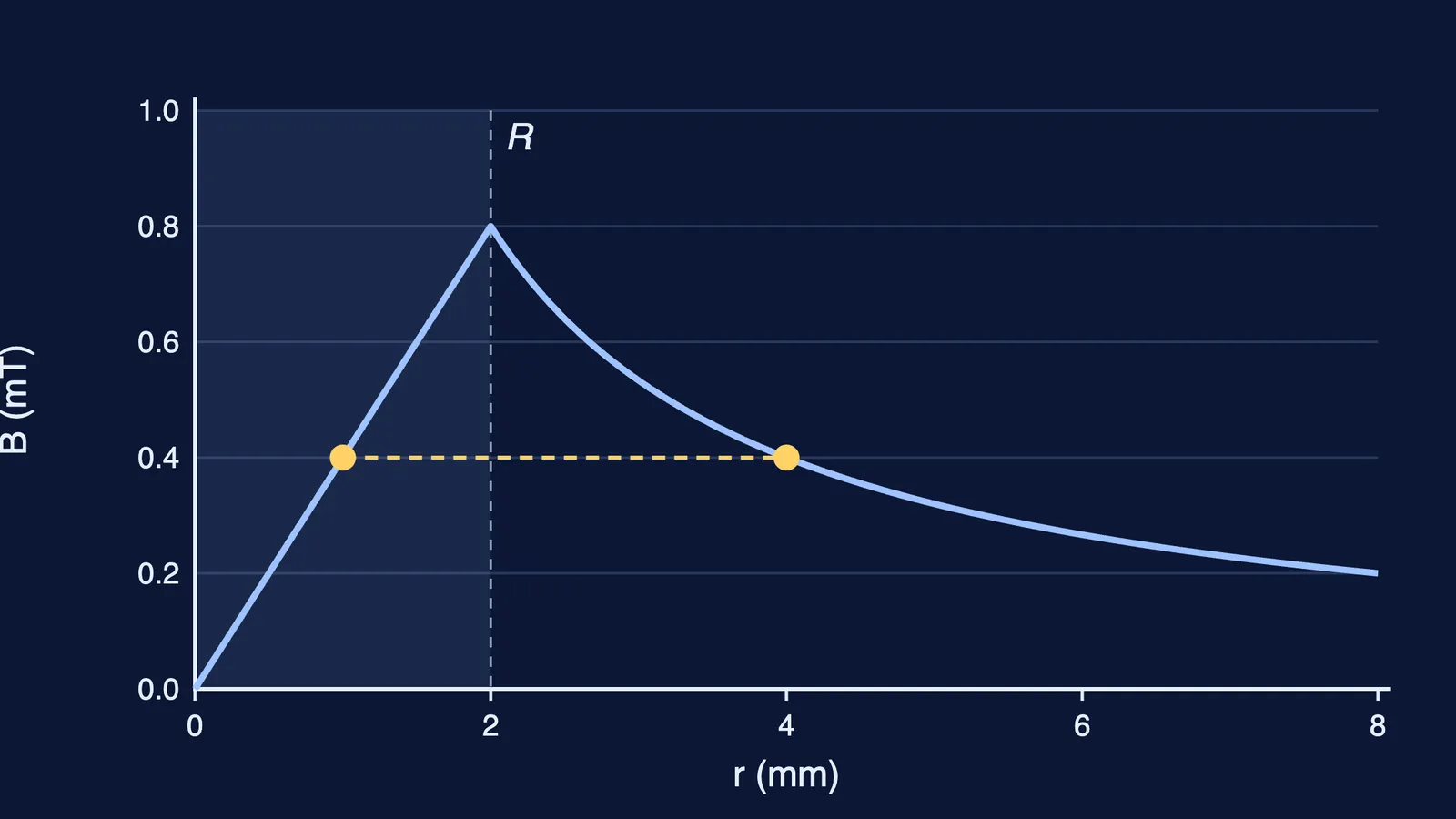
Q7 (hard). A long straight wire of radius 2.0 mm carries 8.0 A spread uniformly over its cross-section. The fields at 1.0 mm and at 4.0 mm from its axis are:
(A) 0.40 mT and 0.40 mT (B) 1.6 mT and 0.40 mT (C) 0.80 mT and 0.40 mT (D) 0.20 mT and 0.40 mT
Answer: (A). Outside, B = μ₀I/(2πr) = 2 × 10⁻⁷ × 8.0/0.0040 = 0.40 mT. Inside, Ampere's law encloses only the fraction r²/R² = 1/4 of the current, so B = 2 × 10⁻⁷ × 2.0/0.0010 = 0.40 mT.
Trap: (B) uses the outside formula at 1.0 mm, inside the wire.
Q8 (hard). A long straight wire carries 10 A. A rectangular loop carrying 2.0 A lies in the same plane, with its 15 cm sides parallel to the wire at 2.0 cm and 6.0 cm from it. The near side's current is in the same direction as the wire's. The net force on the loop is:
(A) 1.5 × 10⁻⁵ N, towards the wire (B) 2.0 × 10⁻⁵ N, towards the wire (C) 3.0 × 10⁻⁵ N, towards the wire (D) 4.0 × 10⁻⁵ N, away from the wire
Answer: (B). The short sides' forces cancel. The near side is attracted with 2 × 10⁻⁷ × 10 × 2.0 × 0.15/0.020 = 3.0 × 10⁻⁵ N; the far side carries the opposite current and is repelled with 1.0 × 10⁻⁵ N. Net: 2.0 × 10⁻⁵ N towards the wire.
Trap: (C) counts only the near side.
If the same wrong method keeps returning, the Fermi Problem Library has worked problems with a step-by-step solver that explains the reasoning rather than printing an answer.